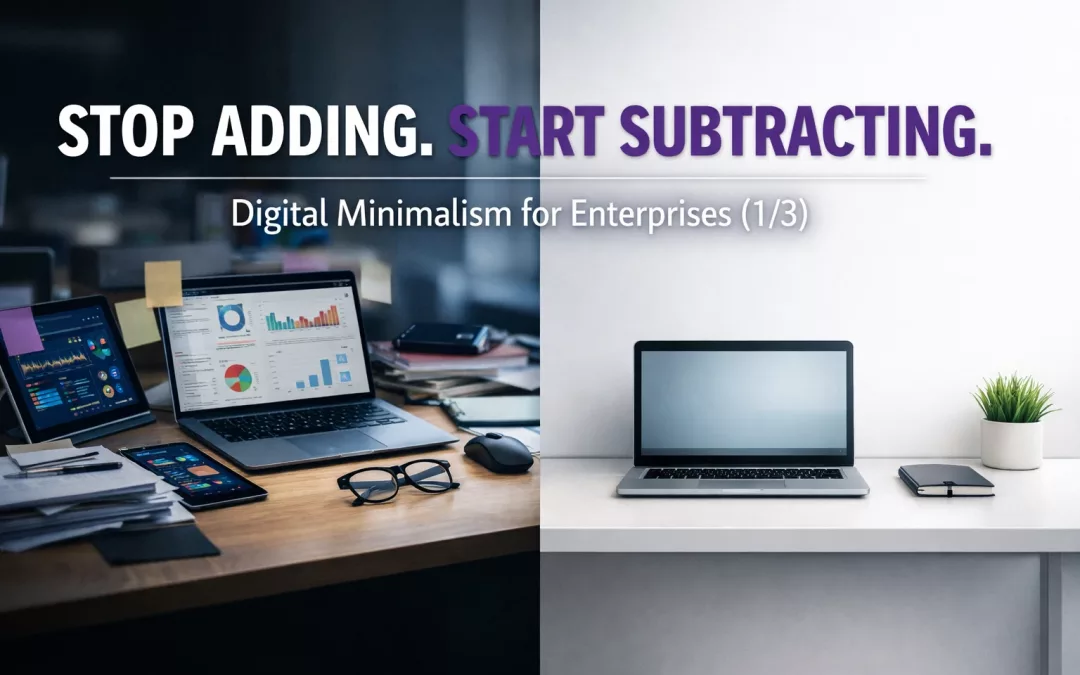
Every big transformation starts with good intentions. But when progress turns into accumulation, digital transformation quietly becomes digital clutter.
A new platform for working together promises to make it easy to work together. A new analytics dashboard says it can display insights that were previously hidden. An AI helper promises to take care of boring tasks. An automation tool promises to get rid of busywork.
Each of these initiatives makes perfect sense on its own. The business case is strong, the demo is smooth, and the projected return on investment (ROI) is very good. But together, something else happens completely. Digital mess.
Not the kind that lives on hard drives, but the kind that lives in workflows, calendars, and the exhausted employees’ minds. It doesn’t show up on balance sheets, but it slowly eats away at the productivity that digital transformation is supposed to bring at the first place.
The Illusion of Progress
For a lot of businesses, digital transformation has quietly turned into digital accumulation. More tools. More dashboards. More connections. More people signing up. More sellers. Every quarter, the technology portfolio grows, but one thing that doesn’t grow as quickly is clarity.
Recent research has shown that the average business now uses more than 300 SaaS applications, many of which are duplicate collaboration tools. A study in the UK of more than 500 people who make financial decisions found that 52% think their company uses too many platforms. Finance teams are in charge of an average of seven different systems, and about 40% of these systems don’t work well together or aren’t connected at all. Accountancy Age
Technology is meant to make things easier. But growth that isn’t managed has the opposite effect. Parallel systems do the same jobs. Reporting layers copy the same information. AI pilots start with a lot of excitement, but they never become part of daily life. Teams spend their days switching between platforms instead of doing real work.
The organization gets very busy. But not always better. It is like a running engine but the gear is not really engaged
The Complexity Tax: What We Don’t Count
From my experience in the industry, I can confidently say that every new system makes things heavier without being seen. The more connections there are, the harder it is to integrate. The area of attack on security grows. The cost of training adds up. Governance duties stack up. Managing vendors becomes a full-time job.
Most businesses carefully figure out how much licenses will cost. Few people think about the cognitive cost behind every new purchase.
Smallpdf’s recent survey of 1,005 U.S. employees found that workers spend an average of 4.5 hours a week (29 full workdays a year) looking for files, emails, or links they have already seen. This work does not add value. We pay this tax for the mess that is digital.
Every new interface tries to get your attention. Every dashboard needs to be read and understood. Every notification tries to get your attention. “App fatigue” is a cumulative burden of cognitive exhaustion that comes from using too many unrelated tools.
The outcome is not digital empowerment. It is decision fatigue on a large scale.
Why We Almost Never Stop
It’s interesting how businesses handle technology in an uneven way. People think that approving new tools is a sign of progress. Taking down old ones is seen as part of running a business, if it even happens.
No one cuts a ribbon when they take down a dashboard. No one throws a party when they cancel a subscription that isn’t needed. Normally, stopping feels like losing. Adding seems like moving forward. But this addiction to addition goes back a long way in the mind. We prefer additive changes when addressing problems, neglecting subtractive solutions even when they prove to be more effective. This bias is exactly what organizations do.
We can see the effects of this one-way growth. Gartner modeling indicates that organizations that do not rationalize their application portfolios incur technology debt that adversely affects both financial performance and sustainability. Those who do rationalize can cut their technology debt by about 11% and their IT-related emissions by almost 15%. ComputerWeekly
But most businesses keep adding to their collections. One estimate says that almost a third of software spending goes to licenses that aren’t used, which is a clear sign that portfolios have grown too big to be managed rationally. Another study found that 53% of SaaS licenses are not being used at all.
Accumulation is not what mature transformation is about. It is about disciplined subtraction.
The 3R Discipline: A Framework for Sanity
Digital minimalism does not oppose technology. It is for impact. It doesn’t ask if a tool is useful on its own. It asks if the whole system (people + tools + workflows) works together in the best way possible to make things clear and useful.
A simple but strict discipline can change the course:
Reduce. Get rid of features, reports, or processes that don’t add any measurable value anymore. You need to be honest about what you actually use and what you just bought. Not login counts, but behavior-level data shows real engagement.
Retire. Stop using tools that do the same thing as other tools or only make small improvements compared to how much they cost. The goal isn’t to get the fewest licenses possible; it’s to get the best value for the least amount of cognitive friction.
Re-focus. Instead of doing thirty small tests, tie your digital investments to three to five big goals. When every tool has to prove itself against a small number of business goals, portfolio discipline becomes possible.
When subtraction is used strategically, things become clearer and better.
The Hard Question That Determines Leadership
Before giving the go-ahead for the next AI tool, automation layer, or analytics dashboard, leaders should ask themselves one question: “What are we willing to give up in return?”
If the answer is “nothing,” then the organization is not changing. It is growing.
And gathering things isn’t a plan. It is inertia dressed up in paperwork for buying things.
Workers can feel this. Employees want their companies to use a standard set of core tools for working together. They don’t want more options. They want fewer choices, fewer changes, and clearer expectations.
The organizations that win won’t be the ones that used the most tools. Those who had the guts to get rid of the ones that weren’t needed will be the ones. Executives who know that strategy is just as much about what you don’t do as what you do will lead them.
That’s where real leadership starts.
If this topic resonates with you, then I am delighted to hear your ideas too. In my book Life in the Digital Bubble, I explore how AI and digital systems are reshaping not just IT but also work, families, and society over the next three decades. And if you’re ready to turn AI from a noisy collection of projects into a clear operating model, my digital transformation and AI consulting services are focused on helping leaders design that next phase with structure, realism, and confidence.