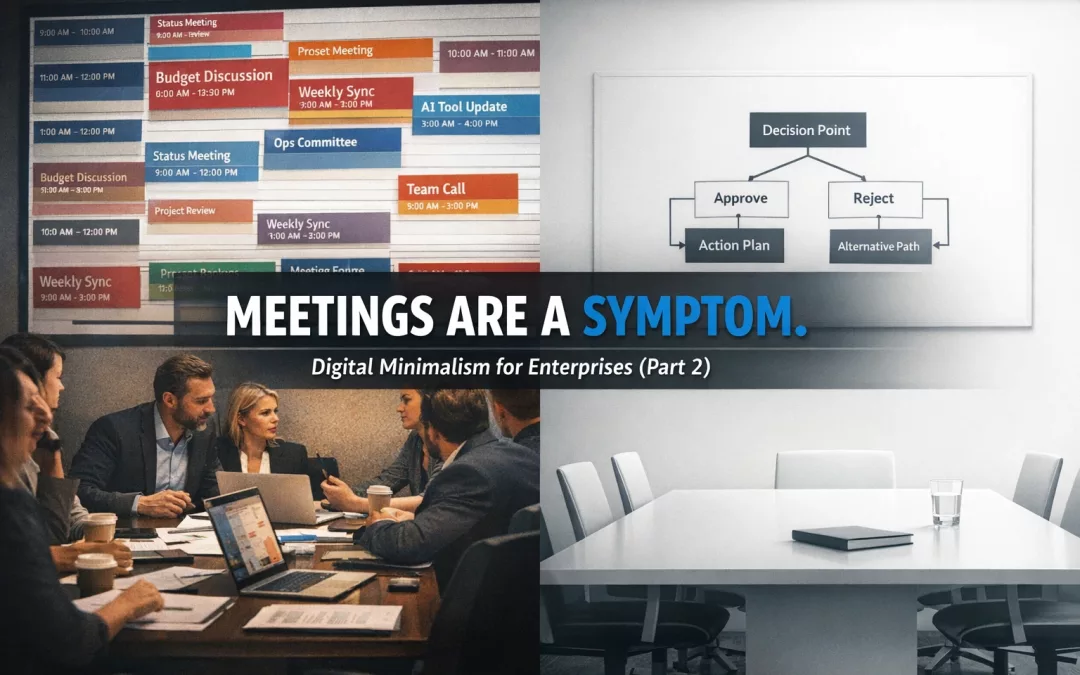
Most companies see meeting overload as a problem with behavior. People need to be more disciplined. Managers need clearer plans. Teams need fewer places to meet.
From the perspective of IT leadership, this diagnosis is not complete. Meeting inflation is rarely a people problem. It is an architectural signal. And until technology leaders treat it as such, calendars will keep filling regardless of how many “no-meeting Wednesdays” are declared.
Meetings as a Symptom of System Design
Information flows in a predictable way in a well-designed digital business. People trust data. It’s clear who has the right to make decisions. The systems work together. Metrics are set once, not argued about every week on different dashboards.
Meetings fill in the gaps when this architecture does not cover all the ground. Steering committees that meet regularly are formed to settle disagreements. Alignment sessions are held more often to make ownership clear. Status updates are the default way to keep work visible. Governance layers expand to oversee fragmented tool landscapes.
The calendar serves as a corrective measure for deficiencies in system design.
Consider the scenario where a new AI tool emerges and fails to integrate with existing processes. Now, the team needs to meet with IT every week, do security reviews, and hold alignment meetings with every business unit that is affected. Prior to the tool, there were no such meetings. None would be needed if the architecture could easily take on new features.
The Hidden Cost of Fragmentation
Adding new tools without a good reason makes integration harder or even impossible if the target state is not clear or at least cemented by a set of requirements. It makes data inconsistent because different systems give different numbers. It makes things even more unclear when teams argue over whose dashboard shows the truth. It makes the governance surface bigger, which means more oversight is needed.
Each of these variables makes things less certain. Uncertainty creates a need for coordination. And coordination, of course, requires even more meetings.
Research backs up the pattern: workers waste a lot of time just switching between tools and making sure that information is the same on all platforms. When systems don’t share data easily, teams have to work together to line up numbers by hand. When it’s not clear who owns what, meetings are the default way to figure out who does what.
From an IT perspective, meeting inflation is a measurable result of portfolio fragmentation. The more we let digital accumulation happen, the more overhead alignment we create.
Decision Latency Is a Systems Metric
When businesses say they make decisions too slowly, it’s usually not because they’re unsure. It is a lack of clarity in the organizational architecture.
If it takes three meetings to confirm a simple metric, two committees to approve a basic tool, and regular alignment sessions to assure that reporting is consistent, then speed is structurally impossible. The organization has built slowness into how it works.
There are decision rights frameworks that stop this from happening. When every decision that needs to be made has a clear owner, required inputs, and a designated location, those decisions can be made effectively. When decision rights are still unclear, every choice turns into a meeting or even a series of them.
Leaders in technology don’t just run systems. They make places where people can make decisions. Those settings either let things happen quickly or make sure they take a long time.
What IT Leadership Must Stop Doing
The architectural view needs different kinds of changes than the behavioral view.
Stop adding new tools without getting rid of old ones that are still in use. For every new platform, there should be a plan for what to do with the old one. If nothing can be retired, ask yourself if the new tool is really needed.
Don’t add more layers of government every time things become more complicated. Governance should facilitate decision-making, not exacerbate existing decision-making obstacles. If there are more governance meetings, governance itself might be the problem.
Please ensure that as dashboards expand, the metrics remain consistent. Every time there is a disagreement over a number, there are meetings to settle it. Establish a single source of truth and ensure their adherence. Instead of putting uncertainty on calendars, let architecture take it in.
Please refrain from scheduling repeated meetings to clarify matters. When teams ask for a new sync to “stay aligned,” ask them what information they need that isn’t already in the systems. A better dashboard is often the answer, not another meeting.
Instead: Design for Clarity
The alternative emphasizes architectural simplicity over adherence to discipline.
For each important metric, set up one source of truth. There is no more meeting about whose numbers are right when everyone looks at the same numbers.
Make it clear who is entitled to make decisions at the organization architecture level. Make public who makes decisions, what information they need, and which forum handles which decisions. Make it easy to find. Make it possible to enforce.
Keep rationalizing the application portfolio. Make the landscape simpler, and the need for coordination goes down on its own.
Use measured coordination overhead as a way to judge performance. If possible, keep track of how many hours of meetings it takes to make a decision and how long it takes to make a decision cycle. Use this information to find out where architecture is not working.
The Leadership Question
People in charge of technology should regularly ask an uncomfortable question:
How many of our recurring meetings would go away if we stopped using new tools for six months?
The answer shows how much of the coordination load is built in and how much is needed. If meetings continued without modification, the calendar issue might indeed be behavioral. But if meetings got smaller when the number of tools stopped growing, the diagnosis would be clear: meeting inflation is a sign of bad design.
Inflation is not a problem with time management. This is a problem with the design of the system. Additionally, systems design is under the purview of the technology leader. If a leader thinks that too many meetings are an HR problem, calendars will keep filling up regardless of what they do. The leader who sees meeting patterns as diagnostic data about the health of the building can address the root causes instead of just the symptoms.
When information flows smoothly, decisions have clear owners, and systems work together perfectly, the need for coordination goes down. Meetings go back to being what they should be: places to discuss things that can’t be done at different times, not daily ways to fix broken architecture. The number of tools a company uses will not be a useful way to measure digital transformation. The measure of digital transformation will be the amount of coordination overhead required by those tools.
The calendar serves as a tool for maintaining a score. The architecture is the game.
If this topic resonates with you, then I am delighted to hear your ideas too. In my book Life in the Digital Bubble, I explore how AI and digital systems are reshaping not just IT but also work, families, and society over the next three decades. And if you’re ready to turn AI from a noisy collection of projects into a clear operating model, my digital transformation and AI consulting services are focused on helping leaders design that next phase with structure, realism, and confidence.