
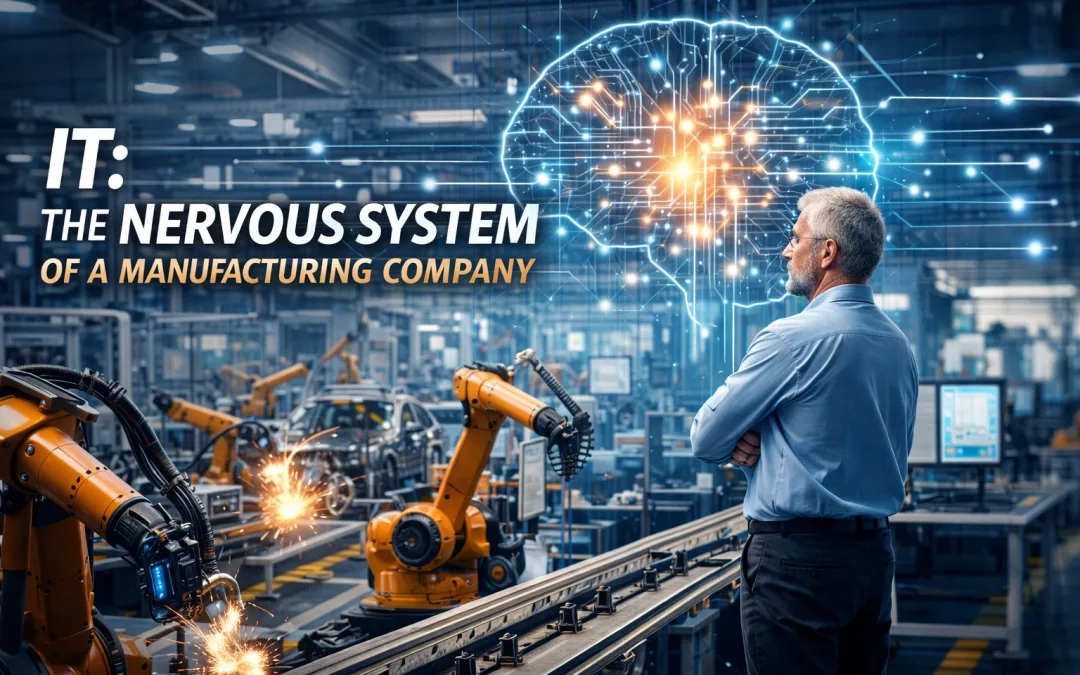
Most manufacturers still view their IT department as a support team, consisting of individuals responsible for computer repairs and server maintenance. This old way of thinking is now a big problem. Today, IT has become the company’s central nervous system. It connects everything, senses what’s happening on the factory floor, and helps leadership make smart decisions. If this network is slow or broken, the whole operation suffers.
It’s not enough to just have robots to win in modern manufacturing. It’s about having an IT system that is always looking for ways to reduce costs and make things run more flexibly.
Let’s talk about the first big chance this “nervous system” gives you: downtime and asset utilization. We will also talk about three other topics: waste and rework, energy use, and labor productivity. I will handle more about these topics in the future.
The body and the nervous system: a simple analogy
Production is the muscle; it does the physical work.
Finance is the circulatory system; moving value and resources.
Supply chain and logistics are the skeleton and arteries; the structure that connects everything.
Leadership and strategy are the brain; setting direction and priorities.
This leaves IT, which operates as the nervous system, at the center of it all:
- It gets signals (data) from customers, markets, machines, and sensors.
- It sends those signals safely throughout the company.
- It lets you make decisions based on your reflexes (automation) and your conscious mind (analytics, AI, and human judgment).
When the nervous system is broken up into separate spreadsheets, networks, and systems, the muscles can’t work together, and the brain gets a delayed or distorted view of reality.
You can buy new robots, new lines, and new tools. But you’ll still lose money through downtime, waste, and firefighting if your nervous system isn’t working right.
The first big lever: Downtime and asset utilisation
One of the most obvious and painful ways to reduce manufacturing margin is through unplanned downtime. Likewise, a robust IT nervous system can have one of its most quantifiable effects there. According to the research, businesses can transition from reactive to predictive maintenance, significantly reducing downtime and maintenance costs, when IT and operational technology (OT) are integrated and sensor data flows into analytics and AI tools.
However, the impact goes beyond simply purchasing a software license and a few sensors. The design of IT plays a crucial role. Three essential elements make up a strong IT nervous system for addressing downtime:
1. The asset’s complete visibility
- Machine data (OT) is recorded in an organized manner, including status, alarms, and cycles.
- The same asset is associated with work orders, parts, and maintenance history (IT).
- Real-time asset health is displayed alongside production schedules and priorities.
Separating IT and OT removes this comprehensive view. Teams waste time looking for different systems. The entire downtime overview is displayed on a single screen or dashboard when they occur.
2. A data model designed for forecasting rather than merely reporting
Conventional reporting uses downtime as a statistic and looks backward. A nervous system foresees downtime and perceives it as a preventable risk. This highlights a significant difference between traditional BI teams, which focus on past data, and modern data teams, which prioritize future outcomes and require a different set of capabilities, mindsets, and management approaches.
The process entails developing infrastructure to stream data into models in almost real time, standardizing event codes, and developing a common downtime taxonomy. In this case, IT architecture, including networks, data platforms, and integration, directly influences Overall Equipment Effectiveness (OEE).
3. Workflows that are embedded rather than merely dashboards
A dashboard is merely an expensive screen if it forecasts failure without altering behavior. When IT makes new workflows possible, real change occurs:
- Rather than merely using a calendar, maintenance is scheduled based on anticipated risk.
- Risk thresholds set off automatic work orders.
- Instead of being stuck on an “AI island,” escalations are incorporated into already-existing tools like CMMS or ERP.
This is supported by studies on IT/OT convergence, which show that true value arises when predictions are integrated into operational procedures.
IT is more than just “supporting” the plant when these three components are present. By anticipating failures, planning interventions for when they are least important, and recovering lost capacity, it is rewiring the plant’s perception of time.
Why IT-OT convergence is the future, not a buzzword
Historically, IT and OT came from different worlds:
- OT was about safety, deterministic behavior, and physical processes.
- IT was about business systems, office networks, and information.
They had different priorities, technologies, and even cultures. In many organizations, they barely spoke the same language. Over the last few years, that separation has become a liability.
To enable real-time optimization, successful smart factories require fully aligned IT and OT functions. Industry reports now view this convergence as a strategic necessity that is essential for cost optimization, efficiency, and predictive maintenance, but it also reveals security and cooperation gaps where integration is still lacking.
Convergence in the body analogy refers to one thing:
The nervous system, muscles, and brain are no longer able to function as distinct species.
In practical terms, this means:
- When designing networks, security, and identity, it is important to consider both offices and plants. One unified system that serves the entire company will replace the fragmented infrastructure.
- Data model alignment: We need to connect and speak the same language with production orders, maintenance records, machine events, and quality results.
- Putting in place shared governance: The architecture and risk model are jointly owned by IT, OT, and security; no more compartmentalized accountability.
We cannot avoid this convergence. The perceived comfort of keeping two worlds apart will be greatly outweighed by the costs of staying apart as AI and automation spread throughout the factory floor, as measured by downtime, rework, inefficiency, and cyber risk.
Three other levers to be considered
Downtime is just the beginning. Three other significant cost levers are also transformed by an advanced IT nervous system; each is significant enough to be worthy of a thorough examination.
1. Rework and Scrap
Manufacturers can significantly reduce waste and warranty costs by combining data with AI-powered vision to target the most costly flaws rather than just the most prevalent ones.
2. Utilities and Energy
Businesses can lower kilowatt-hours per unit while achieving their ESG objectives through submetering, real-time monitoring, and AI optimization, making efficiency a win-win situation.
3. Productivity of Labor
Engineers and operators can concentrate on what really matters instead of constantly fighting fires thanks to smarter tools, linked knowledge systems, and automation of low-value tasks.
In future posts, I’ll examine each lever from the perspective of IT as the nervous system, including how signals travel, where choices are made, and how the entire company can function more intelligently and effectively.
A different role for IT in manufacturing
When IT is seen purely as a cost center, the question will always be, “How can we make IT cheaper?”
When IT is recognized as the nervous system of the manufacturing body, the question becomes more intriguing:
“How can we design this nervous system so that the whole body becomes more productive, resilient, and competitive?”
That question changes the role of IT leadership:
-
The role of IT leadership shifts from maintaining tools to designing signal flows.
-
The responsibilities range from resolving incidents to mitigating losses.
-
This shift involves not only implementing requests but also co-architecting value with operations, finance, and the plants.
For manufacturing companies facing pressure on margins, energy, and talent, this shift is not about luxury. It is about survival. The muscles will always remain important. But in the next decade, the companies that pull ahead will be those that understand one simple fact:
You cannot win the cost battle with strong muscles alone.
You need a nervous system that actually knows what is happening and acts on it in time.
This reflection is part of my broader work on how the “digital bubble” is reshaping factories, organizations, and the way people work together. In Life in the Digital Bubble, I explore how these forces will evolve over the next three decades and what they mean for leaders, teams, and families. If your organization is ready to turn these ideas into a concrete roadmap for its plants and IT landscape, my digital transformation and AI consulting services are designed to help leadership teams build that next phase with clarity, structure, and accountability.