
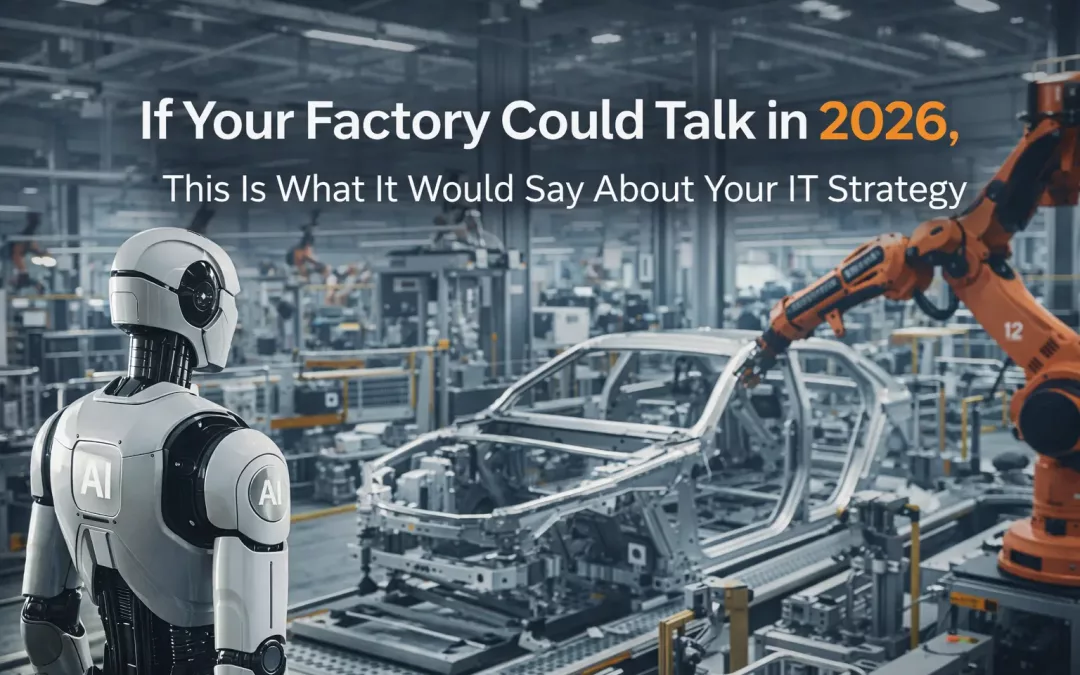
A modern plant today looks impressive. There are “AI-Powered” stickers on some terminals, and robots spin around and dashboards glow. The boardroom seems to have welcomed the future. But if your factory floor could talk this year, it would be less about flashy presentations and more about hard truths. Let’s listen in.
“I’ve heard you talk about AI. I’m still waiting for a nervous system.”
“I’m your paint line, your body shop, and your final assembly. I hear you talking about AI strategy on your conference calls. Still, most days I feel like a bunch of smart but disconnected organs with no central nervous system to hold me together.”
Surveys indicate that almost a third of manufacturers are using AI in some way. That sounds wonderful. But on the ground, data is still stuck: machine metrics in local PLCs, quality stats in one silo, maintenance logs in another, and ERP data floating in a cloud far away.
The slide deck has AI, but the connective tissue doesn’t. Your factory doesn’t need more pilot projects; it needs a digital spine. It requires consistent asset IDs, universal event codes, and a real-time layer where signals can interact and make decisions. Every AI app is just a one-time craft project without it.
“You Bought Me Robots. You Never Finished My Data Backbone.”
“You gave a lot of hardware, new sensors, and robots. Thanks. But you never finished connecting my nervous system. I generate a significant amount of data during each shift, but it simply disappears.”
Check out the leaders. Volkswagen’s AI-powered “factory cloud” across 43 plants is already saving millions of dollars. Bosch is spending billions on making processes smarter and faster. Their goal isn’t to add more features; it’s to make the factory itself into a useful data product.
A single data model for machines, quality, and energy that everyone can use. There is one common method for using and managing models. Your factory isn’t ungrateful; it just wants you to invest as much in data as in hardware.
“Physical AI is Coming. Can We Please Be Ready Before the Robots Arrive?”
“You think installing robots was the big transformation? That was the warm-up act.”
The next wave is Physical AI, which is intelligence that moves, senses, and makes decisions in real space. The World Economic Forum points to this as the solution to a lack of workers and changing demand. It’s not just a theory anymore. Starting in 2028, Hyundai and Boston Dynamics will use humanoid Atlas robots to do real work in car plants.
Your factory’s question is very important: “Before you allow thinking and moving robots onto my floor, will you please ensure that my architecture, safety rules, and governance are all in place?” When you make a bad choice here, the cost isn’t just a bad report; it’s also safety, scrap, and downtime.
“Your IT Strategy Still Lives in the Office. I Live on the Line.”
“Your IT diagrams are beautiful: clouds, platforms, data lakes. But they often stop at the firewall. I live on the other side.”
A lot of the time, IT strategy is written from the office out. The network, security, and access models are made for desks, not for shifts and production lines. In the meantime, smart manufacturing needs to fill this gap.
“Bring your Head of IT, your OT leaders, and your plant managers together in one room” is what your factory is asking for. Don’t leave until everyone agrees on one architecture. “I can’t work with two brains.”
“I Don’t Need More Pilots. I Need a Roadmap from Cost to Capability.”
“You’ve proved AI can work in one cell, on one line. I get it. Now, please stop proving and start scaling.”
Examples of plants stuck in permanent pilot mode include a vision system for a single weld and a predictive model for a single pump. Each one has its worth, but your factory is begging for maturity: a clear cost-first roadmap that focuses on downtime, scrap, or energy use; a realistic plan to industrialize data and models across sites; and committed ownership so that capabilities don’t disappear when the project team leaves.
The leaders see AI in the plant as a multi-year capability program that is directly related to P&L lines like cost per unit, not as a series of science experiments.
If your factory could sum it all up plainly, it might say this:
“I don’t need more buzzwords. I need you to treat me as a living, learning system.”
In practice, that means:
1. “Give me a nervous system” A connected data backbone that unifies machines, quality, maintenance, and energy into one real-time view.
2. “Give me a brain you can trust” AI systems that are governed, monitored, and designed for explainability and safety from the ground up.
3. “Give me a body that can evolve” An architecture ready to host Physical AI and new automation without starting from scratch every time.
4. “Don’t forget my humans” Train, empower, and involve the operators and engineers who will work alongside this new intelligence.
It’s not enough for your IT strategy to just support business software anymore. Manufacturing is increasingly relying on this approach to create physical value. The question isn’t if your factory is smart. It’s about whether you’re ready to hear what it’s been trying to tell you all along.
This reflection is part of my broader work on how the “digital bubble” is reshaping factories, organizations, and the way people work together. In Life in the Digital Bubble, I explore how these forces will evolve over the next three decades and what they mean for leaders, teams, and families. If your organization is ready to turn these ideas into a concrete roadmap for its plants and IT landscape, my digital transformation and AI consulting services are designed to help leadership teams build that next phase with clarity, structure, and accountability.