
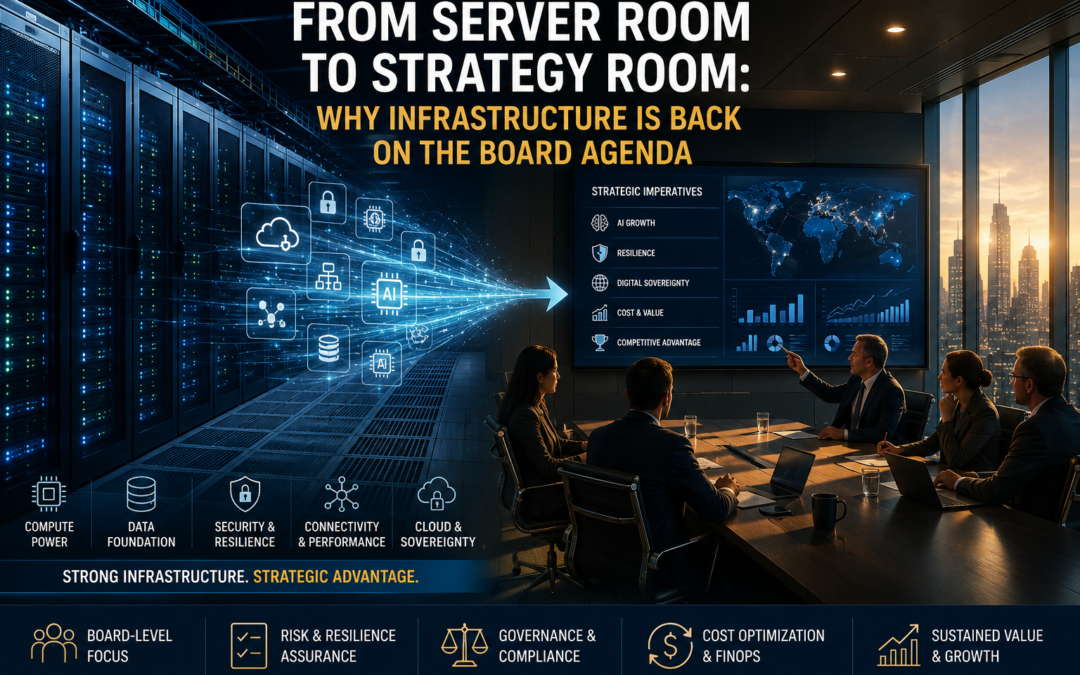
For years, IT infrastructure was a back-office utility. It was supposed to be stable, accessible, secure, and largely invisible. Boards only paid attention when something went wrong.
That time is gone.
Infrastructure has emerged as one of the most critical strategic bases for the enterprise. This principle applies whether you are considering AI deployment, cyber resilience, digital sovereignty, cost predictability, business continuity, data governance, or even regulatory affairs. It all comes down to one question:
Do we have the right digital foundation for the ambitions we are setting?
This is not just a technical issue for the IT department anymore. This is a board-level conversation.
The message is clear for leaders tasked with digital transformation and AI: Infrastructure is no longer just the platform beneath strategy. It's part of the strategy.
The hyperscalers already understand this
The clearest signal comes from the hyperscalers themselves.
Google announced its eighth generation TPUs at Google Cloud Next ‘26, including TPU 8t for accelerated training and TPU 8i for cost-effective, near-zero latency inference, as well as Virgo Networking for high-performance AI infrastructure at massive scale.
Google also said that Virgo Network and TPU 8t can connect 134,000 TPUs in a single data center fabric and more than a million TPUs in multiple sites into a single training cluster. If you take a moment and consider this announcement from Google, you will clearly see that it's not just a product announcement. It’s a sign of strategy.
Alphabet also projected capital expenditures of $175 billion to $185 billion in 2026 as it increases investments in compute capacity and AI infrastructure. Microsoft announced a $10 billion investment in Japan in AI infrastructure, cybersecurity partnerships, and workforce development from 2026 to 2029. MARA Holdings agreed to buy Long Ridge Energy & Power for $1.5 billion, moving itself beyond bitcoin to digital infrastructure and power for data centers as AI demand increases.
Do you recognize the pattern?
The biggest technology players do not treat infrastructure as a cost center. They are viewing it as a source of control, scale, resilience, and competitive advantage.
If boards operating in the secret sauce preparation do so, then every other board should take notice.
The infrastructure cliff: AI cannot run on yesterday’s foundation
Most organizations have an ambitious agenda for AI. Fewer have had the difficult conversation of whether their infrastructure can actually support it.
AI workloads are unlike traditional enterprise applications. They are more compute-intensive, more data-dependent, more cost-variable, and more sensitive to latency, governance, and security constraints.
Technical concerns, business concerns, and digital sovereignty requirements are driving enterprises to hybrid cloud and private cloud, according to SUSE’s Cloud and AI Pulse Survey, which found that 59% selected hybrid cloud and 16% selected private cloud in that context. The survey also included nearly 600 enterprise technology leaders from the US, UK, Japan, India, and Germany and linked AI adoption directly to infrastructure, budgets, governance, and resilience priorities.
The economics are changing too. Flexera’s 2026 State of the Cloud Report found that cloud-based AI workloads have contributed to wasted cloud spend rising to 29%, the first increase in five years. The same report found that generative AI became the third most widely used public cloud service, rising to 58%
CloudZero’s 2026 FinOps research found that 40% of companies today are spending $10 million or more on AI annually, but many still don’t have a clear view of what is driving that spend or whether it’s providing value.
This is the infrastructure cliff.
Enthusiasm can get companies started on AI pilots. But they can’t scale AI responsibly without the right foundation for compute, data, security, cost management, sovereignty, integration, and operations.
The question on the board is not
“Are we doing AI?”
The question is more
“Do we have the infrastructure, governance, and economics to scale AI without creating new risk?"
Geopolitical fragility: Cloud is still physical
The cloud can be intangible. But every cloud service still needs physical locations, power, cooling, networks, legal jurisdictions, and geopolitical stability.
Iranian drone strikes damaged data centers in the Middle East in early March, and Amazon expected it would take several months to restore cloud operations that were damaged in the region, according to a report published by Reuters in April 2026. AWS even advised customers to relocate reachable resources to other regions and restore unreachable resources from offsite backups. As of the week of April 30, 31 AWS services in Bahrain and the UAE remained listed as disrupted.
In an article in September 2025, “Will Data Centers Become the #1 Targets in the Next Global War?” I argued that data centers may become some of the most strategic targets in future conflicts. The argument is not theoretical anymore. The physical security of data centers is an issue of national and corporate resilience as AI, cloud platforms, digital identity, payment systems, logistics, and public services depend on concentrated digital infrastructure.
These developments should change the nature of board-level conversations around resilience.
A regional outage is no longer a technical availability situation. It could turn into a geopolitical, operational, legal, financial, and customer trust scenario.
The same goes for digital sovereignty.
So the practical questions here are:
• Where is our most sensitive information?
• Who holds the encryption keys?
• What jurisdictions are our critical workloads running in?
• But what happens when a cloud region is unavailable for weeks or months?
• Are we demonstrating control or simply presuming it?
These are not architectural technical questions anymore. These are enterprise risk questions.
The cloud economics pivot: Repatriation is not retreat
For more than a decade, many organizations had one simple default: cloud first.
That is past history. The more mature posture is not on-premise first or cloud first. It is first workload.
CIO.com framed this shift well: repatriation is not retreat, and replatforming is not indecision. They all point to maturity, not ideology.
Some workloads belong in the public cloud because they require elasticity, speed, global reach, or access to advanced managed services. Others require predictable cost, low latency, sovereignty, performance stability, or tighter operational control and may be better suited to private cloud, colocation, edge infrastructure, or dedicated platforms.
The board should not be asking the following:
“Are we cloud-first?”
The real question is
“Are we placing each workload where it will provide the best balance of value, resilience, control, compliance, and cost?”
And this aspect is where FinOps also changes. FinOps is not just about cutting cloud bills anymore. The understanding of technology value is becoming a strategic discipline. Generative AI is creating dynamic and less predictable workloads, new pricing patterns and challenges with forecasting and budgeting, as Flexera says in this report.
Boards should, therefore, stop asking the following:
"How much do we spend on the cloud?”
They should inquire:
“How much bang are we getting for every buck we spend on infrastructure?”
And perhaps more importantly:
Do we have the necessary governance in place to obtain this information?
The board’s infrastructure agenda
“Infrastructure has to be on the board agenda because it now determines whether digital ambition translates into operational reality.
Protiviti’s 2026 board agenda shows that more than 60% of boards are already allocating time for AI on their agendas, but many do not have durable structures to translate discussion into policies, controls, and measurable outcomes. KPMG’s 2026 board agenda identifies key board focus areas as scenario planning, crisis response, organizational resilience, AI strategy, data governance, and cyber security governance.
Infrastructure serves as a unifying element for all of these subjects.
A practical agenda for board-level infrastructure should have five buckets.
1. AI readiness
Can we scale AI, not just pilots, on our infrastructure?
Boards should ask about the organization’s compute capacity, data architecture, security model, integration capability and operating model to scale AI responsibly.
The key question:
Can we scale AI without creating uncontrolled cost, technical fragility, or compliance exposure?
2. Resilience
Can the organization continue to operate during regional outages, cyber events, supplier failures, or geopolitical disruption?
The key question:
If one of our critical cloud regions or infrastructure providers became unavailable for three months, what would happen to the business?
3. Sovereignty and control
Does the organization know where its data, workloads, backups, models, and keys reside?
The key question:
Can we demonstrate control over our most sensitive digital assets, or are we depending on assumptions?
4. Economics and value
Can the organization connect infrastructure investment to business outcomes?
The key question:
Do we understand cost per workload, cost per transaction, cost per inference, and value per investment?
5. Optionality
Can the organization move workloads when regulation, cost, risk, or strategy changes?
The key question:
Have we designed for reversibility, or have we created new forms of lock-in?
This shift also changes the role of the CIO. The CIO can no longer present infrastructure only through availability metrics, project status, and cost dashboards. Those remain important, but they are not enough.
The CIO must translate infrastructure concepts into language that the board can understand:
• Resilience.
• Risk.
• Strategic optionality.
• AI scalability.
• Cost predictability.
• Regulatory confidence.
• Operational continuity.
• Competitive advantage.
This phase is where infrastructure leadership becomes business leadership.
Boards do not need to understand every architectural decision. But they do need to understand the consequences of those decisions.
They need to know which strategic goals the current infrastructure enables, constrains, or puts at risk.
Conclusion
Infrastructure has moved from the server room to the strategy room.
The organizations that understand these changes will make better decisions about AI, resilience, sovereignty, cost, and long-term competitiveness. They will not treat infrastructure as a hidden technical layer. They will govern it as a strategic foundation.
Those that continue to treat infrastructure as a back-office cost center will eventually discover that their most important ambitions are limited by foundations they failed to modernize.
Organizations with the boldest AI vision will lead the next decade, not just on their own.
Organizations with the strongest digital foundation will lead the effort to make that vision real.
If this argument resonates with you, the real question is not whether infrastructure belongs on the board agenda. It is whether your organization has the leadership, operating model, and governance to act on it.
That is precisely why I wrote Life in the Digital Bubble to explore how AI and digital systems will reshape not only technology but also work, families, and society over the coming decades. And for leaders navigating these shifts today, my CIO advisory practice focuses on one thing: moving beyond scattered initiatives to build clear, durable operating models that turn emerging technologies into measurable business value. If you are ready to have that conversation, let’s talk.
Get my latest articles in Google
Add tamerbadawy.com as a preferred source to see more of my articles in Google Search and AI results.