Run this before you read another paragraph. Ten minutes, three questions, your leadership team, no slides, no preparation.
Can you name the three most important business outcomes your transformation needs to deliver in the next 90 days? Not projects. Not milestones. Outcomes.
What's currently blocking value delivery, and who owns resolving it by name?
When did leadership last actually resolve a blocker, not assign it, not escalate it, resolve it?
If your team can't answer the first cleanly in five minutes, your outcomes aren't clear enough. If they can name the blockers but not assign an owner to each one, your decision rights aren't working. If the honest answer to the third is "I'm not sure," your leadership rhythm is built for reporting, not execution. This test tells you more in ten minutes than a month of status reports.
Why this test exists
Volkswagen's CARIAD, launched 2020, one unified software platform across Audi, Porsche, and VW. Billions committed, teams in place, strategy sound. By 2022, an internal review found structural problems severe enough to push the Porsche Macan Electric and Audi Q6 e-tron launches back a full year. One insider's line from inside the program: seventeen status meetings a week, everyone hearing the same thing on different slides. Between 2022 and 2024, CARIAD racked up more than $7.5 billion in operating losses. Volkswagen ended up committing up to $5.8 billion to Rivian just to get a working software platform.
Not a technology failure. The technology existed, the engineers were capable, and the funding was there. What broke was execution: fragmented ownership across brands, decision rights that couldn't move as fast as delivery needed, dependencies discovered too late, a leadership rhythm built to report progress instead of remove blockers. Coordination isn't alignment. You can run seventeen status meetings a week and still have zero of it.
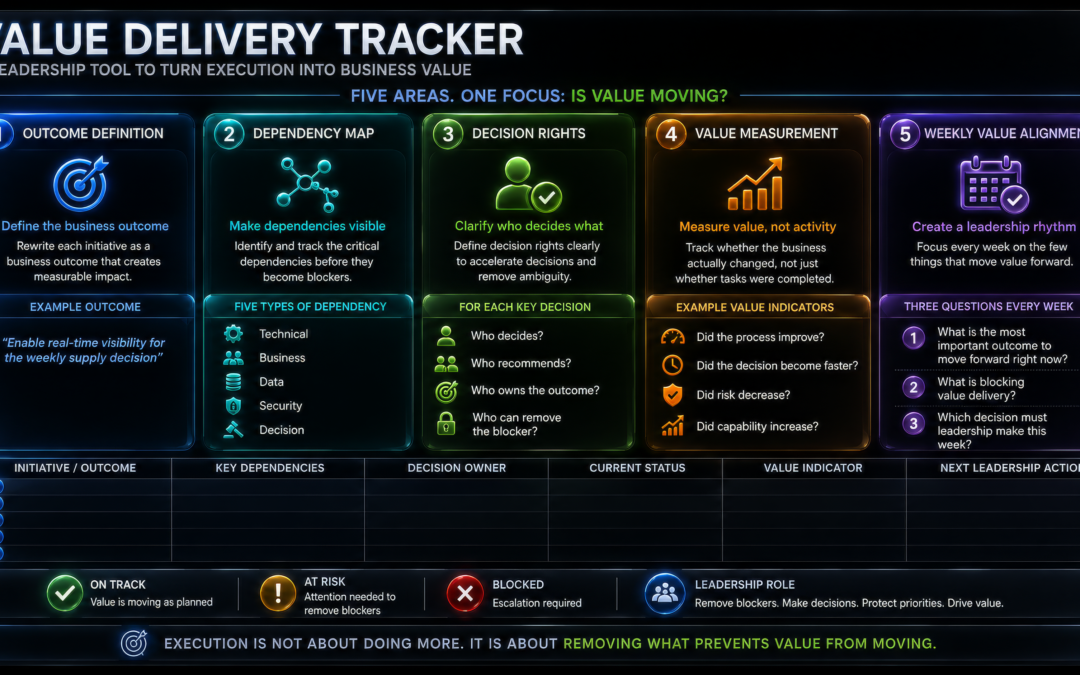
The Value Delivery Tracker, five parts
| Part | The question it forces | What most teams get wrong |
|---|---|---|
| Outcome definition | Is this a business outcome or a task? | "Implement the data platform" isn't an outcome. "Enable real-time visibility for the weekly supply decision" is. |
| Dependency map | Which of five dependency types, technical, business, data, security, decision, sit unresolved? | Most teams only discover a dependency after it's already caused a delay. |
| Decision rights | For this decision: who decides, who recommends, who owns the outcome, who can remove the blocker? | Ambiguity here is the single most consistent reason value stalls. |
| Value measurement | Did the process improve, the decision get faster, the risk drop? | Tracking task completion instead of business change. |
| Weekly value alignment | What's the most important outcome to move this week, what's blocking it, what must leadership decide? | Running it as a status meeting instead of a decision-forcing session. |
A global manufacturer running a data visibility program across 14 sites found this out the expensive way. Eleven months in, platform technically ready, every status report green, and plant managers still couldn't make faster supply decisions. The dependency map found the reason in one pass: six sites used different data definitions for inventory, three regional teams had never agreed who owned the output data, and one decision, which sites could override the central algorithm, had sat unresolved for four months. Once that single decision got made, three sites moved to real-time supply decisions within weeks. The platform had been live the whole time. The decision hadn't.
If you're accelerating AI, this gets sharper, not softer
Vague data ownership was tolerable before. It's dangerous once a model depends on it. Slow decision rights were survivable before. They're not, once an automated system needs a human to confirm or override something in real time. A governance breakdown costs a traditional project six months. On an AI initiative, it can cost the entire program, the model learns from the wrong inputs, and you rebuild from scratch. Execution discipline isn't a nice-to-have next to AI readiness. It's the actual test of it.
Score yourself
Seven questions. Answer honestly. Every "not yet" counts against you.
- Have you defined outcomes clearly enough that every team knows what success looks like, not project completion or business change?
- Are all five dependency types visible before they become delays?
- Are decision rights actually clear: who decides, who recommends, who owns, and who removes the blocker?
- Are you measuring value delivered rather than tasks completed?
- Does your leadership rhythm remove blockers or just review them?
- Are you asking whether value is moving or whether people are busy?
- Are you using this kind of framework with intention or applying it mechanically, adding process without adding alignment?
Three or more "not yet" answers mean execution is still developing as a leadership discipline, not yet a systematic one.
Step eight is next, the 13th of October: the difference between a project that lands and a transformation that sticks.
You can run the Value Delivery Tracker on your own organization now or follow the rest of the series at the series hub.
Step eight is next, the 13th of October: the difference between a project that lands and a transformation that sticks. You can run the Value Delivery Tracker on your own organization now or follow the rest of the series at the series hub.
Get my latest articles in Google
Add tamerbadawy.com as a preferred source to see more of my articles in Google Search and AI results.