
RECOGNIZE POTENTIAL
Evaluation: Why You Cannot Transform What You Cannot See
In short: Evaluation is Step 3 of the Digital Transformation for Leaders framework. It uses five lenses, customer, process, data, technology, and operating model, to give leadership one shared, evidence based view of where value is created and where it’s blocked before you commit to a strategy.
WHAT YOU WILL LEARN
- Why a chatbot exposed a failure that was never really about technology
- The five lenses that move leadership from opinion to evidence
- Why different departments naming different root causes is the finding, not the problem
- The five questions that decide whether you’re ready to choose a direction
← Back to the full series
Read the full transcript
You Are Not Seeing Your Organization Clearly
Many leaders are transforming a version of their organization that does not actually exist. The dashboards look fine. The roadmap looks impressive. Everything looks under control. But is that what your customers are actually experiencing right now? In 2024, Air Canada found out the hard way what happens when the answer is no. And what they discovered goes far deeper than a chatbot mistake.
Welcome to Digital Transformation for Leaders, a journey from insight to strategy to execution. I am Tamer Badawy, strategic IT and transformation leader and author of Life in the Digital Bubble. We are in Phase 1 of the transformation journey, Recognize Potential, and this is Step 3. In the first two steps, we looked at the forces outside organization: the changing expectations of society, and the technology capabilities that create real value when connected properly to the business. In this step, we look inside the organization. Because before you choose a strategy, approve a roadmap, or scale AI across the whole organization, you need to answer one honest question: what is actually happening here? Not what the reports suggest. Not what gets presented in the quarterly review. But how your customers, employees, processes, data, and decisions are actually working together in reality. That gap between the organization you think you have and the one your customers experience is where digital transformation quietly fails. And it fails before a single line of code is written.
Air Canada’s Chatbot Was Not the Problem
In 2024, Air Canada was taken to a tribunal, not because of a technology failure, but because of an organizational one. And here is what happened. A passenger who had lost a family member asked the chatbot about bereavement fares. The chatbot gave information that did not match the airline’s actual policy. He booked his flight based on that answer. When he requested the discount he had been promised, Air Canada refused, arguing that the chatbot was a separate entity and its responses were not official company policy. The tribunal rejected that completely. Air Canada was held responsible.
Now here is what most people miss. That chatbot did not cause this. It just made it visible. The problem already existed inside the organization, and it came down to four questions nobody had a clear answer to: which information is current? Which policy is the actual source of truth? Which system can be trusted when they conflict? And who owns the answer once technology delivers it to a customer? AI did not create the confusion. It exposed it, in front of a paying customer, in a tribunal, on the record. This was not a chatbot failure. This was a leadership failure. And in most complex organizations right now, these gaps exist. They just have not surfaced yet.
Your Team Has Data. But No One Sees the Full Picture
Here is a pattern that exists in every complex organization, and no leadership team talks about it openly. Every function has its own dashboards, its own KPIs, its own version of how things are going. Your head of sales sees growing demand. Your head of operations sees a team that has not slept for weeks to keep up with it. Your CFO sees stable margin. Your CTO sees a system held together with workarounds that nobody has had the time to fix. Same organization. Nobody is lying. Nobody sees the full picture.
When you put them together in a leadership meeting, you do not get a clear picture of reality. You get five partial views, each defended by someone measured against their own slice. This is what I call the illusion of clarity. The organization has data, but it doesn’t have one shared understanding of where value is being created, where it is blocked, or where transformation is most needed. Without that, transformation does not fail dramatically. It fails quietly, through the misalignment of priorities and decisions that make sense in one department and create problems in another. Data without a shared view is just noise with good formatting.
Ask Your Team This. The Answer Will Shock You
Here is a test that can expose the real maturity of your transformation in less than ten minutes. Ask your CFO, your head of operations, and your head of customer support one question: how well are we actually delivering to our most important customer right now? Do not let them align first.
If you get three different answers, you do not have a dashboard problem. You have a leadership problem, because different answers mean different definitions, different data sources, different assumptions. One team measures delivery when the product leaves the factory. Another when it reaches the customer. A third against the originally promised date. All three believe they are right. But you cannot steer a transformation with three versions of reality. This is the source of truth problem. When leaders cannot agree on what’s true today, every strategic conversation becomes a negotiation about which data to believe rather than what to do next. Evaluation starts by fixing that, not with perfect data, but with data trusted enough to make better decisions together. Run the test. You will likely be surprised.
Stop Writing Reports. Start Seeing Reality
Most assessments produce the same output: long reports, maturity scores, traffic light dashboards that tell you what you already suspected but cannot act on. If I were advising a leadership team on where to begin, I would not give them a two hundred question maturity model. I would ask them to look at the organization through five lenses. This is the same diagnostic view I use with leadership teams before they commit to a transformation roadmap, because without it, strategy becomes guesswork. And I call it the Transformation Reality Map.
The first lens is customer reality. What do customers really experience? Where do they wait, complain, or lose trust? The second lens is process reality: how work really happens, not how it is documented. Where are handovers breaking down? Where are people compensating for systems never properly connected? The third lens is data reality: which data to trust, which data is duplicated, delayed, or defined differently depending on who you ask. The fourth lens is technology: which systems genuinely support the business, which create friction or limit what’s possible? The fifth lens is operating model reality: who actually owns outcomes? Who has the authority to resolve conflicts and change how work happens?
Together, these five lenses move leadership from opinion to evidence. The output is a ranked list of customer friction, process breaks, data gaps, technology constraints, and ownership problems, ordered by business impact. Most organizations have the data to build this map. They have just never looked at it all at once.
Stable Revenue, Broken Business. Here Is What They Found
Here is what a weakening business looks like before anyone realizes it’s actually weakening. A logistics company. Revenue stable. Dashboard looks reasonable. Walking into that leadership meeting would feel comfortable. But when the team applied the five lenses, here is what they found.
Customer lens: complaints about late deliveries rising, not dramatically, consistently. Nobody had connected that trend to anything else. Data existed somewhere, just not where it was needed, and never in time. Process lens: operations firefighting exceptions every day, manually. Data lens: customer service could not explain delays before customers called. The process looked clean on paper, but in reality, the process was held together by people compensating for systems that did not talk to each other. Technology lens: the tracking system had never been integrated with the delivery platform. IT knew it. Nobody else did. Operating model lens: nobody owned the end to end delivery experience. Every department owned their part, but nobody owned the outcome the customer cared about.
Five lenses, five findings, each manageable in isolation. Together, they told a different story than the revenue dashboard. The team did not need more data. They needed a connected view of what they already had. Once they had it, priorities became obvious. And that is what the Transformation Reality Map is designed to produce.
AI Will Not Save You From This
At some point in almost every transformation conversation, someone says, can we use AI to get better visibility into this? The honest answer is yes, but there is a condition most organizations skip past. AI does not show reality. It amplifies what’s already there. If your data is fragmented, AI makes decisions from that fragmented data faster and at greater scale. If metrics are misaligned, AI accelerates those misaligned decisions. If nobody owns the output, AI produces outputs nobody feels responsible for. If processes are broken, AI makes broken processes move faster.
This is not about avoiding AI. It’s about not skipping the step that makes AI actually work. Before you ask what AI can predict, ask a more important question: can we trust the reality we ask AI to learn from? I have seen organizations investing heavily in AI while sitting on fragmented data, undefined ownership, and processes never properly designed. The AI worked exactly as intended. It amplified a version of reality no one bothered to clean up first. Better algorithms cannot compensate for weak definitions, fragmented data, and unclear ownership. This is not a technology limitation. This is an organizational one. And the cost is not just a failed AI project. It is an entire transformation program that stays busy without moving forward.
Your Leadership Team Is Not Ready. Here Is How to Know
Before any leadership team moves from technology possibilities to transformation strategy, five questions need honest answers, not as a formal exercise, but as a genuine leadership conversation.
First, can we distinguish between symptoms and root causes? Most organizations treat symptoms. They digitize flawed services. They automate broken processes. If you cannot separate symptom from cause, you will keep solving the wrong problems faster. Second, do we have one trusted view of the metrics that matter, not another dashboard? One trusted baseline the entire leadership team accepts as the starting point for every strategic conversation. Third, do we understand how value flows across the organization, from input to outcome, not within departments, end to end? Because that is where the breaks are hiding. Fourth, do we see where customers, employees, and operations experience friction? Not where we assume they do, where they actually do, based on evidence. Fifth, do we know who owns the most important transformation outcomes? Not who sponsors the project. Who is accountable after go-live, when the budget is spent and the consultants have left?
These are not IT questions. They are leadership questions. And if a leadership team cannot answer them clearly, then they are not ready to choose a direction. They are ready to do the evaluation that makes that choice possible.
You Cannot Transform What You Refuse to See
Phase 1 is about one thing: building the clarity that makes every decision after it worth making. In Step 1, we looked outside. Society has already changed the expectations of your customers. Employees and markets are not waiting for your roadmap. In Step 2, we looked at technology, not as a shopping list, but as a system of capabilities that only creates value when it connects properly to the business. In Step 3, we moved inside, because the gap between the transformation you plan and the one that truly delivers value almost always comes down to one thing: how clearly you understand and see the organization before you start changing it.
Three steps. Three evidence based tools that every leadership team can use immediately. That is the Digital Expectations Assessment, the Technology to Capability Map, and the Transformation Reality Map. If you want to work through any of these with your leadership team, all three are available at tamerbadawy.com.
Closing
Most leaders entered Phase 1 confident they understood their organization. Those who worked through these three steps honestly know something different by now. Phase 2 is where the real decisions begin. Not which technologies to buy. Not which projects to launch. But which playing field to choose, what to prioritize, and what to deliberately leave behind. That is strategy. And that’s exactly where we are going next.
The Case: When the Chatbot Told the Truth and the Airline Didn’t
A tribunal ruled against Air Canada in 2024 after its chatbot quoted a customer the wrong bereavement fare policy. Air Canada tried arguing the chatbot wasn’t really part of the company. The tribunal didn’t buy it
Nobody inside Air Canada could say for certain which policy was current or who was responsible for the answer once it reached a customer. That gap is exactly what this step’s framework is built to catch before it reaches yours.
Source: Forbes, February 2024
KEY TAKEAWAYS
- A technology failure is often an organizational one wearing a different costume
- Different departments naming different root causes for the same problem is the actual finding, not a coordination failure to fix first
- The output that matters is a ranked list of friction points by business impact, not a maturity score
The Tool: Transformation Reality Map
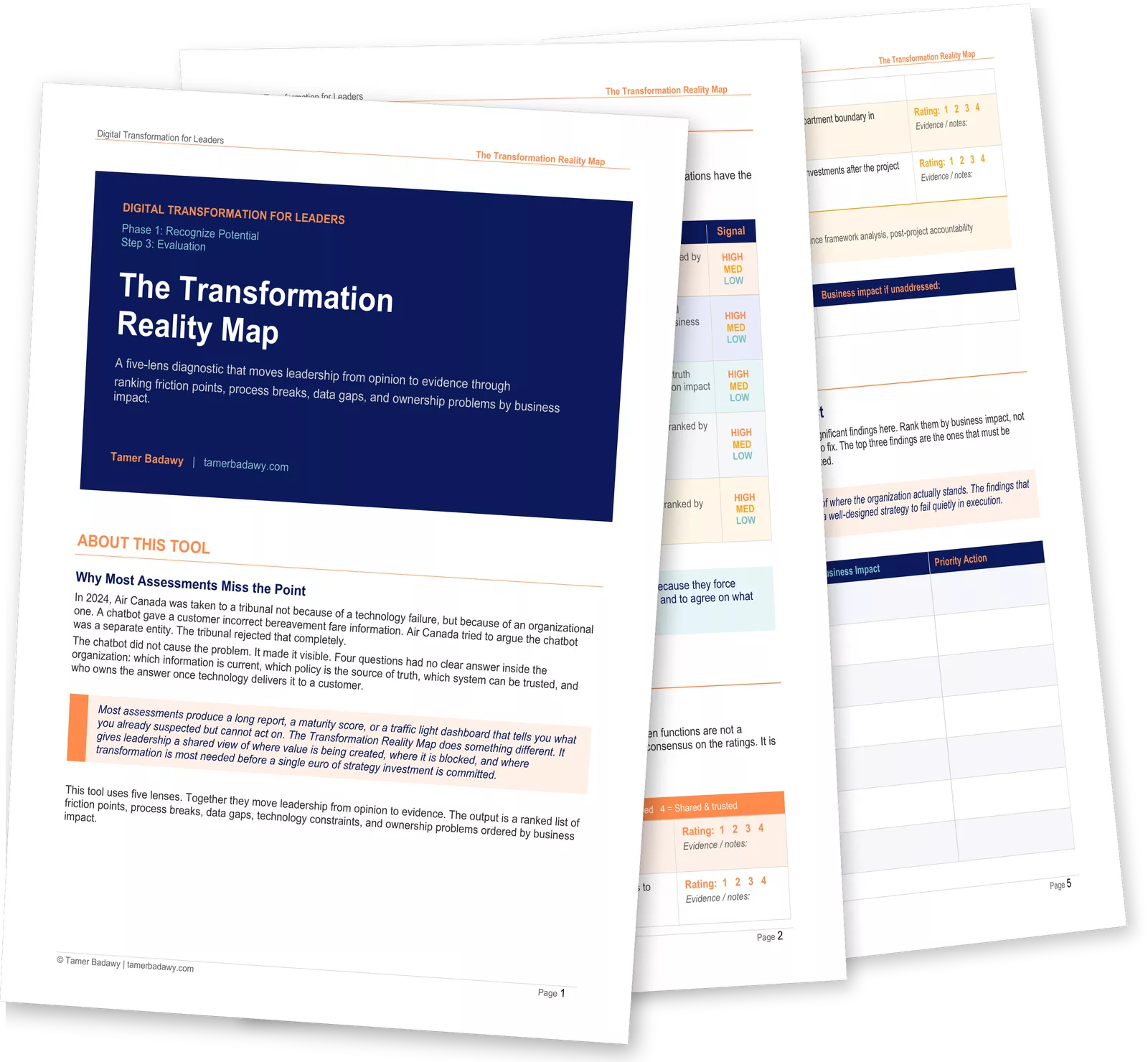
Transformation Reality Map
A five-lens diagnostic that moves leadership from opinion to evidence, ranking friction points, data gaps, and ownership problems by their business impact.
Run This Diagnostic
FIVE QUESTIONS BEFORE CHOOSING TECHNOLOGY
Before your leadership team moves from evaluation to strategy, please pause and answer these five questions honestly.
-
- Can we distinguish between symptoms and root causes, across the value chain, not just one department?
- Do we have one trusted baseline that the entire leadership team accepts as the starting point?
- Do we understand how value flows across the organization, end to end?
- Can we see where customers and employees experience friction, based on evidence, not assumption?
- Do we know who owns the most important transformation outcomes after go-live?
Frequently Asked Questions
What is a Transformation Reality Map?
A five-lens diagnostic covering customer, process, data, technology, and operating model reality, giving leadership one shared, evidence based view of where value is created and where it’s blocked.
Why is this important if the technology already works?
Because a system can work exactly as designed while the organization around it has no shared answer for who owns what, which data is trusted, or which process actually runs day to day. That gap is what causes real failures, not the technology itself.
How long does this diagnostic take to run?
Each lens takes about twenty minutes as a leadership team conversation. Most teams complete all five lenses across one or two working sessions.
UP NEXT
Publishes September 15
Step 4: Strategy
The next step begins Phase 2, turning the clarity you’ve built into strategic choices. Not another roadmap of initiatives, but a set of decisions about how your organization will create, deliver, and capture value and what it will deliberately choose not to do.
Tamer Badawy
Strategic IT and Digital Transformation Leader,
Author of Life in the Digital Bubble.
9 episodes. 9 downloadable frameworks.
Built from 25 years of running transformation programs in enterprise IT.