Most breakthroughs don’t come from inventing something brand new. They come from connecting existing technologies to a problem everyone else ignored.
I recently met with Andi Zaugg, CEO and co-founder of Levitate Aerospace. What really impressed me wasn’t some moonshot vision. It was something simpler: his company spotted a gap in the physical world that everyone else had just accepted as unsolvable. That gap exists in the sky. And it turns out that this gap hides an operational problem that can be developed into a business that triggers a very specific and profitable business model while saving end customers a means to reduce costs, a lot of costs.
The Blind Spot Everyone Looks Past
Modern infrastructure runs on long lines. Power grids, railways, and pipelines. cables. Highways Coastlines, you name it. These assets stretch for thousands of kilometers. They need constant watching. Cracks form. Trees grow too close. Leaks happen. Erosion creeps in. But the tools we use to watch them haven’t scaled properly; actually, in some operations, they still depend on manual human eye-watching and checking techniques that are extremely inefficient and costly, besides being slow and even sometimes dangerous. Right now, some other operators depend on helicopters flying overhead, burning fuel at enormous cost, or drones capturing detailed images but running out of battery in less than an hour. As a result, for those methods, operators end up with fragments of data instead of a complete picture. They know something happened somewhere, but they rarely see the full story. That fragmentation is exactly where Levitate starts.
The Middle Mile Nobody Built For
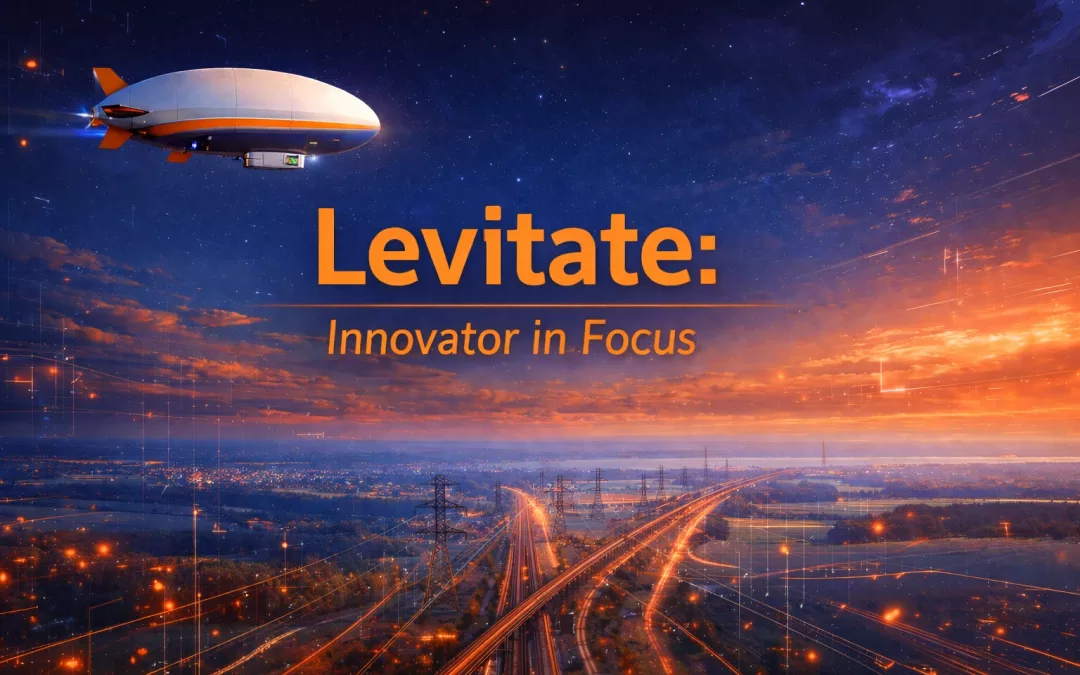
Levitate Aerospace builds what they call the missing layer between drones and helicopters. Their aircraft, the TENEO | E, uses two forms of flight at once. Helium provides buoyancy, while wings provide aerodynamic lift. This hybrid approach lets it fly for roughly six hours per mission while carrying serious sensors: LiDAR, 100-megapixel cameras, and the kind of gear that captures real detail. Instead of short drone hops or expensive helicopter burns, this platform uses helium to reduce energy demand while staying airborne long enough to matter. It was designed for one job: digitizing entire infrastructure corridors in a single pass.
That means operators get continuous digital twins of their assets, not scattered snapshots stitched together later. But here is the part that matters. Levitate does not call itself an aircraft manufacturer. They call themselves a data infrastructure company, and this is what brought my attention to them because what they are actually selling is nothing more than answers. Levitate operates on a Data-as-a-Service (DaaS) model, which means they provide data management and delivery services over the internet.
Infrastructure operators do not buy the aircraft. They buy the insight. Levitate handles everything. Flight planning. Regulatory approvals. Flying the mission. Running the sensors. Processing the data. The customer receives structured information that drops directly into their data centers. Then their customers can further feed their asset management systems, activate their predictive maintenance models, or even update their digital twins with the latest needed data.
This distinction matters because the aircraft is not the value. The data is. The aircraft is just the tool that collects it.
Levitate talks about the “middle mile” of infrastructure. That is the 50-to-200-kilometer range. This range is too far for a drone to cover efficiently. The distance is too short and repetitive for a helicopter to cover economically. This middle mile runs through everything. Energy grids crossing countries. Rail lines wind through mountains. Pipelines are stretched across vast deserts. The coastlines continue to erode year after year. Nobody built a system specifically for this range. Operators just solved their problem with what already existed, but now it is time to change this. Levitate is essentially creating a new category of aerial monitoring built precisely for this gap.
The Real Pattern Here
The interesting part is not just the helium or the sensors but it is how Levitate arrived at the solution. They did not invent a technology and go searching for somewhere to use it. They started with a concrete operational question: How do we monitor long infrastructure corridors continuously, efficiently, and safely?
Then they pulled together technologies that already existed. Lighter-than-air engineering. Electric motors. Autonomous flight. High-res sensors. Geospatial processing. None of these are new alone. Together, they become something new. And the intersection is the cornerstone. I want to focus on this combination because this is increasingly how real innovation works.
A lot of innovation is not about the single breakthrough, but it is about the intersection.
For a while, startups chased single technologies. AI. Blockchain. Autonomous vehicles. The next wave looks different. It lives at the intersections. AI plus medicine. Robotics plus agriculture. Sensors plus climate monitoring. The combination of digital twins and physical infrastructure is crucial. In Levitate’s case, the combination of lighter-than-air flight, geospatial data, and infrastructure monitoring creates unique solutions. These intersections produce solutions that are specific, hard to copy, and deeply wired into how industries actually operate, such as improving efficiency in logistics, enhancing safety in construction, and optimizing resource management in agriculture. That combination is difficult to beat.
A Signal for What Comes Next
Levitate looks like an aerospace company at first. Take a closer look. It is something else. The real insight wasn’t the plane. The real insight was understanding that monitoring infrastructure is fundamentally a data problem, even though it may appear to be an aviation problem. The answer is clear once you look at it that way. Make the plane based on the data. It should not be the other way around.
The companies that will shape the next ten years won’t just be based on cool technologies. They will emerge from specific locations where different fields intersect. Engineering and data. Hardware and software together. The combination of digital intelligence and physical infrastructure is essential. Levitate Aerospace meets that criteria. They didn’t try to come up with a new way to fly. They asked a more insightful question: What if we created a sky that contains only the information we truly need?
Sometimes that question is where the real work starts.
If this topic resonates with you, I’d love to hear what you think. In my book Life in the Digital Bubble, I talk about how AI and digital systems will change not just IT but also work, families, and society in the coming decades.
And for organizations navigating these changes today, my digital transformation and AI consulting services help leaders get past random projects and create a clear, structured operating model that turns new technologies into real business value.