How ego-driven leadership distorts reality, delays decisions, and quietly derails digital transformation
As a technology leader, I’ve seen a pattern that quietly hurts even the most well-funded transformation programs and projects. This pattern happens over and over again. It doesn’t come with a loud announcement. Instead, it starts with how a leader sees things and slowly changes reality until it can’t change anymore, and this has to do with the first and most important sin? Pride.
In Dante’s view, pride isn’t just being arrogant. It’s when a leader loves themselves too much and starts to put their perspective above what is real. This isn’t just a flaw in character when it comes to enterprise technology; it’s a major risk for leaders.
When Pride Becomes Leadership Blindness
The most dangerous thing about Pride is not what you see, but how it changes how you see things. When CIOs work from this place, something small but important happens: they lose their ability to see clearly. Their own thoughts become the main source of truth.
People hear other points of view, but they don’t really think about them. People get feedback, but they don’t take it to heart. Even when the truth is obvious, like when things don’t go as planned, delivery is late, or the organization sends clear signals, it is ignored or reinterpreted. Talk turns into fights. Noise comes from arguments. The signal is gone.
In this state, people can deny even the most obvious truth. Not on purpose. But that’s because it’s not there anymore.
This internal blindness will always change how the legacy CIOs act. As time goes on, a leader is less open to being challenged, less interested in other points of view, and more attached to their own way of doing things. The conversation is less balanced. No one questions decisions.
The leader starts to work outside of the organization instead of inside it. This makes a clear separation between IT leadership and their teams, between IT and other business units, and between intention and actual execution.
People stop questioning ideas not because they agree or disagree, but because they see that it doesn’t change anything.
The “Prestige Project”
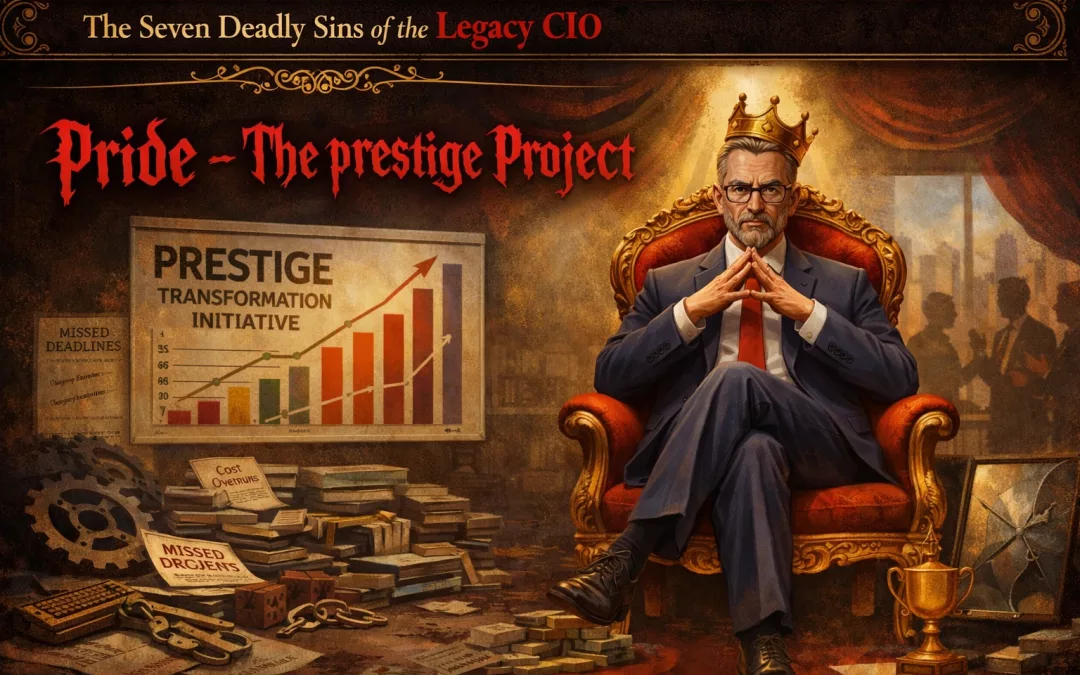
This is where Pride becomes real. It often shows up in what I call the Prestige Project, which is a big, highly visible transformation project that the CIO talks about all the time. It has a name, a plan, a timeline, good funding that goes on for years, and a lot of visibility at the board level.
It is shown as the change and the transformation. But as time goes on, it becomes more than that; it becomes part of who the CIO is.
When a project is linked to identity, it is almost impossible to question it. The project goes on even when the results aren’t what they were supposed to be, the deadlines are pushed back, the work gets harder, and the value isn’t clear. Why? To stop it, Pride would have to do the one thing it doesn’t want to do: look in the mirror.
The real damage, however, extends beyond the CIO. It affects the management board.
The board must decide whether to continue, change, change priorities, or end large transformation programs. But for the board to make the right choice, they need one important piece of information: a clear and full picture of what’s going on.
Pride makes this a dangerous place to be. Because the CIO can’t communicate clearly when they don’t see the whole picture. Problems are made easier. Problems are looked at in a new way. People don’t think risks are as bad as they are. Not on purpose, but because you can’t see the whole situation anymore. Or even worse, on purpose, but this is a subject for another sin.
This means that choices are made with only some of the information, and usually only the good subset of that information and not the ugly truth beneath. The organization keeps putting time, money, and effort into projects that may not be the best ones anymore.
At the same time, a new problem comes up. While the Prestige Project gets all the attention, smaller but important projects are put off, basic IT upgrades are put off, and new chances are missed.
“The organization becomes narrowly focused not because other areas aren’t important, but because they don’t fit the story.”
This pattern doesn’t usually take down a CIO overnight. Its cost is sneaky; it builds up slowly through more complicated systems, less flexibility, unhappy teams, and a slow loss of trust between IT and the business. Eventually, a gap forms: change is happening only on slides, but not in reality.
The Antidote to Pride
Not having confidence is not the opposite of pride, but it is self-awareness that is disciplined.
To be a good modern CIO, you need to be committed to:
- Thinking about what you think you know and challenge your own assumptions.
- Being truly open to feedback that makes you uncomfortable involves taking action, not just listening.
- Making a distinction between one’s identity and individual projects.
- Being brave enough to stop, adjust, or even change course.
Leaders who are strong don’t always push forward. They are the ones who know when to stop and think again.
The Legacy CIO always asks, “What can we do to make this program work?”
The modern CIO asks instead, “Is this still the right program?”
That change is small. But it changes everything.
Closing Reflection
Dante placed pride at the beginning of the seven deadly sins for a reason. Once perception is biased, subsequent corrections become increasingly challenging. Pride doesn’t often show itself in technology leadership. But you can see the effects in the choices that aren’t made, the truths that aren’t accepted, and the transformations that never fully happen.
In the next article, we will explore the second sin: Envy—Outsourced Thinking and how the Legacy CIO, who doesn’t have a clear vision for the future, relies on consulting, outside frameworks, and industry trends. This makes the organization follow others instead of leading, and it misses out on new types of competition.
If this topic resonates with you, I’d love to hear what you think.
In my book Life in the Digital Bubble, I explore how AI and digital systems will reshape not only technology but also work, families, and society in the decades ahead.
And for organizations navigating these changes today, my digital transformation and AI consulting services focus on helping leaders move beyond scattered initiatives and build clear operating models that turn emerging technologies into real business value.