The vendor called it the future. A new ERP architecture, cloud-native, built for where the industry was heading. Our CIO believed it, and he was not wrong to be interested. The old system worked, but it was a generation behind, and the vendor's message was clear. Move now and move early, and you'll stay ahead. Wait, and you fall behind.
So the ambition was set. We would migrate to the newest architecture. And then the decision that should have followed sat still for a long time, because nobody would own it.
Three Functions, Three Exits
The migration touched three domains, and each one treated the decision as belonging to the other two.
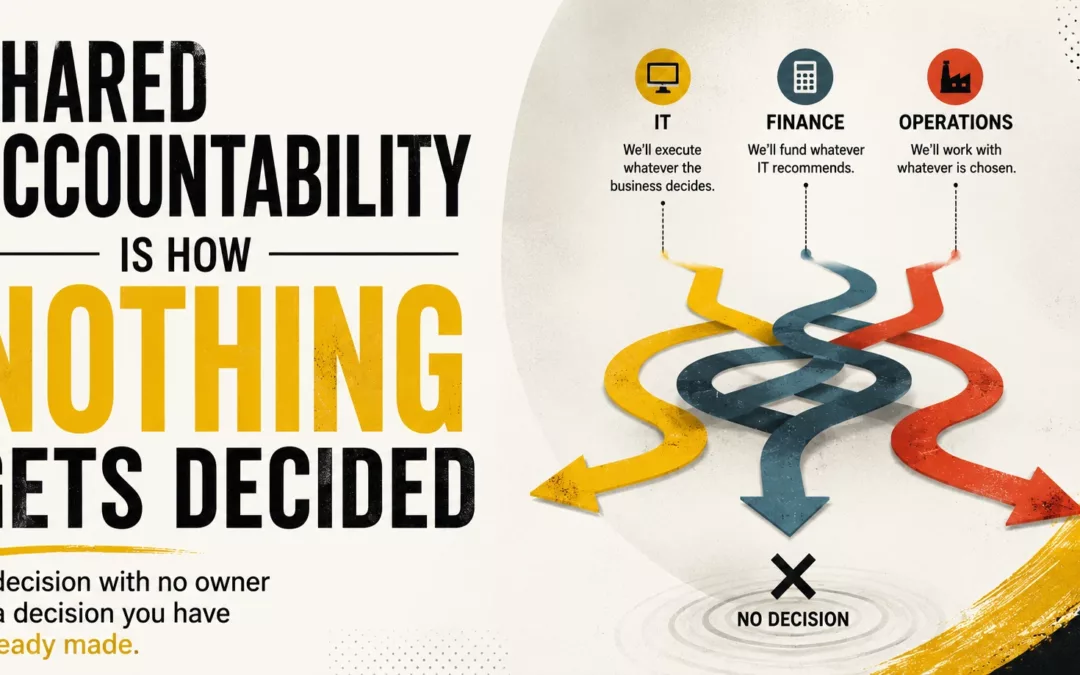
IT said they could execute whatever the business decided, but the business had to decide first. Finance said they would fund whatever IT recommended, but they needed a firm recommendation before releasing that kind of capital. Operations said they would work with whatever was chosen, as long as it did not interrupt production, which quietly ruled out every realistic migration path without offering an alternative.
Each position was reasonable on its own. Together they formed a perfect stall. Three functions, three exits, each one certain the responsibility lived elsewhere.
So nothing moved. The ambition stayed alive in every steering meeting. The commitment to actually choose a path, fund it, and schedule it never arrived. We were enthusiastic about the destination and unwilling to own the first step.
A decision without an owner is one you have already made. You have chosen to let time decide for you.
What the Delay Actually Cost
While the decision sat, the cost was not obvious, which is what made it dangerous. There was no burning platform, no deadline forcing action. Just a slow accumulation of missed ground.
Competitors who made early commitments began to advance in the specific capabilities enabled by the new architecture. Our teams kept building workarounds on the old system, each one making the eventual migration larger and more expensive. The business case that looked strong at the start weakened every quarter, because the longer we waited, the more we had to unwind later. The window the vendor described as an advantage quietly became a gap.
None of this showed up on a status report. This situation illustrates the problem of making decisions that lack clear ownership. When the risk is slow rather than sudden, there is always a reason to wait one more quarter. And we did, many times over.
I wrote about a related pattern in why enterprises must stop adding tools. Indecision does not hold you in place. It moves you backward while you believe you are being careful.
How It Finally Resolved
It resolved the way these things usually do. Not through a clean strategic choice, but through pressure that built until someone had to act.
A senior leader eventually forced the issue, not by deciding alone, but by doing the one thing that had been missing from the start. He named a single owner. One person, accountable for the decision, with the authority to pull input from IT, finance, and operations and then choose. Not consensus. A decision is made based on input from all three parties, but it is ultimately owned by one individual.
Within weeks, a decision that had remained stagnant for far longer than I wanted to admit began to shift. The path got chosen. The budget got scoped. The production impact got planned around rather than used as a veto. The work was hard, but it was finally work instead of circular discussion.
The lesson stayed with me. The problem was never a lack of information. We had studied the options thoroughly. The problem was that shared accountability across three functions was not accountability at all. It was a lack of true accountability, disguised as collaboration.
The Lesson I Carry Now
When a decision is significant and impacts multiple functions, please designate one owner before proceeding. Give that person the authority to gather every perspective and then decide. Input should be shared. Ownership cannot be. The moment a decision belongs to everyone, it belongs to no one, and it will sit until a crisis makes the choice for you at the worst possible time and the highest possible cost.
This connects to something I explored: which decisions you should never delegate to AI. The question of who owns a decision is not a technology question. It is a leadership one, and it applies to every consequential choice a business makes, with or without a vendor promising you the future.
If you have a decision sitting unowned in your organization right now that everyone agrees is important, but nobody has put their name to it, that is not patience. That is drift. And drift has a cost you are already paying, whether you can see it on a report or not.
Breaking a deadlock like this rarely needs more analysis. It needs someone to name an owner and hold them to it. That is a large part of what I do when I work with leadership teams, helping them find where a decision is stuck and fix the accountability gap underneath it. If a stalled decision came to mind while you were reading this, it is worth acting on now rather than waiting for a crisis to act for you. I write more about these patterns in my book Life in the Digital Bubble, and you can find more on transformation and digital leadership at tamerbadawy.com.
Get my latest articles in Google
Add tamerbadawy.com as a preferred source to see more of my articles in Google Search and AI results.