
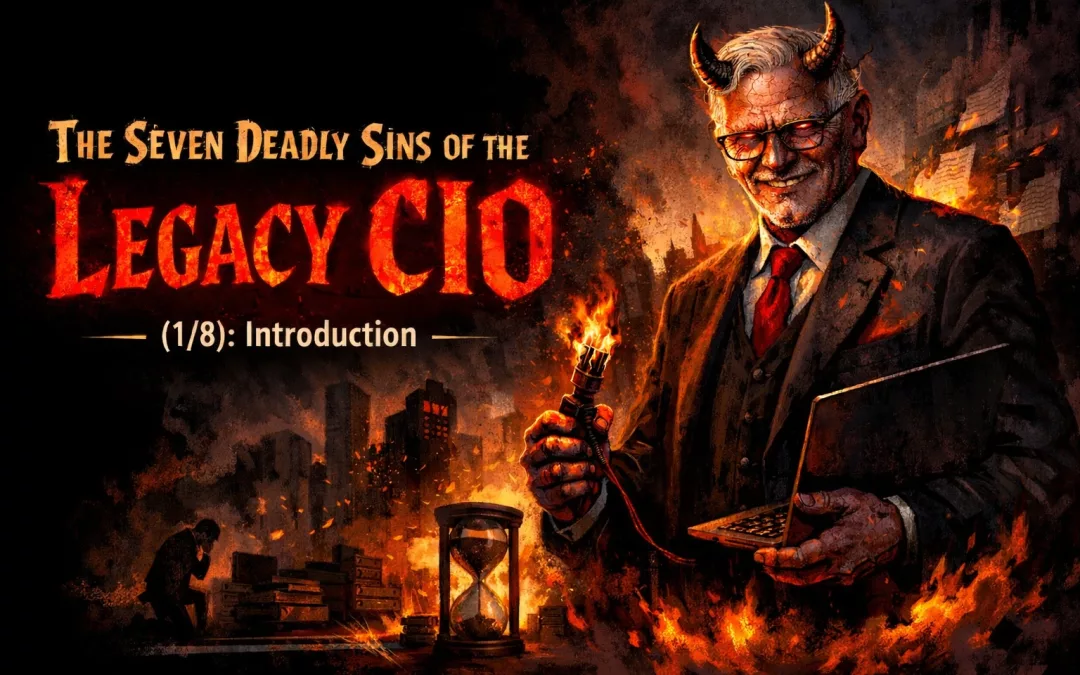
How outdated technology leadership sabotages digital transformation—and how a 700-year-old framework explains why.
I first read Dante Alighieri’s Divine Comedy many years ago, long before digital transformation became one of the most popular corporate concepts. Dante discussed seven fundamental flaws or defects that mankind possesses: pride, envy, wrath, sloth, greed, gluttony, and lust. These sins were described not just as theological conceptions but also as aspects of human nature. Dante claims that these defects influence how people behave, the decisions they make, and ultimately their fate.
Years later, I enjoyed watching Brad Pitt and Morgan Freeman in the film Se7en, which exploited these old ideas in a new 90s way. The story was dark and frightening, but what made it powerful was the same message Dante had delivered hundreds of years before: people do not change as much as we believe. The environment changes. The technology evolves. However, essential human instincts remain mostly unchanged.
As I worked in technology and digital transformation over the years, I began to see something fascinating. Modern organizations follow the same patterns that Dante described hundreds of years ago. Not in the dramatic way that literature and movies depict, but quietly, subtly, and often without anyone’s knowledge. They are particularly evident in the technology leadership of modern companies.
The Evolution of the CIO: From Operator to Strategist
Three decades ago, the CIO’s role was straightforward: stability, control, and cost management. It was the period of discipline, operational excellence, and centralized command. Success included keeping the lights on or just keeping the machine running.
Then the digital age exploded. Technology no longer serves as a support role and has evolved into the driving force behind corporate strategy. CIOs were suddenly expected to be visionaries, innovators, and disruptive forces. They are now expected to mix technical depth with strategic insight and stability with agility. The environment has been entirely redone. But have our leadership behaviors followed suit?
The ghost of the past still haunts many companies’ IT leadership styles. I refer to this figure as the Legacy CIO.
The Legacy CIO is not incompetent. Far from it. Many of them built impressive careers in a slower, more predictable technological era. But a leadership paradigm designed for stability is frequently unprepared for the turbulence of innovation or even the dynamics of a faster-changing business environment such as the one we live in now.
When a past-focused mindset confronts future-focused difficulties, some behavioral patterns emerge. Patterns that provide complication rather than clarity. Patterns that empty the enthusiasm of talented teams and undermine company confidence. Patterns that can destroy transformation from the inside out.
As time went on, I realized that these patterns were not random. They followed a remarkably familiar structure. They reminded me of Dante’s seven defects in people, which he wrote about centuries ago. Of course, not in the literal sense. But in a figurative sense.
The stresses of being a digital leader in today’s environment, such as board expectations, technological advances, limited budgets, vendor ecosystems, and office politics, can easily lead to people acting in ways that demonstrate these deeper human flaws, such as increased anxiety, poor decision-making, and conflicts with team members.
-
- Ego can distort priorities.
- Insecurity can drive imitation instead of vision.
- Reactive leadership can replace thoughtful strategy.
- Avoidance can delay necessary decisions.
- Complexity can be mistaken for progress.
- Technology can be mistaken for transformation.
- And leadership authority can slowly replace leadership purpose.
Each of these behaviors may appear simple to handle on their own. But when you put them all together, they form a pattern. A trend that can gradually knock even the most ambitious digital transformation off course.
This is not merely a guess. Most CEOs have seen it at least once during their careers. Big change programs that last for years but do not deliver the desired value. Technology landscapes are becoming increasingly complex rather than less complex. Smart engineers are leaving organizations because it is challenging to apply their ideas. Business leaders are losing faith in IT’s capacity to keep up with the fast-paced market. When this happens, organizations typically blame technology. However, the issue is typically unrelated to technology. It is usually leadership. Studies by McKinsey suggest that around 70% of digital transformation initiatives fail, and the causes are rarely technological. Leadership and organizational culture are usually at the core of the problem.
This made me look at Dante’s framework in a new way. Not as a moral tale from the Middle Ages, but as a surprisingly useful way to look at modern technology leadership.
The result is this series
Over the coming articles, I will explore what I call the Seven Deadly Sins of the Legacy CIO. Each article will examine one leadership pattern that frequently appears in technology organizations and explain how it can quietly undermine digital transformation.
But, more importantly, we will look into the remedy.
-
- How do we trade the pride of expertise for the humility of lifelong learning?
- How do we convert envy into gratitude for our own distinct strategic path?
- How can we shift from the wrath of a controlling attitude to being patient mentors?
The purpose of this series is to reflect on leadership patterns that are often the result of outdated assumptions, inherited structures, and leadership habits that were once effective but are no longer suited for today’s environment.
But the first and most critical step is to recognize these patterns within ourselves.
In the next article, we will begin exploring the first of these leadership sins.
And as Dante suggested centuries ago, it is the sin from which many of the others begin.
If this topic resonates with you, I’d love to hear what you think.
In my book Life in the Digital Bubble, I explore how AI and digital systems will reshape not only technology but also work, families, and society in the decades ahead.
And for organizations navigating these changes today, my digital transformation and AI consulting services focus on helping leaders move beyond scattered initiatives and build clear operating models that turn emerging technologies into real business value.