How lack of trust in self and team leads to borrowed strategies, imitation, and missed opportunities
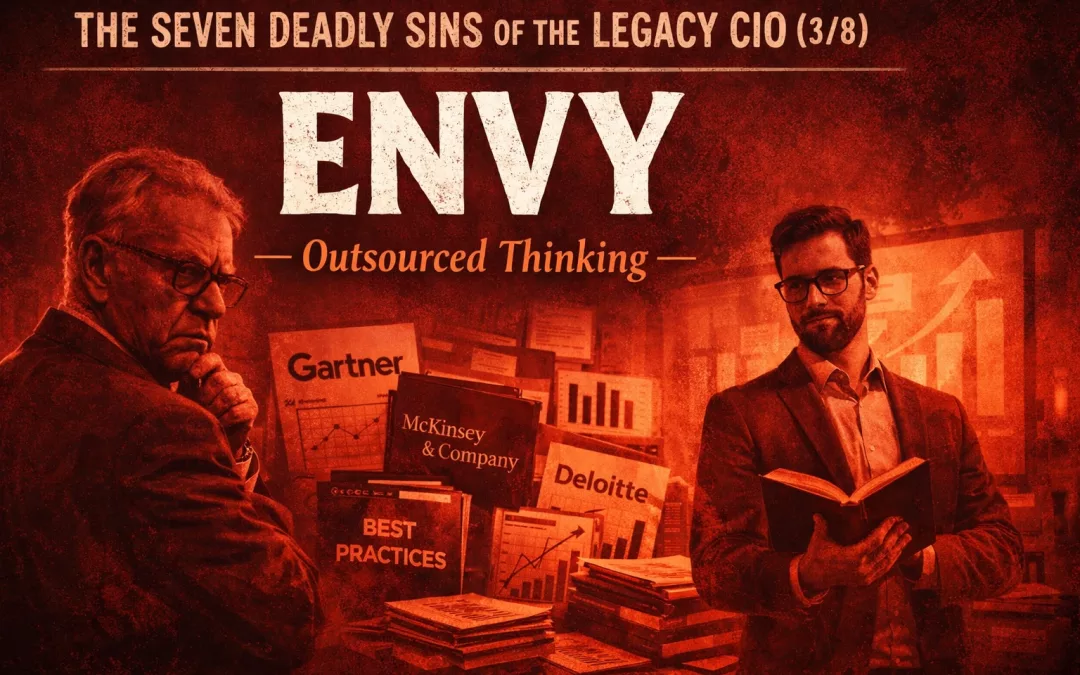
We’ve all seen them. The plans that look perfect on paper. The PowerPoint slides were full of Gartner quadrants, McKinsey frameworks, and industry standards. It looks like rigor to the board. It feels like a shopping list to the group.
This is the sin of **ENVY**.
In Dante’s Inferno, envy was defined as the distortion of perception through comparison. It’s not simply the petty jealousy of wanting what your competitor has. It is a deeper and more damaging failure: not being able to appreciate your own position, path, and abilities.
In modern technology leadership, envy is often seen as a good thing. It actually appears as a more acceptable but far more dangerous version of this, and I call it outsourced thinking.
When “Best Practice” Becomes a dependency
At first glance, it seems like many old IT plans can’t be changed. Industry frameworks, tier-one consulting models, and lots of benchmark data support them. Everything is in line with “best practice.”
But if you go to enough C-suite reviews, you start to see a worrying pattern. When you take away the vendor logos and the consultant boilerplate, one uncomfortable question comes up: “Where does the organization do its own thinking? ”
The Legacy CIOs work from a place that people don’t often talk about in public: a deep lack of trust. They distrust the organization’s maturity and the board’s ability to wait. More importantly, they don’t trust themselves or their own team.
This empty space inside creates a vacuum. Nature and business strategy both hate empty spaces. To fill the gap, the Legacy CIO does something that is expected of them: they outsource strategic thoughts by turning immediately to their trusted management consulting firm, whether it is Gartner, McKinsey, Deloitte, or Accenture, you name it.
The strategy is put together from outside sources instead of being based on the business’s unique culture, hidden assets, and specific path. We believe in the Gartner hype cycle as the truth. We copy the McKinsey deck. We try to keep up with the competitor’s cloud migration schedule.
Of course, none of these inputs are wrong by nature. But when they become the main and only source of direction, you lose the one thing that makes strategy work: ownership.
Strategy Becomes Assembly, Not Creation
When the Legacy CIO works out of envy, the strategy stops being a creation. It turns into an assembly. You take a piece from a consulting deck because it worked for a bank in Singapore. You take a piece from a benchmark report because your competitor has 90% API adoption. You take a piece from a trend analysis because AI is the thing right now.
You put these pieces together with glue.
The document that comes out looks complete. It looks like a plan. It doesn’t have any conviction, though. It doesn’t have the messy, hard, and specific logic of your business. And strangely enough, the Legacy CIO seems surprised and in shock when most of the strategy directives were not achieved after 5 years of executing that strategy.
When you borrow a strategy, it is weak. The strategy loses its anchor when the market changes, like when a competitor changes direction or a consulting contract ends. The organization never built an internal compass, so there isn’t one to fall back on.
The Hidden Driver: Internal Envy
This is where the sin of envy really starts to show up in the Legacy CIO. It’s not just aimed at competitors; it’s often aimed at their own team as well.
When a CIO doesn’t fully believe in their own abilities, it’s hard for them to believe in those of their employees. They don’t see strong people as a way to get more done; they see them as a source of discomfort, and you might actually find them complaining about not having the right people onboard.
Look closely at these organizations. You’ll see subtle behaviors:
- A principal engineer’s radical idea for a new architecture is put on hold because it wasn’t approved by a vendor first.
- People with a lot of potential as leaders are kept out of the boardroom.
- Influence is carefully controlled, not grown.
These behaviors are usually not clear. But over time, this envy inside makes things sterile. People stop being proactive when they realize that new ideas cannot lead to a real change. Look closely at these organizations. You’ll see subtle behaviors. The legacy CIO is too busy managing perceptions to mentor successors, so leadership depth doesn’t grow.
In the end, the most ironic thing happens: an organization that stops thinking for itself.
From Internal Distrust to External Dependency
You have to rely on the thinking outside of the building when you don’t trust the thinking inside. In the world of the Legacy CIO, this is the best time ever for consulting firms. These companies are not worthless; rather, they are being asked to do something they shouldn’t:
- take the place of the client’s judgment.
- Frameworks take the place of judgment.
- Benchmarks take the place of vision.
- Strategy is replaced by trends.
This makes the Legacy CIO feel safer. When making a decision, a Tier 1 analyst firm can support it. If a strategy is the same as a competitor’s, it’s “market standard.” It gives you a warm blanket of reasons when you sit in front of the board.
The Ceiling of Ambition
This brings us to the most damaging ceiling of all: the ceiling of ambition.
When you base your strategy on comparison, your goal is to catch up. Your goal is to be as good as your competitors. You want to be “as good as” the company that is the best in your field. But you hardly ever try to beat them in a way that matters to you.
In today’s world, this is a deadly mistake. The usual suspects are no longer the only ones who are competing. Disruption comes from new business models, different industries, and unexpected combinations of technology.
If you only look at visible benchmarks, like how much your direct competitor spends on the cloud or how many people work for the industry leader, you miss the threats that aren’t visible. You make plans for a war that already happened, but your enemy is making plans for a new battlefield.
The Real Cost of Envy
The cost of this pattern isn’t immediate. It doesn’t show up as a red line on a quarterly report. But it is structural, and it is devastating:
- Loss of Strategic Identity: You become indistinguishable from your competitors. If your strategy looks exactly like theirs, you’ve eliminated your unique advantage.
- Reduced Innovation: You can’t innovate by consensus. You can’t invent the future by copying the past.
- Dependency: You become addicted to external input. When the consultants leave, the momentum stalls.
- Underutilized Talent: Your best people didn’t join to implement a consultant’s blueprint. They joined to build. When they realize they are just assembly workers, they leave.
A painful gap starts to form over time. The technology function is missing something important; it’s empty at its core.
The Antidote: Trust as a Strategy
Being alone is not the answer to envy. I’m not saying we should fire all the consultants or burn the Gartner reports. For context, outside input is crucial. The answer is confidence.
- Trust in your own judgment.
- Trust in your team’s ability.
- Have the ability to question outside frameworks when they don’t fit your situation.
The modern CIO of today doesn’t ask, “What do the analysts say?” and then stop. They ask, “What do the analysts say, and how does that apply to our business situation? “
They don’t use external data to change their strategy; they use it to help them make decisions. They are brave enough to tell the board, “I know the industry is going left, but we need to go right for our business, and here is the unique advantage we will gain by doing so.”
The Legacy CIO starts with the question, “What are others doing, and how do we align?”
The Modern CIO starts with the question, “What is right for our organization, and how do we lead?”
It is a small shift in language but an enormous shift in outcome.
One leads to imitation. The other leads to differentiation.
One leads to safety. The other leads to resilience.
One leads to dependency. The other leads to ownership.
Closing Reflection
Dante described envy as the inability to appreciate one’s own place. In technology leadership, it manifests as the inability to trust one’s own direction.
If you look at your strategy and see a mirror of your competitors, if your roadmap is dictated by the calendar of a consulting firm, or if your team looks to external vendors for permission before pursuing bold ideas, you are living in the sin of Envy.
It is time to stop borrowing. It is time to start owning.
The market doesn’t reward the best imitator. It rewards the organization with the conviction to chart its own course.”
In the next article, we will explore the third sin:
Lust—The Architecture of Distraction.
And how the Legacy CIO, driven by control and visibility, creates complexity and competing initiatives that distract from real outcomes and weaken the organization’s ability to deliver transformation.
If this topic resonates with you, I’d love to hear what you think.
In my book Life in the Digital Bubble, I explore how AI and digital systems will reshape not only technology but also work, families, and society in the decades ahead.
And for organizations navigating these changes today, my digital transformation and AI consulting services focus on helping leaders move beyond scattered initiatives and build clear operating models that turn emerging technologies into real business value.