
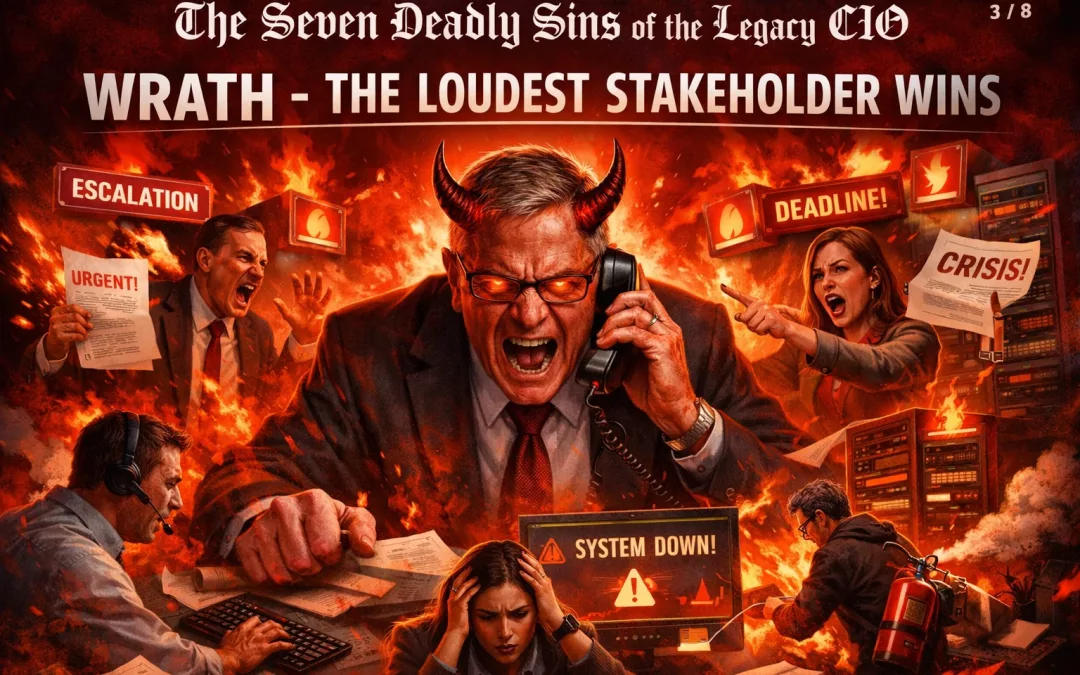
How reactive leadership, constant escalation, and system chaos quietly replace strategy
We all honor the technology leader who listens. The CIO who checks their email at 23:00. The person who jumps on every problem. The person who is always there, always fixing things, and always responding.
We call this commitment. This is what we mean by “leadership.” But in the context of the Seven Deadly Sins, this is a whole different story. This is Wrath.
Wrath in Dante’s Inferno was more than just anger. It was loss of control. A state in which reaction replaces reason, impulse replaces clarity, and the soul is influenced by external forces rather than directed by internal conviction.
Wrath doesn’t often show up as visible anger in the legacy CIO. It looks like something that is much more accepted and praised by peers and superiors, but on the other hand, it is something damaging for any modern organization, which I call “constant responsiveness.”
When Responsiveness Becomes Reaction
The Legacy CIO is often the organization’s hero at first. People say wonderful things about them because they are always there. They are the head firefighter, running from one important task to the next. They enjoy a good level of acceptance in the whole organization because they serve all and offer help and support all the time.
From the outside, this looks like hands-on leadership. It looks like commitment and dedication. But things are different inside the organization, a whole different truth most people do not notice. Every week, priorities change. Roadmaps are adjusted so often that they lose their meaning. Teams are worn out because they go from one urgent task to the next without ever finishing anything that matters.
And slowly, almost without anyone noticing, something critical disappears: “direction.”
The organization might be moving fast, but not in the right direction.
The Loudest Stakeholder Wins
When a legacy CIO operates in a state of wrath, prioritization is no longer a structured process. It becomes a gauge for pressure.
The stakeholder who makes the most noise gets attention. The most escalated issue gets priority. The most visible problem is the first one to be fixed, no matter how important or urgent it is to the strategy.
Everything needs to be done right away. Security patches, executive pet projects, and a small bug reported by a senior vice president all go into the same overflowing bucket.
When everything is urgent, nothing is strategic.
Some organizations think that motion is the same as progress. They think that doing things is the same as achieving them. The legacy CIO, stuck in this cycle, starts to think that this mess is just the cost of doing business in a complex world or abnormal industry situation.
The Illusion of Control
The Legacy CIO believes, “I am being responsive.” But in reality, they are being controlled.
They are controlled by:
- escalation
- incidents
- business pressure
- fragmented demands
In this case leadership is no longer defining direction; it is just reacting to noise. The legacy CIO has transformed into a highly compensated, highly skilled executive who allows the loudest voices to dictate their priorities.
A System, Not a Capacity Problem
When I talk to CIOs and IT leaders who are stuck in this cycle, they almost always say the same thing: “We just need more resources.” We have too much to do. There is too much demand.
This is the critical misunderstanding.
Of course the shortage of resources is a major factor, but it is not the core issue. Firefighting is not a problem with capacity. It is a problem with the system.
You can’t hire your way out of trouble. Putting more people into a broken system doesn’t fix it. It just makes things more chaotic by adding more people, which makes it harder to coordinate, more communication problems, and more fires.
Firefighting is not a capacity problem. It is a system problem.
The Real Drivers of Chaos
Across the organizations I have observed, the same patterns appear again and again. These are not isolated issues. They are systemic failures that create the conditions for wrath: lack of clear prioritization
- Lack of clear prioritization. No single source of truth for what matters most.
- Weak operating models. Unclear who does what and how work flows.
- Unclear separation of responsibilities. The lines between “run,” “grow,” and “transform” are blurred.
- Increasing tool and system complexity. More tools mean more noise, more context switching, more cognitive load.
- Insufficient governance. No mechanism to say “no” or “not yet.”
- Unstructured communication. Information flows through Slack, email, meetings, and escalations with no discipline.
These are not isolated issues. These aren’t technical issues. There are problems with the structure. And they make it so that reacting is the normal way to do things.
The Cost of Wrath
The effects of this pattern are slow to show up, but they are disastrous. Teams get stuck in a cycle of putting out fires. Burnout becomes a common problem. People stop believing that strategic initiatives will ever be finished because they lose steam so often. Delivery becomes unreliable, which hurts the trust between IT and the business.
And as time goes on, something deeper happens: the company stops moving forward, or at least its IT department does.
Not because they didn’t try hard enough. The work is huge. The effort is what is wrong. The department is putting all of its energy into staying alive and has no time for growth.
Wrath in leadership is not an emotional failure. It is a structural failure.
This is what happens when priorities aren’t kept safe. When systems aren’t built to be strong. When enforcement of governance is not done because it seems “political.”
Instead of being intentional, leadership becomes reactive. The legacy CIO is no longer in charge of the ship. They are just getting rid of water pouring from the ship’s body.
And this is the worst part: people often praise the legacy CIO for this. People praise them for being the one who “keeps the lights on.” “But being in charge doesn’t mean keeping the lights on. It is maintenance. And maintenance, no matter how heroic, doesn’t give you an edge over your competitors.
From Firefighting to Flow
The solution is not to work harder. The solution is to redesign the system.
Moving from firefighting to flow requires structural discipline, not heroism. It requires:
- Clear prioritization aligned with business value. One list. One owner. No ambiguity.
- Structured operating models with defined responsibilities. Everyone knows their role, and work flows predictably.
- Simplified system landscapes. Complexity is the enemy of stability.
- Strong governance supported by trust. Governance is not bureaucracy. It is the discipline of focus.
- Stable and optimized processes. Predictability enables innovation.
This is not theoretical. It is practical. And it is achievable. But it requires the CIO to stop being the firefighter and start being the architect.
Closing Reflection
Dante described wrath as when you lose control of yourself. In modern IT leadership, this loss of control is not often emotional. It is systemic. It is easily noticed in the regular shift of priorities and constant escalations. And the result is clear: activity increases, but results do not.
People praise the legacy CIO for being responsive. But being responsive isn’t a good thing when it turns into reaction. It is a sin. It is giving up strategic leadership for the false illusion of control.
The organization doesn’t need a firefighter who works faster. It needs a leader who is willing to change the system so that fires don’t start in the first place.
In the next article, we will explore the fourth sin:
Sloth—Ignoring Shadow IT.
And how avoidance, rather than action, allows complexity and risk to quietly spread across the organization.
If this topic resonates with you, I’d love to hear what you think.
In my book Life in the Digital Bubble, I explore how AI and digital systems will reshape not only technology but also work, families, and society in the decades ahead.
And for organizations navigating these changes today, my digital transformation and AI consulting services focus on helping leaders move beyond scattered initiatives and build clear operating models that turn emerging technologies into real business value.