
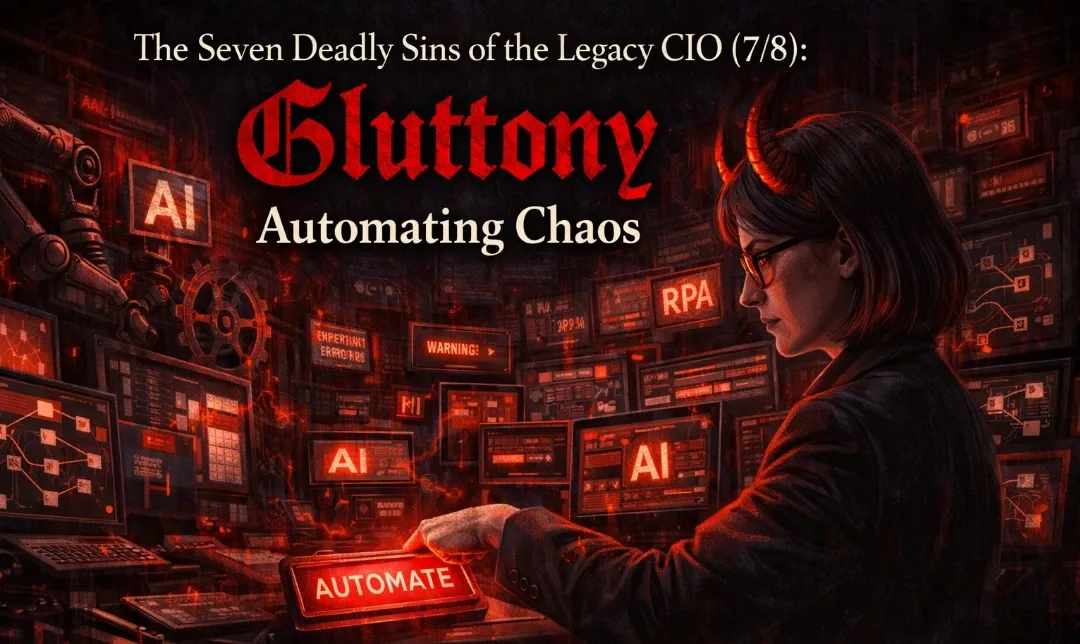
How applying automation and AI to broken systems accelerates problems instead of solving them
In Dante's Divine Comedy, Gluttony is more than just eating too much. It has to do with eating too much without being able to stop. Taking in more than you can handle. Growing without any rules. Eating without knowing.
This understanding of gluttony is important because it shows a pattern that is becoming dangerously common in technology leadership. The behavior has taken on a new and powerful form, not in food or drink, but in the uncontrolled use of technology. And the effects are often hidden under the surface of what looks like progress.
Automation is everywhere these days. AI co-pilots. Engines for workflows. Automation of robotic processes. Platforms with low code. It seems like every problem has a tech-based solution. It seems that automation can fix any problem that isn't working right.
It's clear that CIOs are under a lot of stress. Get going faster. Do more things automatically. Use AI now. Vendors also push this message. Business leaders want it. The fear of falling behind makes you feel like you have to do something right away. And in this setting, the urge to use every new feature becomes too strong to resist.
The Legacy CIO responds quickly. A process is slow? Automate it. A workflow is complex? Digitize it. A decision is manual? Apply AI. At first, this feels like progress. Things move faster. Output increases. Dashboards light up with impressive metrics.
But something deeper stays the same. The issues that made the process slow, complicated the workflow, or made decision-making difficult have not been resolved. They've just been covered up. And this is where the risk lies. The legacy CIO just covers the wound with a plaster, but it may be rotting underneath. The legacy CIO in this case does not solve the problem; he covers it or even makes it bigger.
The Uncomfortable Truth
Automation does not fix problems. It amplifies them. This is an uncomfortable truth that many leaders prefer to ignore. If a process is unclear, automation makes it consistently unclear. If data is wrong, AI makes it faster and more scalable wrong. If responsibilities are blurred, systems make confusion more efficient.
The technology doesn't care about the quality of what it's doing. It just does it faster. So the problems that should have been fixed before automation are now worse and happen faster. What used to be a small problem turns into a big problem very quickly.
But of course I am not saying that automation is bad; actually,
automation is the best thing that can happen on top of processes and systems that are healthy; otherwise, it is just another level of burden.
The AI Illusion
This becomes even more dangerous with AI. AI systems rely on data quality, clear logic, and defined outcomes. Without these foundations, AI does not create intelligence. It creates an illusion.
The outputs look real. It looks like decisions are made automatically. The organization feels like it has done something important. But the same problems are still there. Now they're just behind a smarter interface. Also, the problems are harder to find and fix because the interface looks complicated.
This makes things very dangerous. Organizations get faster, but not better. There is more production. More things to do. More automated. But no real change in the results. Going fast without a plan doesn't get you anywhere. It makes things more confusing.
Teams get busier, but they don't get better at what they do. Systems make more, but they don't give as much value. The team thinks that doing things is the same as achieving things. And the faster it goes, the less meaningful the results become.
The Real Cost
The effects of this pattern are very bad. With faster chaos, problems spread across systems right away. It used to take weeks for things to spread, but now it only takes minutes. Scaling errors means that mistakes are no longer one-time events. One mistake in data can cause problems in dozens of automated processes.
People stop trusting you. People who work in business stop trusting what the system says. When automation keeps giving wrong results, people lose faith in it. And wasted money adds up. The organization spends a lot of money on AI and automation, but gets activity instead of value.
And most importantly, the organization becomes less clear. It's almost impossible to figure out what's really going on when broken systems run at high speeds. The problems are hidden by the complexity, and the speed makes them harder to find.
Gluttony in leadership is not about using too much technology. It is about using technology without discipline. It is the desire to consume every new capability. AI. Automation. Digital platforms. Without asking the essential question: “Are we ready for this?"
The inability to pause, to evaluate, and to fix before accelerating is what separates disciplined leadership from the reckless consumption of the legacy CIO. And the cost of this lack of discipline is paid across the entire organization.
From Acceleration to Discipline
The solution is not to reject automation. Automation and AI are powerful tools that can deliver tremendous value. The solution is to apply them intentionally.
- Fix Before Automating: Before any automation, clarify the process, define ownership, and remove unnecessary steps. Automation should improve a system, not compensate for a damaged one.
- Data Discipline: No AI without clean data. No automation without consistent inputs. Data quality is not a technical detail. Without it, no amount of automation will deliver reliable results.
- Selective Automation: Not everything should be automated. Some processes require human judgment, flexibility, and contextual decision-making. Automation should be applied where it adds value, not everywhere simply because it is possible.
- Outcome Focus: The goal is not speed. The goal is impact. Modern CIOs don't ask how much they can automate. They want to know what result they are improving. Moving quickly without a plan is not progress. The legacy CIO wants to know, "What can we make automatic?" The modern CIO asks, "What do we need to fix before we automate?" This shift is crucial. One speeds up chaos. The other makes things clearer. One puts consumption first. The other one puts foundation first.
Closing Reflection
Dante described gluttony as excess without control. In today's IT leadership, this looks like speeding up without control. More automation. More AI. More speed. All were done with the goal of moving forward. But not with discipline.
And over time, the outcome is clear. Things happen faster, but understanding goes down. Trust begins to fade. The organization gets better at making the wrong choices. Not because technology didn't work, but because it was not used for a good reason.
The way forward is not to slow down. It is to build first and then speed up. First, fix it, then automate it. To bring discipline to consumption. Because speed built on broken foundations does not create progress. It creates chaos at scale.
In the next article, we will explore the sixth sin:
Lust—Power Over Purpose.
And how the desire for control, visibility, and influence can shift IT leadership away from its true purpose.
If this topic resonates with you, I’d love to hear what you think.
In my book Life in the Digital Bubble, I explore how AI and digital systems will reshape not only technology but also work, families, and society in the decades ahead.
And for organizations navigating these changes today, my CIO advisory focus on helping leaders move beyond scattered initiatives and build clear operating models that turn emerging technologies into real business value.
Get my latest articles in Google
Add tamerbadawy.com as a preferred source to see more of my articles in Google Search and AI results.