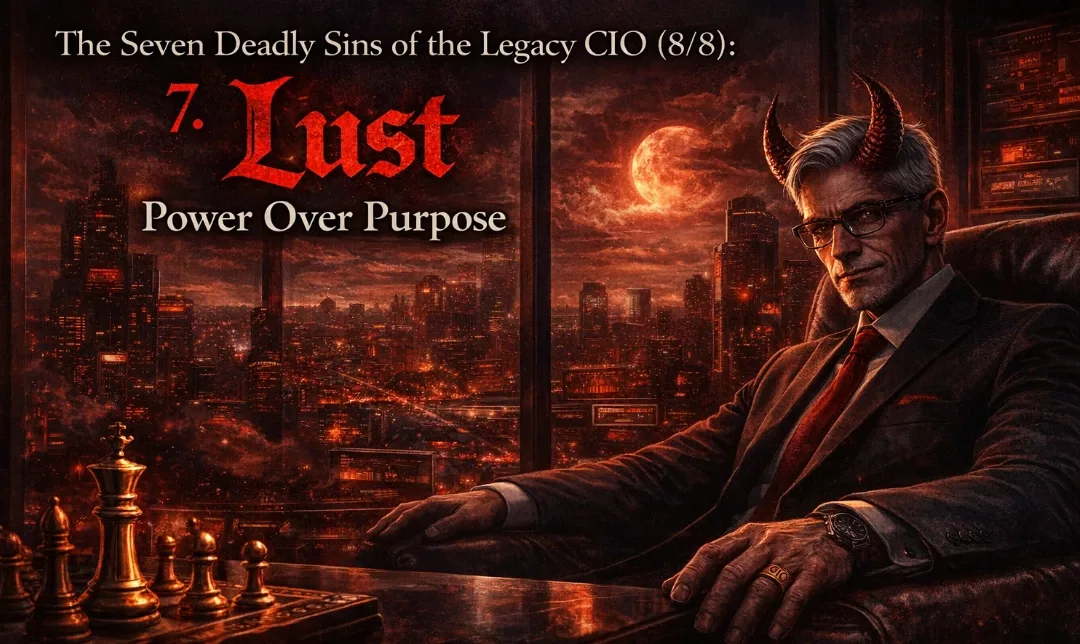
How the desire for control, visibility, and influence shifts IT leadership away from its true role
In Dante's Divine Comedy, Lust is more than just desire. It's a misguided desire. A force that takes your mind off of what really matters. A focus on getting what you want right away instead of long-term goals. A disconnect between what you want to do and what you actually do.
This comprehension of Lust is crucial as it uncovers the most sophisticated and deadly weakness in technological leadership. It doesn't look like laziness or incompetence. It looks like success. But underneath, the focus has changed from helping the business to helping the self.
At some point, the role of the CIO can begin to shift. Not in title. Not in responsibility. The focus shifts from empowering the business to managing the organization. From making things better to keeping power.
This change is rarely made public. The leader doesn't wake up one day and decide to put himself first. It happens slowly, almost without anyone noticing. Because the outside behaviors look like strong leadership, they often go unnoticed until it's too late.
At first, this change is hard to see. It begins with small patterns. Wanting to see everything that is going on. Ensure that he is making all decisions. Increasing control over budgets, teams, and systems. There is a reason for these actions. They can even look like strong leadership. A CIO who wants to be a part of everything can seem interested and dedicated. A CIO who makes all the decisions in one place may seem to be making sure that things are of high quality and consistent. But the reason changes over time. It starts as a desire to help, but then it turns into a need to control.
Control Over Contribution
The Legacy CIO starts to look at success in a new way. Not by results, business value, or effect. But by how much control they have, how big their organization is, and how visible they are in making decisions. Instead of asking "what value do I create?" the question becomes "how much do I own?"
This changes the meaning of success in a big way. When control is the goal, every choice is made with the CIO's power in mind. People support new projects not because they add value, but because they give them more power. Teams grow not because they need to, but because bigger is better.
This creates a pattern that we all know. Centralizing decisions that were previously distributed. Expanding IT boundaries to absorb adjacent functions. Bringing more and more under direct control. Not always because it benefits the organization, but because it increases control.
There are logical reasons for each expansion. Consolidation will make things work better. Centralization will guarantee consistency. Putting things together will lower risk. But underneath the surface of reason, there is something else that drives it. The desire to have more. To be more important. To be indispensable.
The Loss of Purpose
This initially gives the impression of strength. IT is the conduit for everything. There is centralization of decision-making. Visibility rises. The organization appears to be controlled and in order. However, the expenses start to mount beneath the surface.
Every decision needs central approval, which reduces agility. Ideas are filtered through layers of control, which slows innovation. When business units feel constrained rather than supported, trust vanishes. Collaboration is replaced by control, and the organization grows weaker rather than stronger.
This is the point at which lust turns harmful. The initial goal of IT leadership is evident. to make the business possible. to add value. to encourage change. The role exists for these reasons. However, purpose wanes when power takes precedence.
Maintaining control becomes more important to the legacy CIO than producing results. Instead of being a system to be enabled, the organization becomes a structure to be managed
Leadership is not about how much one controls. It is about how much value one enables. This distinction separates the Legacy CIO from the modern CIO. One measures success by the size of their kingdom. The other measures success by the impact they create.
In leadership, lust has nothing to do with ambition. It has to do with misplaced ambition. the urge to take center stage. to be seen. to be essential. rather than strengthening the organization. The leader's desires take precedence over the organization's needs. And everything is altered by that change, no matter how small.
From Power to Purpose
The solution is not to reduce leadership. It is to realign it.
- Enable, Don't Control: IT should empower the business, not restrict it. The role of technology leadership is to remove obstacles, not create them. To provide capabilities, not permissions.
- Distribute Ownership: Decisions should happen where knowledge exists, not only at the top. Empowering teams to make decisions accelerates the organization and builds capability.
- Focus on Outcomes: Measure success by business impact, value delivered, and problems solved. Not by scope of control or size of organization.
- Let Go: Strong leaders are not those who hold everything. They are those who know what to release. The ability to let go of control is the mark of true confidence.
Closing Reflection
Dante described lust as desire without direction. In modern IT leadership, this appears as power without purpose. The role becomes larger. The influence becomes greater. The visibility increases. But the impact declines. Not because of lack of effort, but because the focus has shifted.
Final Reflection on The Full Journey
The Legacy CIO does not fail suddenly. They decline in stages.
Pride: stops seeing reality
Envy: stops trusting themselves
Wrath: reacts instead of leads
Sloth: avoids what matters
Greed: accumulates without discipline
Gluttony: accelerates chaos
Lust: loses purpose
Every sin builds upon the previous one. Every setback increases the others. And the outcome is a gradual drift away from what matters rather than a single catastrophic event.
The future CIO is not defined by control. But by clarity, discipline, trust, and purpose. The future CIO understands that technology does not transform organizations. Leadership does.
This concludes the Seven Deadly Sins of the Legacy CIO series. Thank you for following the journey.
If this topic resonates with you, I’d love to hear what you think.
In my book Life in the Digital Bubble, I explore how AI and digital systems will reshape not only technology but also work, families, and society in the decades ahead.
And for organizations navigating these changes today, my CIO advisory focus on helping leaders move beyond scattered initiatives and build clear operating models that turn emerging technologies into real business value.
Get my latest articles in Google
Add tamerbadawy.com as a preferred source to see more of my articles in Google Search and AI results.