Every case in this series so far has been a cautionary one: BMW backing off a bad idea, Lidl writing off half a billion, Air Canada losing in tribunal, the BBC losing to Parliament, Volkswagen paying Rivian to fix what it couldn't build. This week's episode breaks that pattern. This one worked, and it's the only story in the series that did.
Right now, somewhere in your organization, someone is exporting data out of the system you just spent months rolling out, into a spreadsheet, because the spreadsheet still works better for them. That export is a quiet vote against your transformation, and it's the real reason this step exists: you can hit every milestone, launch on schedule, and still watch the organization keep doing things the old way underneath a newer interface.
Roche, one of the oldest healthcare companies in the world, ninety-thousand-plus employees, faced a familiar problem: biosimilar competitors closing in, an unprecedented run of new medicines to launch, and digital reshaping how medicine gets researched and prescribed, all at once. Most organizations respond with a new operating model, a reorg, a system rollout, then a change management deck explaining the new operating model. Roche didn't. They built a four-day leadership program called Kinesis and sent their senior leaders through it first, before touching structure at all.
Change happens on three levels, and only one of them is visible
Structure is the part that gets announced: roles, processes, systems, decision rights. It's the part every transformation plan documents in detail, and the part most leadership teams treat as the whole job.
Culture is how the organization actually behaves day to day, underneath the org chart, the norms, the trust between teams, the patterns leaders actually follow rather than the ones they publish.
The individual level is skills, mindset, and confidence, and it's where adoption genuinely happens or doesn't. Most organizations update the structure, deploy the system, redesign the operating model, and then wonder why nothing changed. The formal structure moved. The way people actually work didn't.
Roche started at the third level, with its most senior leaders, examining their leadership style before a single process changed. Structure followed the individual shift, not the other way around. Follow-up workshops were offered, in Roche's own words, as an invitation, not an expectation. Nobody was ordered into new ways of working. Tammy Lowry, the architect of the program, called the result a revolution nobody was forced to join. Agility is now deployed across tens of thousands of people at Roche, and it started with leaders spending four days looking at themselves before asking anyone else to change.
People don't resist change. They resist loss.
People adapt constantly, new tools, new routines, whenever the benefit is obvious. What they resist is what they believe they're losing: competence, control, clarity, status, time, meaning. Leadership sees efficiency; employees may feel pressure. Leadership sees standardization; teams may feel a loss of flexibility. Leadership sees better data; people may feel watched. Neither side is wrong. The gap between what leadership sees and what people experience is the actual job of change management, and clarity closes it faster than more communication does.
Five practices, one honest caveat
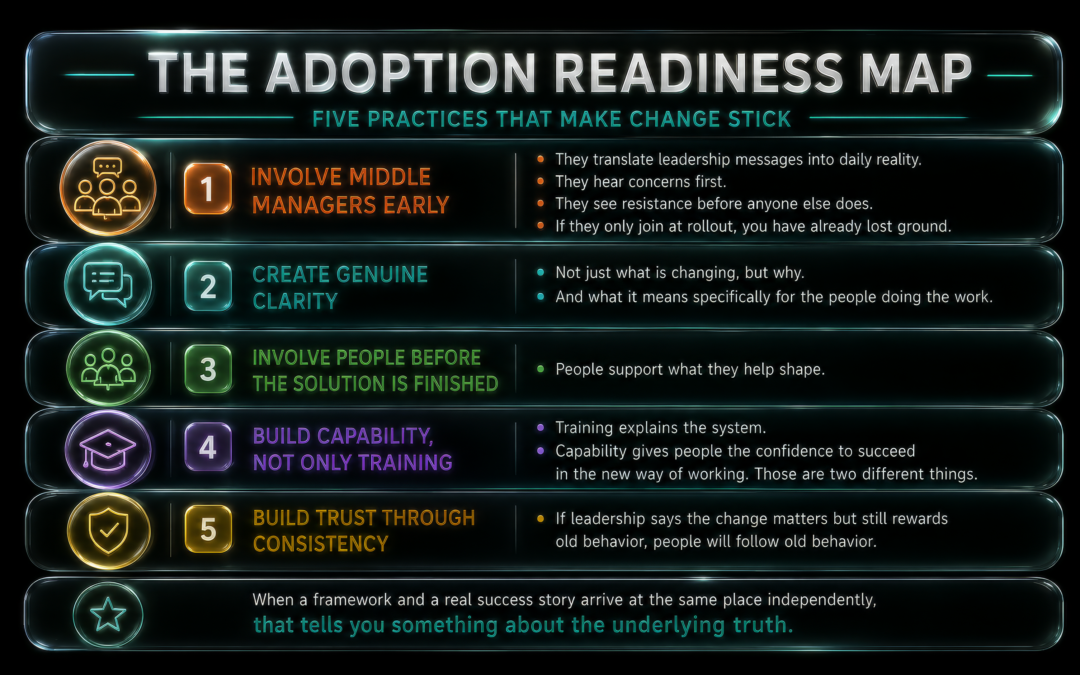
The Adoption Readiness Map behind this episode wasn't built from Roche's story. It came first, from patterns across many transformations, most of which didn't go nearly as well. Roche just happened to independently land on two of its five practices, which is its own kind of evidence.
- Involve middle managers early, they translate leadership's message into daily reality and see resistance before anyone else does.
- Create genuine clarity, not just what's changing, but why, and what it means for the person doing the work.
- Involve people before the solution is finished, people support what they help shape.
- Build capability, not only training, training explains the system, capability gives people the confidence to actually use it.
- Build trust through consistency, if leadership says the change matters but keeps rewarding the old behavior, people will follow the old behavior.
Go-live isn't the finish line. The real evidence is whether the new process is actually used correctly, whether manual workarounds are decreasing, whether decisions are getting faster, whether people feel confident, not whether the project team says it's done.
What's coming
Step nine, the 20th of October, closes the entire series: whether an organization can keep evolving once the program officially ends.
You can run the Adoption Readiness Map on your own organization now, or follow the rest of the series at the series hub.
Step nine, the 20th of October, closes the entire series: whether an organization can keep evolving once the program officially ends. You can run the Adoption Readiness Map on your own organization now, or follow the rest of the series at the series hub.
Get my latest articles in Google
Add tamerbadawy.com as a preferred source to see more of my articles in Google Search and AI results.