MAKE CHANGE HAPPEN
Change Management: Every Export Is a Quiet Vote
In short: Change Management is Step 8 of the Digital Transformation for Leaders framework. It tests whether people actually changed how they work, not just whether a system went live, using the same practices that made Roche’s leadership transformation stick.
WHAT YOU WILL LEARN
- Why Roche started its transformation with leaders’ minds, not a new system
- The real reason people resist change, and why it’s rarely the change itself
- The three levels where change either sticks or quietly fails
- The five practices that separate adoption from a system nobody actually uses
← Back to the full series
Read the full transcript
Every Export Is a Quiet Vote Against Your Transformation
Somewhere in your organization right now, someone is exporting data from your new system into a spreadsheet. Not because they are lazy. Because the spreadsheet still works better for them. And every one of those exports is a quiet vote against your transformation. The question is not whether your system went live. The question is whether anyone changed how they work.
Welcome back to Digital Transformation for Leaders, a journey from insight to strategy to execution. We are in Phase 3: Make Change Happen. In the previous episode, we looked at project management, turning the plan into delivered value. Today we tackle the more challenging aspect of execution: bringing people along. Because you can deliver every milestone, hit every deadline, and still change nothing.
And for a change in this series, the story I brought you is not a failure. It is one of the best change management stories I know. And it comes from right here in Switzerland.
Roche Changed Minds Before It Changed Systems
In Basel sits one of the oldest healthcare companies in the world, Roche. More than 90,000 employees in over 100 countries. A few years ago, Roche faced a moment many of you will recognize. Biosimilar competitors were entering the market, while the company was launching an unprecedented number of new medicines. And digital was changing the way medicines were researched, developed, and prescribed. There was a huge amount of change in a short period of time.
Now, here is what makes this story worth your attention. Roche did not start with a new structure. Not with a new system. Not with a reorganization announcement. They started with their leaders’ minds. They built an immersive program for senior leaders called Kinesis. Leaders spent days examining their own leadership style, and how their own mindset shaped the organizations they led. Not slides about a new operating model. Leaders teaching each other, and working on themselves first.
And then comes my favorite part. The follow-up workshops for leadership teams were offered, in Roche’s own words, as an invitation, not as an expectation. Nobody was ordered into the new ways of working. Leaders were invited to explore their own experiments with their own teams. And it spread. Leaders came back from the program showing up differently, and their organizations noticed.
Today, agility is widely deployed across Roche, with tens of thousands of people applying new ways of working. Tammy Lowry, Roche’s Global Head of Talent Innovation and the architect of the program, summed it up in three words. It’s a revolution. A revolution nobody was forced to join. They did not push change onto people. They invited people into it.
You Are Not Deploying a System. You Are Moving People.
As technology leaders, we spend most of our time focused on systems. Platforms, integrations, data, security, governance. All of that matters. But I have learned that transformation is not primarily a system change. It is a human transition from one way of working to another. From familiar tools to unfamiliar ones. From local habits to shared standards. From manual workarounds to structured processes. From knowledge held in someone’s head to knowledge visible in a system.
People are not just learning a new tool. They are adjusting how they work, how they make decisions, and how they feel competent in their role. Sometimes they are adjusting how they understand their own value in the organization. Change management is not a communication plan. It is leadership work.
People Do Not Resist Change. They Resist Loss.
We often hear that people resist change. I think that is incomplete. People change all the time. They learn new tools. They adapt to new services. They change routines when the benefit is clear. What people resist in organizations is what they believe they are losing. Loss of competence. Loss of control. Loss of clarity. Loss of trust, status, time, or meaning.
And this creates a gap I have seen in many transformations, across industries and organization sizes. Leadership sees efficiency. Employees may see pressure. Leadership sees standardization. Teams may see lost flexibility. Leadership sees better data. People may see more monitoring.
The antidote to resistance is clarity. Not more communication. Clarity. Clarity about what is changing, why it is changing, and what it means for the person doing the work. Good change management connects what leadership sees with what people experience.
The Change You Announced Is Not the Change That Happens
Change happens on three levels. The first level is structure: roles, processes, systems, decision rights. The visible part of change. The part that gets announced and documented. The second level is culture: how the organization actually behaves day to day. The norms, the trust between teams, the leadership patterns people actually follow. The third level is the individual: skills, mindset, confidence, motivation. This is where adoption either happens or it does not.
Most organizations focus heavily on structure. They update the process, deploy the system, change the operating model. Then they wonder why adoption is slow. The formal structure changed. The way people work did not change yet.
Roche understood this. They started at the third level, the individual, with their most senior leaders. And only then did structure and ways of working follow. Culture and individuals are where the old way of working persists, or finally changes.
The Five Practices That Make Change Stick
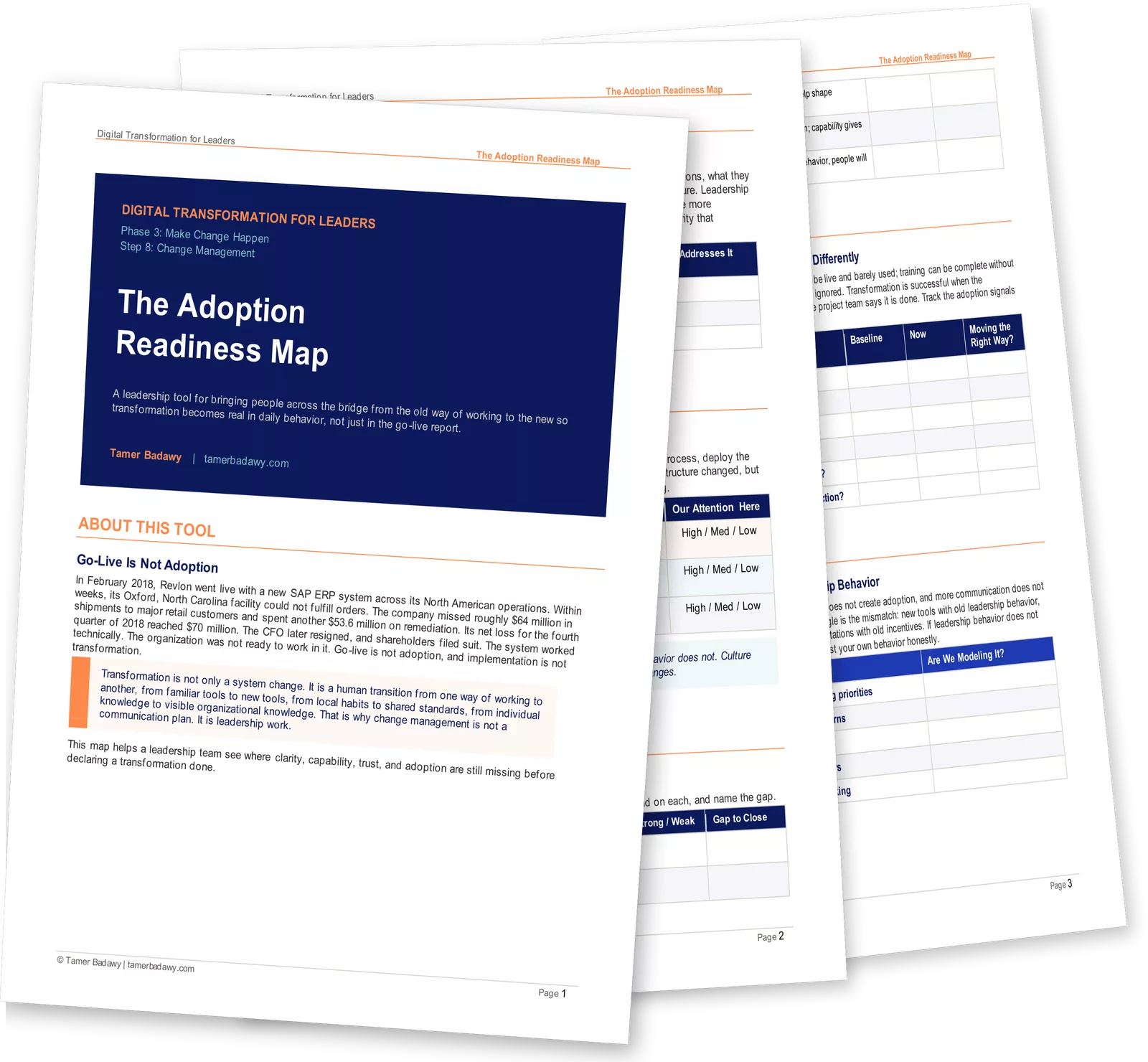
In practice, the transformations I have seen succeed do five things well. I have organized them into a tool I call the Adoption Readiness Map.
The first practice is involving middle managers early. They translate leadership messages into daily reality. They hear concerns first. They see resistance before anyone else does. If they only join at rollout, you have already lost ground.
The second practice is creating genuine clarity. Not just what is changing, but why, and what it means specifically for the people doing the work.
The third practice is involving people before the solution is finished. People support what they help shape.
The fourth practice is building capability, not only delivering training. Training explains the system. Capability gives people the confidence to succeed in the new way of working. Those are two different things.
And the fifth practice is building trust through consistency. If leadership says the change matters but still rewards old behavior, people will follow old behavior.
Now, one honest note. I did not build this map from the Roche case. It comes from patterns I have observed across many transformations, most of which did not go as well. But when I studied what Roche did, I was genuinely impressed by how closely two of their choices match this map. They involved people before the solution was finished, the invitation instead of the mandate. And their leaders modeled the change first, before asking anyone else to change. When a framework and a real success story arrive at the same place independently, that tells you something about the underlying truth.
If You Cannot Measure Adoption, You Are Guessing
Change management should not be treated as a soft activity. It needs evidence. A system can be live and barely used. Training can be completed without creating confidence. A process can be documented and still be ignored. So leaders need evidence of adoption, not just evidence of go-live.
Are people using the new process correctly? Are manual workarounds decreasing? Is data quality improving? Are decisions becoming faster? Do people feel confident working in the new environment? Are business outcomes moving in the right direction? These are the signals the Adoption Readiness Map is built around.
Transformation is not successful when the project team says it is done. It is successful when the organization works differently and better.
New Tools Cannot Run on Old Leadership Behavior
In digital transformation, leadership must also change. More reporting does not automatically create trust. More control does not automatically create adoption. More communication does not automatically create understanding.
Leaders need to become visible in the change. Explain priorities. Repeat the purpose. Listen to concerns. Remove obstacles. Make decisions. Model the behaviors they expect from others.
This is where many transformations struggle most. New tools, old leadership behavior. New processes, old decision habits. New expectations, old incentives. If leadership behavior does not change, organizational behavior will not change either.
One Step Left. And It Ends Differently.
The Adoption Readiness Map includes a seven question diagnostic a leadership team should be able to answer with evidence before declaring a change adopted. If you want to work through this framework with your leadership team, it is available at tamerbadawy.com, free to download.
In the next episode, we reach the final step of the journey: continuous improvement. The question there is simple and uncomfortable. Can your organization keep evolving after the program ends? That is Step 9, and it is where the Continuous Improvement Engine comes in.
Roche showed us what it looks like when people come along. In the final episode, we will see what it looks like when an organization never stops. Digital transformation is not about technology. It is about bringing people along so the organization changes how it works, not only what it uses. I look forward to seeing you in the final episode.
The Case: Roche’s Kinesis Program
Roche, based in Basel, faced serious pressure: biosimilar competitors entering the market, an unprecedented wave of new medicines launching, and digital reshaping how medicines get researched and prescribed. Most companies respond to that kind of pressure with a new structure or a new system.
Roche built Kinesis, an immersive program where senior leaders examined their own leadership style first. The follow-up sessions for their teams were framed as an invitation, not a mandate. Roche expected 5 to 10 percent of leaders to run a similar session with their own teams afterward. 95 percent did.
Source: McKinsey, 2020
KEY TAKEAWAYS
- People rarely resist change itself. They resist what they believe they’re losing: competence, control, clarity, or status
- Structure is the visible part of change. Culture and the individual are where adoption actually happens or quietly fails
- Roche’s real advantage wasn’t the program’s content. It was framing every follow-up as an invitation, not an order
The Tool: Adoption Readiness Map
Adoption Readiness Map
A tool built around five practices that separate transformations that stick from ones that quietly get worked around, with a seven question diagnostic for evidence of real adoption.
Run This Diagnostic
Evidence of Adoption, Not Just Evidence of Go-Live
Answer these with real evidence, not assumption, before declaring any change adopted.
-
- Are people using the new process correctly?
- Are manual workarounds decreasing?
- Is data quality improving?
- Are decisions becoming faster?
- Do people feel confident working in the new environment?
- Are business outcomes moving in the right direction?
- If leadership stopped watching tomorrow, would the new way of working still hold?
Frequently Asked Questions
What is an Adoption Readiness Map?
Why did Roche start with leadership mindset instead of a new operating model?
What’s the difference between training and capability?
UP NEXT
Publishes October 20
Step 8: Continuous Improvement
Roche showed us what it looks like when people come along. In the final step, we look at what it looks like when an organization never stops.
Tamer Badawy
Strategic IT and Digital Transformation Leader,
Author of Life in the Digital Bubble.
9 episodes. 9 downloadable frameworks.
Built from 25 years of running transformation programs in enterprise IT.