PLAN THE CHANGE
Strategy: Aligning Transformation with Purpose
In short: Strategy is Step 4 of the Digital Transformation for Leaders framework. It forces your leadership team to name where you sit on the value ladder today, what you’ll deliberately stop doing, and whether you’re strengthening or weakening your position in a wider network of value.
WHAT YOU WILL LEARN
- Why Rolls-Royce had to ask what customers were actually paying for, before any technology decision
- Why five executives can each describe your value driver differently, and what that gap costs
- The fifteen minute test that exposes whether your strategy is real or just a wish list
- The six questions to answer before approving another digital initiative
← Back to the full series
Read the full transcript
Your Strategy Document Has a Problem
Pull up your digital strategy document right now. Find the technology section. AI, cloud, automation, data platforms. Delete all of those words. What’s left? If your answer is not much, then you do not have a digital strategy. You have a shopping list. Shopping lists do not tell you where you’re going. They only tell you what you plan to buy.
Welcome back to Digital Transformation for Leaders. This is Phase 2, Plan the Change. In Phase 1, we recognized potential. We looked at society, technology, and evaluation. We looked outside, then inside. Now, in Phase 2, we move from seeing clearly to choosing deliberately. Now the hard questions start. Not what to buy. Not what to build. But what direction to choose, what to prioritize, what to deliberately leave behind. That is strategy. And most of the organizations I work with confuse it with planning. Yours may too.
The Case That Reveals the Real Problem
Let me start with a case that changed how I think about digital strategy. For decades, an engine manufacturer like Rolls-Royce operated in a straightforward model. Build engines, sell engines, maintain engines. Revenue comes from the asset. The airlines told them something uncomfortable. We do not want engines. We want aircraft in the air. We want reliability, predictable cost, guaranteed availability. We want the risk off our books.
So Rolls-Royce built TotalCare, and instead of selling an engine and walking away, they moved to a model where airlines pay per flying hour. Rolls-Royce took responsibility for performance and maintenance. The product did not disappear. The engineering still mattered, but the value was no longer defined by the asset. It was defined by the outcomes that the customer needed.
Most leadership teams look at this story and say, interesting business model, but this is not the lesson. The lesson is this: Rolls-Royce had to answer a much harder question before any technology decision was made. The question was not how do we improve engine maintenance. The question was what are our customers actually paying us for. That question reorders every investment decision that follows. Before your organization buys another platform or launches another AI pilot, your leadership team needs to answer the same question honestly. What value are we actually here to create?
Ask Five Executives. Get Five Strategies
There is a pattern I keep seeing in organizations that look aligned on paper but are divided in reality. Ask your CEO what is the organization’s main value driver. Then ask your COO, then your CFO, then your head of sales, then your CIO. You will get different answers, not slightly different, but fundamentally different.
You will find out that the CEO talks about market position and growth. The CFO talks about margin and capital efficiency. Sales talk about customer relationship and pipeline. Operations talk about delivery speed and cost. The CIO talks about system modernization and data. Every one of them is right, and none of them alone is complete.
This is not a communication problem. It’s a strategic alignment problem. And when a digital transformation initiative lands in an organization where leaders do not share a common view of how value is created, the initiative fragments, because every function pulls it to its own definition of success. Three years later, the project has cost twice the budget and delivered half the outcomes. Everyone blames the technology, but the technology was never the problem. A strategy that five leaders interpret in five different ways is not a strategy. It’s a wish list with a budget attached.
The 15-Minute Test That Exposes Strategy Gaps
Here is a practical test. You can run it in the next fifteen minutes with your leadership team. Do not brief them first. Ask three questions. Write down the answers individually before anyone speaks.
Question one: in one sentence, how does our organization create value for our customers? Question two: what do we need to do to excel in what we currently do not excel at? Question three: name one thing we need to stop doing to focus on what matters most. Do not let them compare notes first.
The gap between the answers is what you are actually managing. If your CIO writes, we create value through operational excellence, and your head of sales writes, we create value through trusted relationships, this means you have a strategy problem. And it will show up in every digital initiative, every technology decision, and in every budget conversation, until someone names it and resolves it. This test does not require a consultant. It requires honesty and fifteen minutes.
The One Page Worth More Than Your Strategy Deck
Most organizations approach digital strategy with a project list. Modernize this. Automate that. Move this to the cloud. Build an AI layer on top. But that’s not strategy. That’s planning. And planning without direction is just organized activity with a budget.
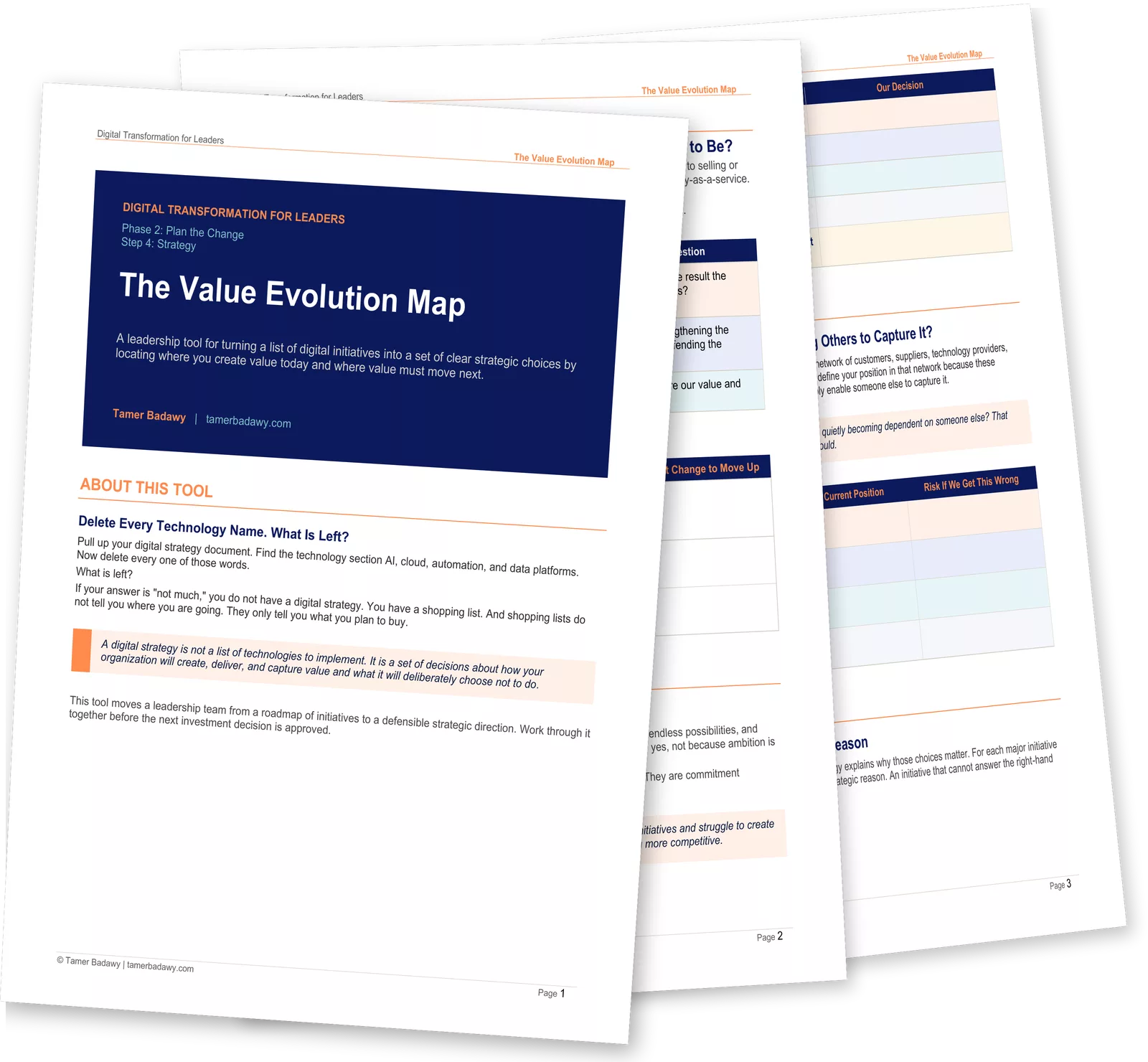
The framework I like to use with leadership teams is called the Value Evolution Map. It’s a one page executive tool. Not a deck. Not a report. One page. It answers three groups of questions that most strategy documents avoid.
First, where are you today on the value ladder? Are you selling a product, adding services around it, or are you accountable for an outcome? Most organizations know where they sit. Very few have made a deliberate decision where they need to be in three to five years.
Second, what choices have you actually made? Not the initiatives on your roadmap. The real choices. Where do you compete? What must you excel at? And what are you prepared to stop doing? Because without this last one, you do not have a strategy. You have priorities competing with other priorities.
Third, who controls the value in your network? Every organization sits in a web of customers, suppliers, partners, platforms, and technology providers. The question is simple. Are you building something others depend on, or are you quietly becoming dependent on someone else? This last question makes executives uncomfortable. It should.
The output is one page: current value position, future direction, and the explicit trade-offs your leadership team has agreed to make. This one page is harder to produce than a forty slide strategy deck, and worth more.
They Were Transforming. Just Not in the Right Direction.
I have seen this inside manufacturing. The company was serious about digital transformation. New ERP. IoT sensors on production equipment. Data analytics platform. Executive attention. Real budget, real intent. But seriousness was not the problem. Direction was. On paper, they were transforming. But when they ran the Value Evolution Map, something became clear very quickly.
The first thing that showed was their current value position was product plus service. They sold machines and maintenance contracts, but the largest customers were asking for outcome based value, guaranteed output, uptime, and performance accountability.
What emerged next was that the strategic choices were not clear. One team wanted to improve service efficiency. Another wanted to push more digital products. Another wanted to defend the current maintenance model. They were all moving, but not toward the same direction.
And finally, they discovered that their ecosystem position was weakening. Two major platform vendors were building direct relationships with end customers. That meant the company risked becoming a component in someone else’s value chain.
None of the current digital investments were wrong, but none of them addressed the actual strategic issue. They were optimizing the current model at a moment when the model itself needed to change. That conversation reset their entire digital agenda.
AI Amplifies the Problem Before It Fixes It
The pressure to move fast on AI is real, and moving fast without strategic clarity is how organizations end up with expensive confusion. If the leadership team moves too quickly into AI without clarifying value, strategy, and operating model choices, the AI will not create direction. It will amplify the lack of direction. That’s why sequence matters.
AI trained on the wrong objectives optimizes for the wrong outcomes. AI deployed into a fragmented operating model produces fragmented results faster. AI built on a value proposition that customers no longer need makes irrelevant products slightly more efficient.
This is not an argument against AI. This is an argument for sequence. Get clear on what value you are creating and for whom. Then decide what role AI plays in delivering that value, better, faster, or at lower cost. Skipping that step doesn’t make the transformation faster. It makes the recovery harder.
Stop the Roadmap. Start Here.
Before your leadership team approves the next digital initiative, consider asking these questions. If we remove every technology name from our strategy, would it still say something meaningful? Can we describe how we create value today and how that value needs to evolve? Do we know which customer problem we are uniquely positioned to solve, and are we building toward that? Do we know what we must become excellent at to win there? Have we made explicit choices about what we will stop, reduce, or avoid? Do we know whether our ecosystem position is strengthening or weakening?
If your leadership team is not aligned on these answers, then pause the roadmap conversation. Start a strategy conversation. These are not technology questions. Each one of them is a leadership question.
From Digital Activity to Strategic Direction
In this step, the goal was not to create a longer strategy document. The goal was to create strategic clarity, because before a leadership team approves the next roadmap, it needs to understand three things. First, how the organization creates value today. Second, how that value is changing. And third, which choices are needed to compete in the future.
This is the role of the Value Evolution Map. It helps leaders move from digital activity to strategic direction. It forces the conversation away from isolated initiatives towards the real questions. Where do we play? How do we win? What value are we here to create? What capabilities must we build? And what must we stop doing so we can focus?
Once those choices are clear, the next question becomes more practical. How does the organization actually create, deliver, and capture that value? That is the business model question. And this is where we go next.
Strategy is not a document. It’s a set of decisions. Decisions about where to focus, what to stop, and how to create value in a world that’s not waiting for you to catch up. In Step 5, we get into the mechanics of how that value actually flows through your organization, and what happens when the operating model cannot support the strategy you just defined. That’s where things get real.
The Case: Rolls-Royce’s Power by the Hour
For decades, Rolls-Royce sold jet engines the same way any manufacturer sells equipment: build it, sell it, service it separately when something breaks. Airlines eventually asked for something different. They didn’t want to own engine risk. They wanted guaranteed hours in the air.
Under the TotalCare program, airlines now pay Rolls-Royce per flying hour, and Rolls-Royce carries the maintenance risk instead of the airline. By 2024, that service model brought in 66 percent of the Civil Aerospace division’s revenue, more than the engines themselves ever did.
KEY TAKEAWAYS
- Rolls-Royce didn’t start with a technology decision. It started by asking what customers were actually paying for
- A strategy five leaders interpret five different ways isn’t a strategy. It’s a wish list with a budget attached
- The hardest part of strategy isn’t generating ideas. It’s naming what you’ll deliberately stop doing
The Tool: Value Evolution Map
Value Evolution Map
A one page executive tool for locating where you sit on the value ladder, forcing real strategic choices, and testing your position in a wider network of value.
Run This Diagnostic
SIX QUESTIONS BEFORE APPROVING ANOTHER DIGITAL INITIATIVE
Answer each as a leadership team, with evidence rather than assumptions
-
- If we removed every technology name from our strategy, would it still say something meaningful?
- Can we describe, in one sentence, how we create value today and how that needs to change?
- Have we made explicit choices about where we will not invest?
- Do our digital investments connect to a clear outcome, or to a list of capabilities we think we should have?
- Do we know where we sit in our broader market network, and whether that position is strengthening or weakening?
- Is our leadership team aligned on the answers to the first five questions?
Frequently Asked Questions
What is a Value Evolution Map?
A one page leadership tool for locating where your organization sits on the value ladder today, forcing real strategic choices, and testing your position inside a wider network of customers, platforms, and partners.
Why did Rolls-Royce change its business model instead of just improving its engines?
Because airlines no longer wanted to own engine risk. They wanted guaranteed flying hours instead. Rolls-Royce had to ask what customers were actually paying for, not just how to build a better engine.
How is this approach different from a normal strategy workshop?
Most strategy work produces a deck full of initiatives. This process produces one page of explicit choices, including what you’ll deliberately stop doing, which most strategy documents avoid naming at all.
UP NEXT
Publishes September 22
Step 5: Business Models
This step created strategic clarity, not a longer strategy document. The next step turns that clarity into an economic logic, how the organization actually creates, delivers, and captures value. That is the business model question.
Tamer Badawy
Strategic IT and Digital Transformation Leader,
Author of Life in the Digital Bubble.
9 episodes. 9 downloadable frameworks.
Built from 25 years of running transformation programs in enterprise IT.