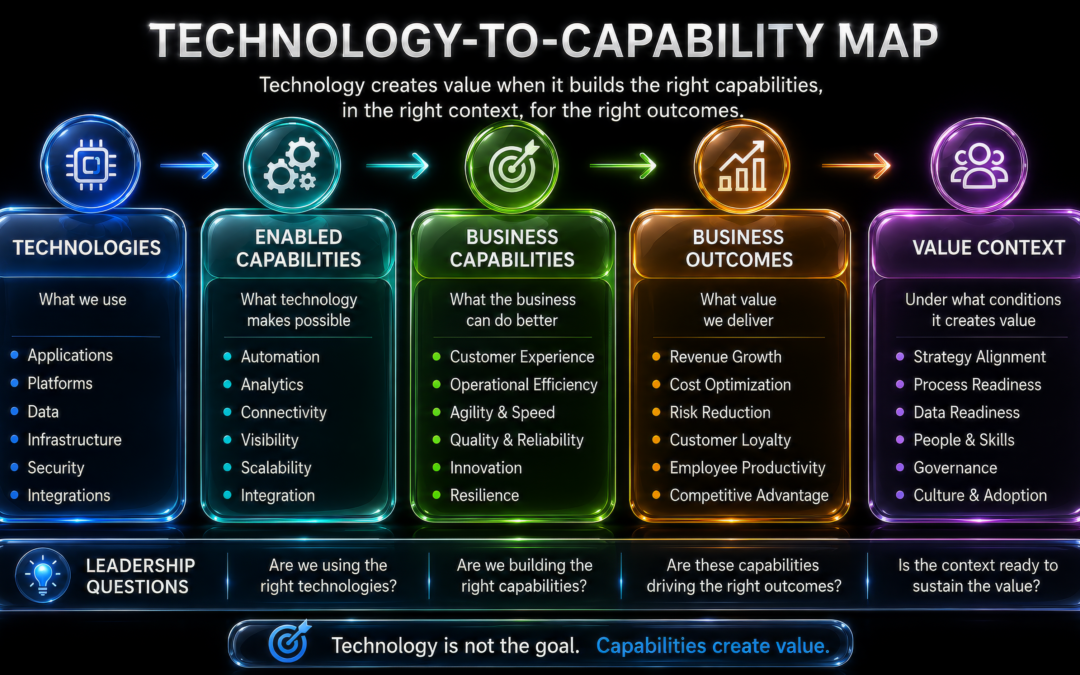
Digital Transformation for Leaders, Step 2: Technology and the Technology-to-Capability Map
You watched the 1st of September episode. Lidl and SAP scrapped their partnership after seven years and roughly €500 million in investment. It’s easy to read that as “SAP failed Lidl.” That’s not actually what happened.
The platform worked. SAP is one of the most widely used enterprise systems in the world, and Lidl was, by SAP’s own account, one of its better customers a year before the project was cancelled. What failed was the fit: the technology never lined up with Lidl’s business model, its processes, its data, and how its people actually worked. Enterprise technology doesn’t succeed in isolation. It has to fit the organization around it like a puzzle piece, not the other way around.
What technology actually does
The video draws a distinction worth keeping. Technology plays three different roles, and most organizations only ever make it through the first one.
Digitalization turns analog information digital, paper becomes data, and manual records become structured information. It matters, but it doesn’t change how the business runs on its own.
Automation reduces manual effort and speeds things up; approvals move faster, and invoices process themselves. This approach creates efficiency, but efficiency alone rarely changes what a customer or employee actually experiences.
Connectivity is where the real shift happens: systems talk to each other, data moves across departments, and decisions get faster because everyone’s looking at the same reality. Most organizations digitize, most automate, and few connect; without connectivity, technology remains fragmented, working in pieces without transforming anything.
Take a delivery problem. Buying a tracking tool feels like the fix, but the real capability depends on whether sales sees the same delivery promise as production, whether procurement sees supplier risk early, and whether customer support can explain a delay before the customer asks. If the answer is no across most of those, the tracking tool is just another interface. The opportunity was never the tool. It was the connected information underneath it.
The seven questions, as a checklist
Before choosing any technology, the video argues leadership needs answers to seven questions, not a list of vendors.
- What business capabilities are we trying to strengthen?
- What problem are we actually solving?
- Is our data ready?
- Are the affected processes clear, end to end?
- Who owns the outcome once the project goes live?
- How will we measure value, not just implementation progress?
- What has to change in the operating model for the project to scale?
Most of these are skipped. When they do, technology becomes an activity instead of a transformation, which is exactly the trap Lidl’s project fell into when the goals could no longer be reached without spending more than the company was willing to commit.
What’s coming
The 8th of September moves from technology to evaluation, and the video is clear that evaluation here doesn’t mean a checklist. It means a leadership discipline for seeing where the organization actually stands before committing more resources, precisely the step Lidl’s project skipped for seven years.
You can run the Technology-to-Capability Map on your own organization now or follow the rest of the series at the series hub.
Get my latest articles in Google
Add tamerbadawy.com as a preferred source to see more of my articles in Google Search and AI results.