
RECOGNIZE POTENTIAL
Technology: Why Tools Alone Do Not Create Transformation
In short: Technology is Step 2 of the Digital Transformation for Leaders framework. It tests whether a technology investment is mapped to a real business capability and whether your organization is actually ready to absorb it before you approve the spend.
WHAT YOU WILL LEARN
- Why technology decisions fail when they start with the tool instead of the capability
- What Lidl's 500 million euro SAP write-off reveals about fit versus function
- The four layers beneath every AI initiative, and why leaders skip the foundation
- The seven questions to ask before approving any technology investment
← Back to the full series
Read the full transcript
The Dangerous Illusion in Digital Transformation
There is a dangerous illusion in digital transformation that if you choose the right platform, launch an AI pilot, or move to the cloud, transformation will follow. But in reality, many transformations do not fail because the technology is weak. They fail because the organization around the technology is not ready to turn it into value. And one of the clearest examples of this cost one major company around 500 million euros. What happened with Lidl and SAP is not just an ERP story. It's a leadership lesson that every organization should understand before investing in AI, cloud, automation, or any major technology program. I will explain why in a moment.
Welcome to Digital Transformation for Leaders, a journey from insight to strategy to execution. In the first step, we looked at society: the changing expectations, pressures, and behaviors outside the organization. Now we look at step two, technology, not as a collection of tools, but as a system of capabilities that connect processes, data, people, and the way the business actually works.
When Technology Does Not Become Transformation
Today, every leadership team is under pressure to do something with AI. The options are endless, the budgets are significant, and the fear of being left behind is real. But the truth is, most organizations do not just struggle with technology. They struggle to understand where technology truly creates value. This is not theory. A well known enterprise case shows how expensive this misunderstanding can become.
In 2018, Lidl stopped a major SAP based merchandise management project, after several years of work and 500 million euros invested. On paper, this was not a weak technology story. SAP is a leading enterprise platform. Lidl is a highly successful company. The ambition was serious. The goal was modernization, but the goal could not be reached without reasonable effort. Lidl decided to continue developing its own system instead, because the issue was not simply the technology. The issue was the fit.
Enterprise technology does not succeed in isolation. It must fit like a puzzle piece into the organization: the business model, the processes, the data logic, the operating model, and the way that people actually work. And this is where many leaders underestimate the challenge. They assume that a powerful platform and a strong company means success. But the real question is different. Can the technology, the process, the data, the operating model, and the people move together?
Technology is a system of capabilities
Organizations do not usually fail because they lack technology. They often fail because they underestimate what must change around the technology. A platform is selected. A cloud strategy is announced. An AI pilot is launched. A new application goes live. But after the implementation, the harder questions appear, such as: is the data ready? Are the processes clear? Is the architecture scalable? Is ownership defined? Are integrations stable? Is the operating model prepared? Are people able to work differently?
Not having a positive answer to these questions means the organization is not only implementing technology. It's adding complexity before creating value. This is why technology should never be understood only as a tool. Technology is a system of capabilities. It's the combination of platforms, data, processes, architecture, ownership, and people that allows the organization to do something better than before. And every technology decision changes the organization around it.
The 4 Layers Beneath AI
Most technology conversations start at the top: AI, automation, new platforms. But the real value depends on the layer underneath. After more than 25 years in IT and digital transformation, I have learned one thing. Leaders understand technology much better when they see it as four connected layers.
At the foundation there is infrastructure. This includes cloud, network, devices, platforms, security, and core operations. Above that, in layer two, you have applications, the systems every organization depends on every day: ERP, CRM, service management, collaboration tools, production systems, and industry specific applications. Above that, in layer three, you have data, and data comes in many forms: master data, operational data, customer data, production data, financial data, and analytical data. And above that, in layer four, you have business capabilities such as user experience, operational efficiency, faster decision making, quality improvement, resilience, and innovation.
The mistake that many organizations make is to jump directly to the top layer. They ask, how do we use AI? But AI depends on everything underneath it: the infrastructure, the applications, the data, and the capabilities. If the foundation is weak, the top layer cannot create sustainable value. It may at best create a few quick wins, but never a lasting transformation.
The Three Roles of Technology: Digitalization, Automation, and Connectivity
Once leaders understand the layers of technology, the next question is simple: what does technology actually do for the organization? In my experience, technology plays three different roles.
The first role is digitalization. This is where analog information or manual activity becomes digital. Paper becomes data. Manual records become structured information. Physical steps become visible in systems. This matters, but digitalization alone cannot change the business.
The second role is automation. This is where technology reduces manual effort, improves speed, and removes manual work. Approvals move faster. Invoices can be processed automatically. Reports can be generated more easily. This creates efficiency, but efficiency alone does not always change the customer or the employee experience.
The third role is connectivity, and this is where real transformation often begins. Systems talk to each other. Data flows across departments. Processes become end to end. Decisions become faster.
So the distinction is very important. Digitalization creates information. Automation creates efficiency. Connectivity creates transformation potential. And this is where many organizations stop too early. They digitize, they automate, but they do not connect. And without connectivity, technology remains fragmented. It works in pieces, but it does not transform the whole organization.
One Tool Cannot Fix the Value Chain
Customer delivery reliability is rarely solved by one tracking tool. It depends on whether the whole value chain can see the same reality. Imagine a company trying to improve its delivery performance. One approach is to buy another tool. This may help, but the whole capability depends on much more.
Can sales see the same delivery promise as production? Can production see material availability in real time? Can procurement see supplier risk early enough? Can logistics update delivery changes automatically? Can customer support explain delays before the customer asks? Can leadership see where the bottlenecks really are?
If the answer is no, then the tracking tool becomes just another interface. The opportunity is not the tool itself. The opportunity is the connected information across the value chain. And this is the difference every leader must understand. Implementing technology is not the same as building a capability.
The Cost of Failed Technology: Lost Credibility
When technology and organization are misaligned, the cost is high. Not only financially. The deeper cost is credibility. I have walked into organizations where people were not resisting change because they were negative. They were resistant because they had seen too much technology without enough value.
A system went live, but nobody could clearly explain what improved. A new tool was added, but the process underneath was still broken. A dashboard looked impressive, but the people knew it did not represent the operational reality. An AI pilot created attention but never became part of the business. And after a while, resistance does not come from lack of understanding. It comes from lack of trust.
This is why leaders must pay close attention. Technology decisions are not technical decisions. They shape trust, behaviors, operating models, and how value is created. A modern CIO does not only ask whether a technology works, but also asks whether the organization is ready to turn that technology into value.
The Technology-to-Capability Map
Before investing in a new technology, leadership teams need more than a list of tools. They need a clear Technology to Capability Map. A simple map should answer a few practical questions.
First, what business capabilities are we trying to strengthen? Second, what problems are we really solving? Third, is our data ready? Fourth, are the affected processes clear and end to end? Fifth, who owns the outcome when the technology goes live? Sixth, how will we measure value, not only implementation progress? And seventh, what do we need to change in the operating model for the technology to scale?
These questions sound simple, but unfortunately they are often skipped. And when they are skipped, technology becomes an activity, not a transformation. A Technology to Capability Map helps leaders see where technology can create real value, where the organization is ready, and where the foundation must be strengthened. First, we must always remember the goal is not to have more tools. The goal is to build capabilities that help the organization create value in a better way in a digital world.
Technology Is Not a Shopping List
So the second step in recognizing potential is not about chasing technologies. It's about understanding which technologies matter, where they fit, and how they connect to value. Technology should not be treated as a shopping list. It should be treated as a system, a system of data, applications, platforms, infrastructure, security, governance, processes, and people. And once leaders understand that system, the next question becomes clear. Where are we today? What's ready, and what is not ready? And where should we invest first?
This is what we will explore in the next episode, when we move from technology to evaluation. Not evaluation as a checklist, but evaluation as a leadership discipline that helps organizations see reality before they commit resources. So in the next episode, we do not guess where to invest. We learn how to evaluate readiness with clarity.
The Case: Lidl and SAP - When Strong Technology Meets the Wrong Fit
Lidl walked away from a SAP implementation in 2018, roughly 500 million euros in, after years of trying to make it work. The platform itself was sound. Lidl was a strong, successful retailer. What broke down was the fit between the two: the processes, the data, the way the business actually ran day to day.
Lidl went back to building its own system instead. That's the exact test this step's framework is built to run, whether your technology decisions are set up to succeed before you approve them or not after you've already invested
Source: Forbes, March 2026
KEY TAKEAWAYS
- Enterprise technology never succeeds in isolation. It has to fit the business model, the processes, the data, and the people around it
- The real signal a technology investment is off track appears in the sequence when foundation layers are skipped before top layer gets attention
- Digitalization creates information, automation creates efficiency, only connectivity creates real transformation potential
The Tool: Technology to Capability Map
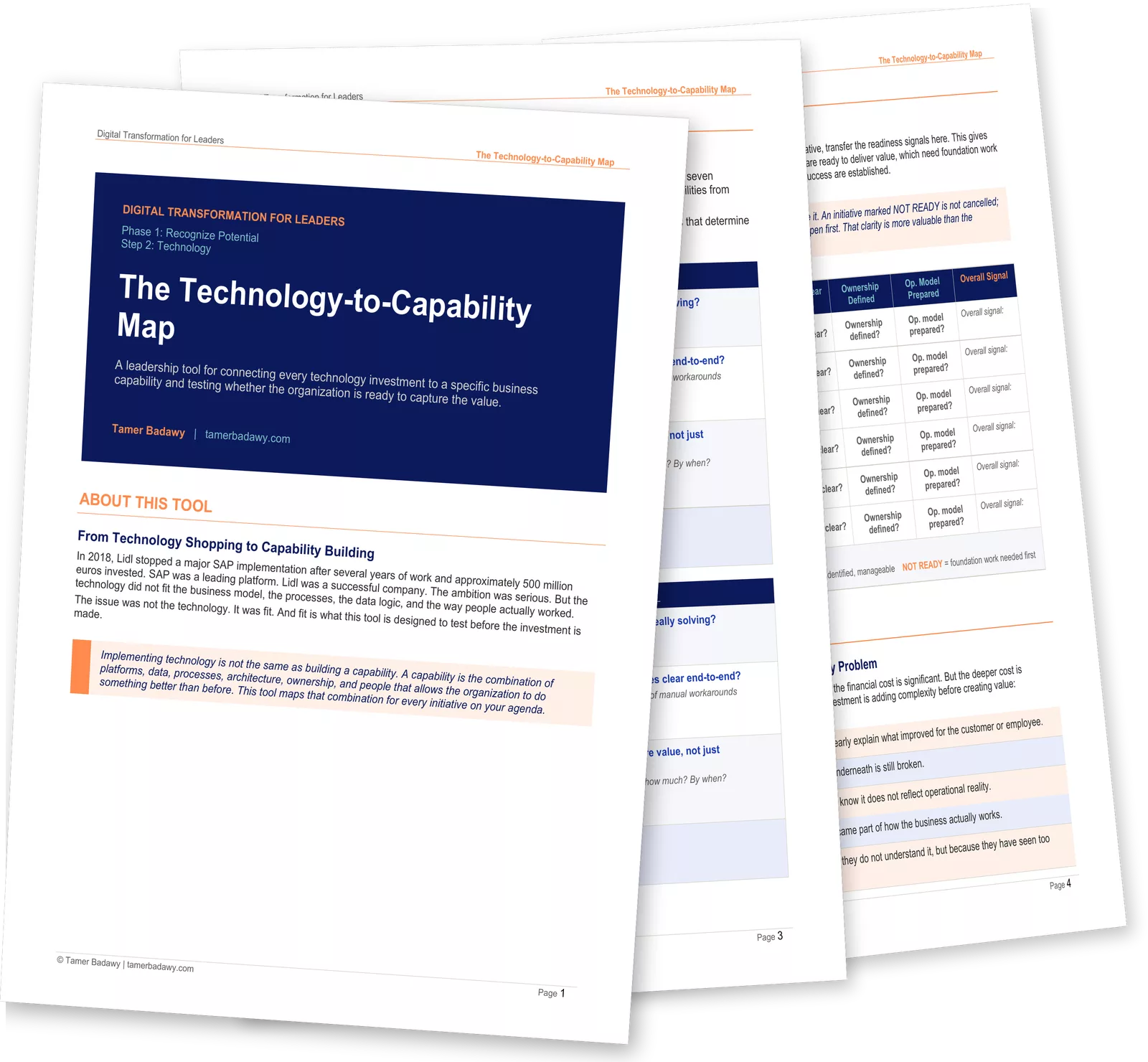
Technology to Capability Map
A structured way to locate every technology initiative across four layers, then test it against seven questions before you approve the investment.
Run This Diagnostic
SEVEN QUESTIONS BEFORE CHOOSING TECHNOLOGY
Before your leadership team approves any technology investment, pause and answer these seven questions.
-
- What business capability are we strengthening?
- What problem are we really solving?
- Is our data ready?
- Are the affected processes clear and end-to-end?
- Who owns the outcome after the technology goes live?
- How will we measure value, not only implementation progress?
- What needs to change in the operating model for this to scale?
Frequently Asked Questions
What is a Technology-to-Capability Map?
A leadership tool that locates every technology initiative across four layers, infrastructure, applications, data, and business capability, then tests it against seven readiness questions before you invest.
Why did Lidl's SAP implementation fail if the platform itself worked?
Because the technology never fit the business model, the processes, or the way people actually worked. The platform was sound. The organization around it wasn't ready to absorb it.
How long does this diagnostic take to run?
Ten to fifteen minutes per initiative with your leadership team. Most teams run it against two or three active technology investments in a single working session.
UP NEXT
Publishes September 8
Step 3: Evaluation
In the next episode, we move from technology to evaluation. Not evaluation as a checklist, but evaluation as a leadership discipline that helps organizations see reality before they commit resources.
Tamer Badawy
Strategic IT and Digital Transformation Leader,
Author of Life in the Digital Bubble.
9 episodes. 9 downloadable frameworks.
Built from 25 years of running transformation programs in enterprise IT.