Your customers might still need what you sell in five years. They might just not need it from you.
That's the uncomfortable question behind this week's episode, and step five breaks from every other step in this series to ask it. No tribunal, no press release, no company you'd recognize by name. Instead, we’ll look at two illustrative scenarios, because this particular failure mode is so quiet that it usually doesn't make headlines until the damage is already done.
The first: a private clinic group in Central Europe, twenty years of reputation, specialist physicians, strong diagnostics, and a referral network built on trust. Then digital health platforms arrived, not as new clinics or new doctors, but as the place patients went first to compare specialists, check wait times, read reviews, and book. The clinic continued to deliver excellent care. It just stopped being where patients started. Most leadership teams would see that as a marketing problem, better SEO, or a new patient portal. It isn't. The platform took over discovery, comparison, and first contact, the exact part of the relationship that decides who a customer trusts before the clinic ever gets involved.
Run the five-year displacement test yourself.
Pick one real customer journey in your organization, booking a service, getting a diagnosis, or renewing a contract, and ask five questions.
- Which part of this journey do customers value most?
- Which part creates the most frustration?
- Which part generates the most useful data?
- What part could a platform, an AI agent, or a new entrant take over in the next five years?
- If that happened, what would your organization still own?
Most teams skip the fifth question. It exposes the gap between the role you think you play and the role the market will actually let you keep.
Five pressure points, not a two-hundred-slide review
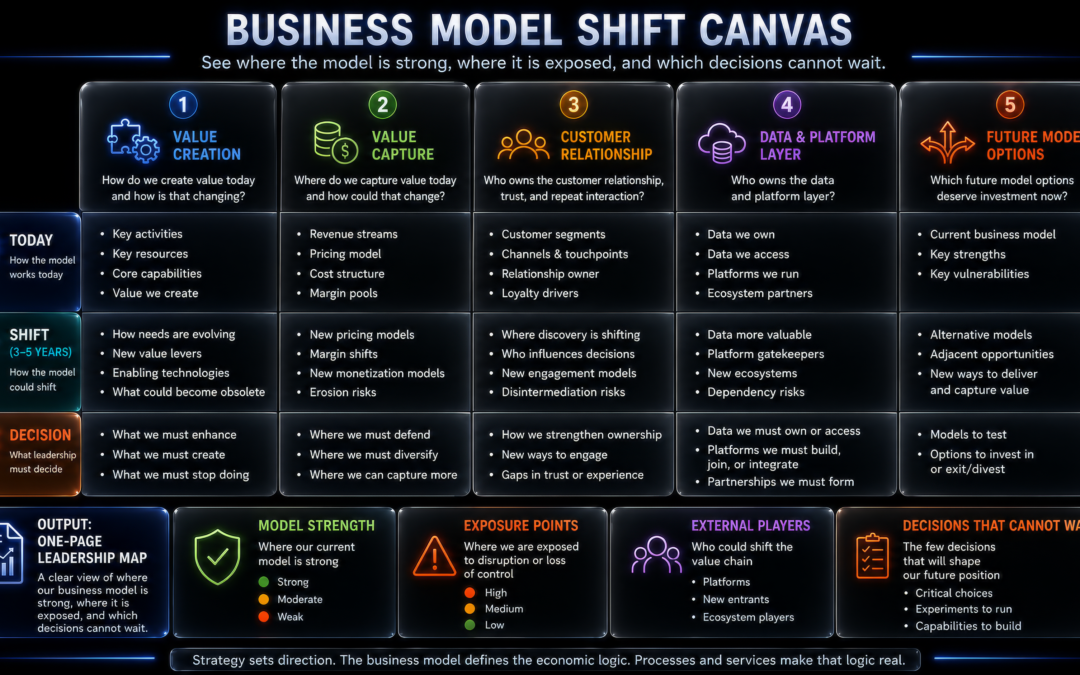
This is the structure behind the Business Model Shift Canvas: where value is created today and how that's changing, where revenue and pricing power actually sit rather than where the invoice goes, who owns the customer relationship, who owns the data and platform layer, and which future model options deserve investment now, because some decisions can't wait three years.
The video's second scenario, a manufacturer, runs through exactly these points. Strong engineering, loyal customers, a stable order book, and a digital agenda that looks reasonable on paper: remote monitoring, a customer portal, and predictive maintenance. Run through the canvas, a different picture appears: customers increasingly want uptime and outcomes, not machine ownership, buyers are asking for subscription and performance-based contracts, and third-party platforms are becoming where customers compare service options and order parts. No single finding is a crisis. Together, these trends shift the question from which system to upgrade to which role the company wants to play in the value chain going forward.
It's worth keeping in mind that if AI sits anywhere in that roadmap, it doesn't just automate work; it can also shift power in the value chain. Whoever owns the data builds the intelligence. Whoever owns the first customer interaction shapes the decision. Whoever owns the platform sets the rules.
Next: can you actually deliver it?
On the 29th of September, we shift from business models to processes and services, focusing on the practical question of whether the organization can deliver the model it has just chosen.
You can run the Business Model Shift Canvas now or follow the rest of the series at the series hub.
Get my latest articles in Google
Add tamerbadawy.com as a preferred source to see more of my articles in Google Search and AI results.