PLAN THE CHANGE
Business Models: On Time, on Budget, Strategically Wrong
In short: Business Models is Step 5 of the Digital Transformation for Leaders framework. It tests whether your digital investments are strengthening your business model or quietly funding a platform that will own the customer relationship instead.
WHAT YOU WILL LEARN
- Why a well run organization can still lose control of the customer relationship
- What Airbnb’s platform position reveals about who really captures value
- The five year displacement test that exposes which part of your value chain is at risk
- The six questions your board should already be asking before the next digital investment
← Back to the full series
Read the full transcript
Before we start, one uncomfortable question. Your customers may still need the outcome. They may still need the service. They may still need the product. But in five years, they may not need you to deliver it. That is the business model question many leadership teams avoid. Not because it is irrelevant. Because it is unsettling.
Welcome back to Digital Transformation for Leaders, a journey from insight to strategy to execution. We are in Phase 2, Plan the Change. In the previous episode, we looked at strategy as a set of choices. Where to focus. How to compete. What to stop. Today we go one level deeper. Because once strategy points a direction, the next question is harder: how does your organization actually create, deliver, and capture value? And is that model still strong enough for what is coming? This is the business model question. And that is what this episode is about.
They Were Still Excellent. That Was Not Enough.
Imagine an organization that is excellent at what it does, and still starts losing control of the customer relationship. Consider a company that had built a strong reputation over twenty years through specialist expertise, high quality delivery, satisfied customers, and a steady referral network built on trust.
Then came a wave of digital platforms. Not competitors in the traditional sense. No new providers, no new specialists. Instead, new platforms that aggregated availability across the region, let customers book directly, showed wait times, reviews, and pricing, and connected people to alternatives and remote options as a first entry point.
The organization was still excellent. But it was no longer the first place customers went to understand their options. Most leadership teams would call this a marketing problem. Better SEO. A new customer portal. More online reviews. But that treats the symptom, not the cause of the shift. The deeper issue was structural. The platform had taken over a critical part of the relationship: discovery, comparison, and first contact. The organization still provided the service. But another player now shaped the decision.
This is not a technology gap. This is a business model gap. And this pattern is not limited to one industry. It appears in manufacturing, financial services, retail, logistics, and professional services, anywhere a platform can move closer to the customer than the traditional provider already is. The leadership question it raises is this: which part of your value chain are you still in control of?
You Can Digitize the Wrong Model Very Efficiently
In most of the organizations I have worked with, no two executives describe value creation the same way. Most have never even noticed. The CEO wants growth. The CFO wants margin protection. The CIO wants a stronger digital foundation. The COO wants reliable operations. The Head of Sales wants better customer access. The Head of Customer Support wants fewer complaints. Each request makes sense.
So the organization invests in digital projects. A new portal. A new CRM. A new data platform. A new AI use case. A new reporting layer. A new mobile app. On the surface, it looks like transformation. But underneath, the business model stays untouched. The organization still engages customers the same way, still captures value in the same places, still depends on the same intermediaries, still uses data mainly for reporting, not for changing the relationship.
The danger is not that the organization does nothing. The danger is that it invests seriously, works hard, modernizes systems, and still protects a model that is quietly losing power. Most digital initiatives sit at a lower level. They optimize or enhance what already exists, while at a higher level, the model itself changes. That is the level most organizations are not looking at. A weak business model does not become strong because it has a digital interface. It may become faster, cleaner, easier to report. But it is still exposed if someone else can own the customer relationship, the data layer, or the platform where decisions are made.
What Would You Still Own?
Most leadership teams have never run this test. The ones that have rarely forgot what it showed them. I call it the Five Year Displacement Test. Take one important customer journey. Booking a service. Getting a diagnosis. Renewing a contract. Ordering parts. Then ask these five questions.
One, which part of this journey do customers value most? Two, which part creates the most frustration? Three, which part generates the most useful data? Four, which part could a platform, an AI agent, a marketplace application, or a new entrant take over in the next five years? Five, if that happened, what would your organization still own?
That fifth question is the one most teams avoid. Because it forces a gap to become visible. The gap between the role you believe you play and the role the market may allow you to keep. That gap is where business model pressure begins.
On Time. On Budget. Strategically Wrong.
You can audit your systems, your platforms, and your data architecture. But none of that tells you whether you are competing on the right playing field. This is the question a technology assessment will never answer. It tells you which systems are outdated, which processes are slow, where data is fragmented. All of that matters. But none of it tells you whether your business model is becoming stronger or weaker.
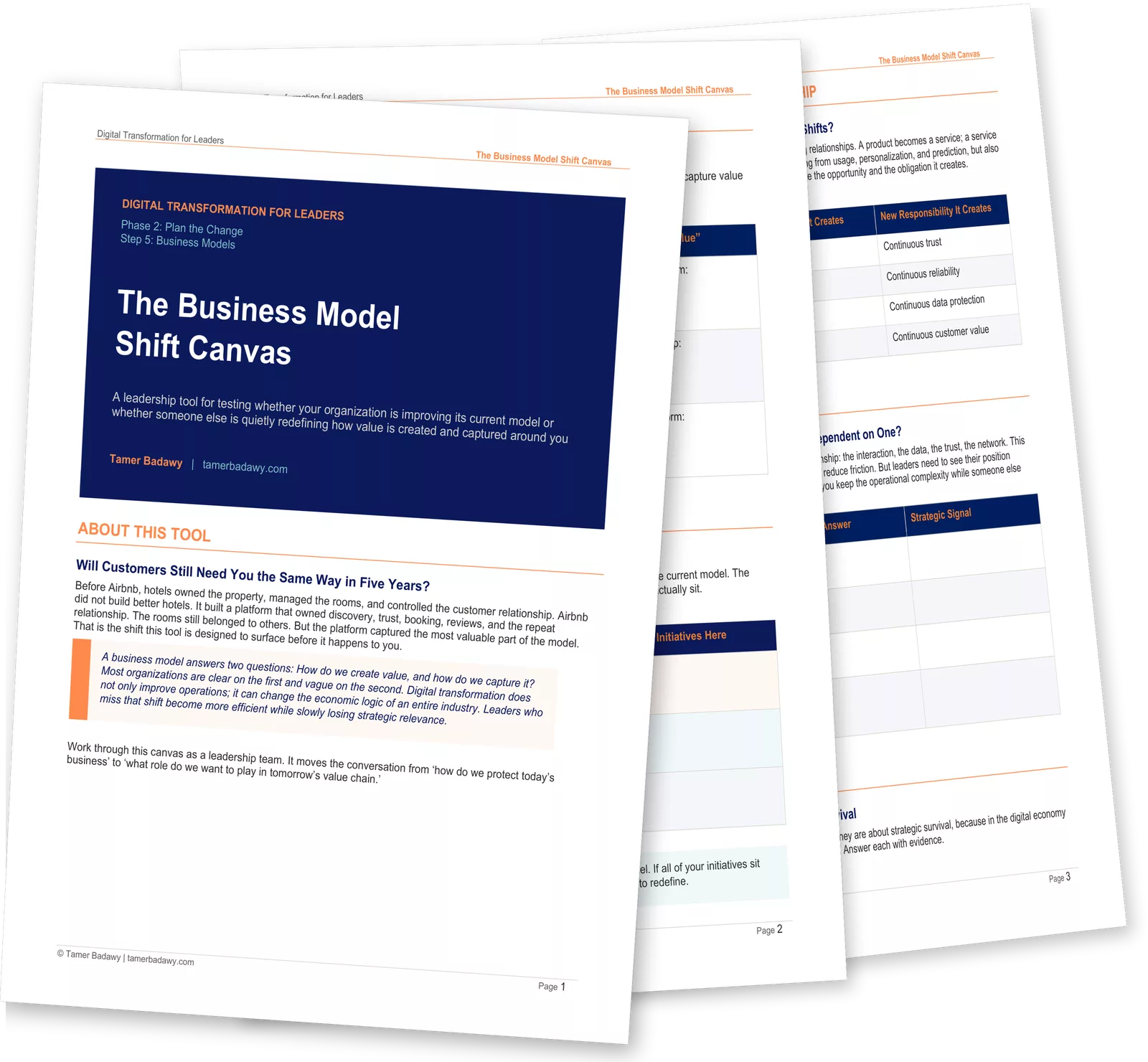
That is why I use the Business Model Shift Canvas. It helps leadership teams see where the current model may come under pressure in the next three to five years, and where decisions need to be made before the market forces them. The test looks at five pressure points.
One, where value is created, and how that is changing. Most organizations know what they sell. Fewer know what their customers are paying for. Two, where the revenue, margin, and pricing power actually sit. Not where the invoice goes. Where the control actually lives. Three, who owns the customer relationship, the trust, and the repeat interaction. Whoever the customer calls first owns more than you think. Four, who owns the data and the platform layer. Data you do not collect today becomes someone else’s advantage tomorrow. And five, which future model options deserve investment now. Not every option needs a decision. But some decisions cannot wait three years.
The output is not a long report. It is a one page view showing where the current model is strong, where it is exposed, which external players could shift the value chain, and which decisions cannot wait. This is the work leadership teams should do before approving any major digital initiative. A project can be delivered on time, on budget, and still fail strategically if it strengthens the wrong model.
The Business Looked Healthy. Until We Looked Closer.
Imagine an industrial equipment manufacturer. Strong engineering reputation. Reliable machines. Good service contracts. Loyal customers. An order book that looks stable. Leadership approves a digital agenda. Remote monitoring. A customer portal. Predictive maintenance pilots. Better dashboards. Each decision looks reasonable.
But when the Business Model Shift Canvas is applied, a different picture appears. Value creation is shifting. Customers increasingly care about uptime, performance, and outcomes, not machine ownership alone. Value capture is under pressure. Buyers are asking for subscription models and performance based contracts instead of one time purchases. The customer relationship is exposed. Third party platforms are becoming the place where customers compare service options, order spare parts, and manage maintenance. The data position is weak. Machine data sits in silos, while cloud and platform players build broader intelligence across many customers and equipment types. Future model options exist, but they require a decision. Does the company keep selling machines? Does it sell uptime? Does it build outcome based contracts? Does it become the trusted performance platform for its installed base?
No single finding alone is a crisis. But together, they change the leadership conversation. The question moves from which system should we upgrade, to which role do we want to own in the future value chain. That is the shift the canvas produces. And it is a different conversation from any technology roadmap review.
AI Does Not Only Automate Work. It Moves Power.
AI and digital platforms are accelerating business model shifts. AI can improve service, automate support, predict demand, personalize orders, and help customers compare options faster than any sales team can respond. That creates real opportunity. But there is a statement worth remembering: AI does not only automate work. It can move power in the value chain.
If another player owns the data, they can build the intelligence. If another player owns the first interaction, they shape the decision. If another player owns the platform, they set the rules. AI does not remove the need for business model thinking. It makes it harder to avoid. A company that uses AI only to optimize internal work may become more efficient. A competitor that uses AI to own the customer relationship may become more strategically powerful.
AI also accelerates a shift that is already underway. One time transactions are becoming ongoing relationships. A product becomes a service. A service becomes a platform. That creates strategic opportunity, but only for the player who owns the relationship. The point is not to slow down technology. The point is to make sure technology strengthens the position you actually want to hold.
Six Questions Your Board Should Already Be Asking
Before approving the next digital project, six questions are worth asking. One, can we clearly explain where our profit, customer loyalty, and strategic control come from today, and which of those are under pressure? Two, which part of the customer relationship do we own directly, and which part is already moving toward others? Three, what data do we have that could strengthen our future position, and what data are we failing to collect? Four, if a platform native competitor entered our market tomorrow, which part of our value chain would be easiest to displace? Five, are our digital initiatives only improving today’s model, or are they preparing the role we want to own tomorrow? Six, which business model option would we regret not testing three years from now?
These are not abstract questions. They shape investment decisions, technology priorities, partner choices, data strategy, and operating model design. Because in transformation, the business model decides what technology should serve, not the other way around.
Strategy. Model. Execution. Here Is Where We Are.
So where does this sit in the wider journey? We are in Phase 2, Plan the Change. Three episodes. Three connected questions. Episode 4 asked where should we compete, and what should we stop. That was strategy. This episode, episode 5, asked is the model we are competing with still strong enough. That is the business model test. Episode 6 will ask can the organization actually deliver it. That is where we go next.
This is also the kind of conversation leadership teams should have before budgets are allocated, roadmaps are approved, and technology choices become commitments. Because once the investment cycle starts, the business model question tends to disappear. Strategy sets direction. The business model defines the economic logic. Processes and services make that logic real. That is where many transformations either become practical or remain stuck in slide decks.
Digital transformation is not only about making the current organization more efficient. It is about asking whether the organization is still positioned to create, deliver, and capture value in the future. So before you approve the next digital initiative, it is worth asking: are we improving today’s model, or are we preparing the model we will need tomorrow? In the next episode, we move from business models to processes and services. Because once the value model is clear, the next question becomes very practical. Can your organization actually deliver it?
The Case: Airbnb’s Debut Above Marriott and Hilton
Hotels used to own every part of the guest relationship: the property, the staff, the booking, the review. Airbnb entered the market without building a single room. It built the layer that sits between the guest and the property instead: discovery, trust, and the moment of booking.
When Airbnb went public in 2020, its market value passed the combined value of Marriott and Hilton, two of the world’s largest hotel companies, despite owning no real estate at all. The rooms stayed exactly where they’d always been. What moved was who controlled access to them.
Source: Forbes, December 2020
KEY TAKEAWAYS
- Being excellent at delivery doesn’t protect you if someone else owns discovery, comparison, and first contact
- A business can digitize its current model efficiently and still be strategically weaker in three years
- The real test isn’t which systems need upgrading. It’s which role you want to own in the future value chain
The Tool: Business Model Shift Canvas
Business Model Shift Canvas
A one page canvas testing five pressure points: value creation, value capture, customer relationship ownership, data and platform position, and which future model options need a decision now.
Run This Diagnostic
Six Questions Your Board Should Already Be Asking
Before approving the next digital project, answer these six questions honestly, as a leadership team.
-
- Can we clearly explain where our profit, customer loyalty, and strategic control come from today, and which of those are under pressure?
- Which part of the customer relationship do we own directly, and which part is already moving toward others?
- What data do we have that could strengthen our future position, and what data are we failing to collect?
- If a platform-native competitor entered our market tomorrow, which part of our value chain would be easiest to displace?
- Are our digital initiatives only improving today’s model, or preparing the role we want to own tomorrow?
- Which business model option would we regret not testing three years from now?
Frequently Asked Questions
What is a Business Model Shift Canvas?
A one page tool testing five pressure points: where value is created, where it’s captured, who owns the customer relationship, who owns the data and platform layer, and which future model options need a decision now.
How did Airbnb outvalue Marriott and Hilton without owning any hotels?
By owning the layer customers actually interact with first: discovery, comparison, trust, and booking. The hotels still owned the rooms. Airbnb owned the relationship, which is where most of the value ended up sitting.
How is this process different from a technology audit?
A technology audit tells you which systems are outdated. It never tells you whether your business model is getting stronger or weaker. This canvas is built to answer that second question specifically.
UP NEXT
Publishes September 29
Step 6: Processes & Services
Strategy set the direction. This step tested whether the model is still strong enough. The next step asks whether the organization can actually deliver it.
Tamer Badawy
Strategic IT and Digital Transformation Leader,
Author of Life in the Digital Bubble.
9 episodes. 9 downloadable frameworks.
Built from 25 years of running transformation programs in enterprise IT.