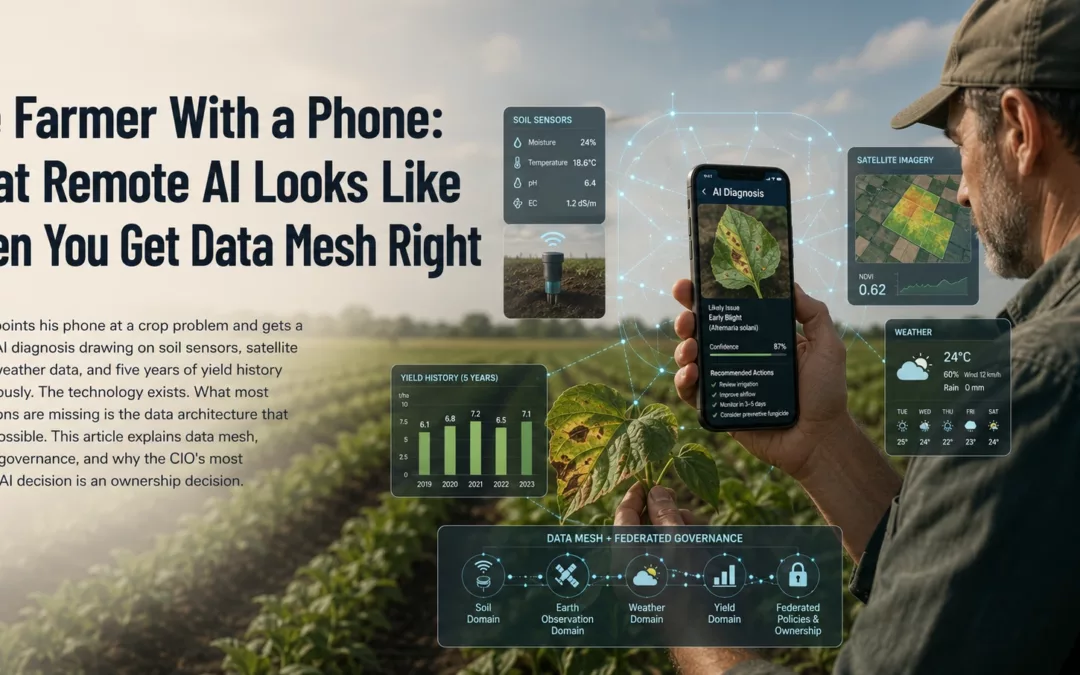
A farmer stands in a remote field. He has poor connectivity, no IT department nearby, and no data scientist on call. He points his phone at a section of crop that does not look right, records a short video, and asks an AI agent what he is looking at. Within seconds, the agent uses soil moisture readings from field sensors, satellite imagery from the past two weeks, local weather forecasts, historical yield data from the same plot in previous seasons, and pest outbreak patterns from neighboring farms. It tells him what is wrong, what to do, and when to do it.
This is not a concept. John Deere already integrates AI, computer vision, and robotics into autonomous farming machinery for real-time field decision-making, and the AI in agriculture market is projected to reach USD 4.7 billion by 2028. Small farmholders using AI tools are already reporting a 120% return on investment. Substack
The technology is not the barrier.
The barrier is the data architecture sitting behind it.
Why Most AI Deployments Cannot Do This
The farmer scenario requires something most enterprise AI deployments do not have: a live, federated data environment where multiple data sources, owned by different teams or entities, are accessible to an AI agent in real time without creating a centralized data bottleneck.
Most organizations have spent the last decade building the opposite: centralized data lakes that become slow, politically contested, and increasingly disconnected from the domain experts who actually understand the data. Central data lakes that become slow, politically contested, and increasingly disconnected from the domain experts who actually understand the data. A central data team that cannot possibly keep up with the volume and variety of data requests coming from across the business. The result is that AI agents are trained on stale snapshots rather than live operational data, and their outputs reflect that limitation.
A global bank that attempted to decentralize its risk and compliance reporting discovered that the primary obstacle was not technical but organizational: business unit leaders were hesitant to accept the accountability that came with data product ownership. That hesitation is the real constraint. Not processing power. Not model quality. Who owns the data, and whether they treat it seriously enough to make it useful.
What Data Mesh Actually Solves
Data mesh is an architectural approach that distributes data ownership to the domain teams closest to the data, rather than centralizing it in a single platform or team. Each domain manages its data as a product, with defined quality standards, clear interfaces, and accountability for what it produces. A self-service platform layer makes those data products accessible across the organization without requiring central mediation.
The principles of data mesh are clean, owned, product-based data with well-defined contracts. These are the bedrock of trustworthy, production-grade AI by 2026. Data mesh is no longer just an analytics architecture. It is the prerequisite for building reliable AI at scale.
The farmer scenario works because the data behind it is structured this way. The soil sensor data is owned and maintained by the agriculture operations team. A geospatial data domain manages the satellite imagery as a product. The weather data comes from an external provider with a defined API contract. The historical yield data sits with the farm management domain. None of these teams need to hand their data to a central team for processing. The AI agent pulls from each domain directly, in real time, through standardized interfaces.
This is what I described in why AI infrastructure belongs on the board agenda: the quality of AI output is inseparable from the quality of the data architecture beneath it.
You cannot resolve a data mesh problem by buying a better model.
Federated Governance: The Missing Piece
Distributed data ownership creates an obvious problem. If every domain manages its data independently, how do you maintain consistency, security, and compliance across the organization? The answer is federated governance, and it is the architectural decision that most organizations either skip entirely or implement too loosely to work.
Federated governance means setting organization-wide standards for data quality, security, privacy, and interoperability, while leaving the operational execution of those standards to the domain teams. A central data council sets the rules. The domains own the execution. Nobody waits for central approval to publish a data product, but every data product meets the same baseline standards before it enters the mesh.
Data mesh embeds domain expertise directly within data teams, ensuring that data products are designed and implemented by people who understand their business context. Domain teams no longer need to translate their requirements through intermediaries, reducing the time from requirement to delivery and improving the quality of the final result.
The data council model handles what federated execution cannot: cross-domain data conflicts, regulatory compliance at the enterprise level, and governance of data products that cross jurisdictional or organizational boundaries. In the farmer scenario, the data council defines how sensor data from third-party IoT providers is classified, how personal farm data is protected under relevant regulations, and which data products are authorized for use by external AI agents. The domains execute within those boundaries independently.
Beyond Agriculture: Where This Matters for CIOs
The farmer with a phone is an illustration of a broader principle. Every organization running operations across distributed environments, multiple sites, different regulatory jurisdictions, or external partner networks faces the same underlying problem. AI is only as good as the data it can access, which is limited by ownership clarity and architectural discipline.
In energy and utilities, a field technician diagnosing grid equipment needs real-time access to asset maintenance history, sensor telemetry, weather data, and regulatory compliance records simultaneously. In logistics, a route optimization agent needs live data from warehouse management, fleet telematics, customs systems, and customer order platforms at once. In manufacturing, a predictive maintenance agent drawing on IT systems rewired across a production environment needs process data, equipment sensor feeds, supplier quality data, and production schedules to be accessible without latency.
None of these scenarios are possible with a centralized data lake model that moves at the speed of ticket queues and quarterly data migrations. All of them become possible with a well-implemented data mesh backed by federated governance.
The Decision
Organizations that have successfully implemented data mesh share a common characteristic: it required top-level buy-in from leaders who understood it was an organizational change, not a technology project. The architecture follows the ownership model. The ownership model requires cultural and structural decisions that only executive leadership can make.
The CIO's role here is not to build the mesh personally. It is to make the case to the business that data ownership is not an IT concern. It is a strategic asset management decision.
Every domain that refuses to own its data properly is a domain that cannot meaningfully participate in the organization's AI future.
The farmer does not consider data mesh. He thinks about his crop. That is the key issue. When the architecture works, the complexity disappears behind the interface, and the person at the edge gets the answer they need. Getting there requires the CIO to have made a series of difficult organizational decisions long before the phone ever leaves the farmer's pocket.
If the questions around data architecture, AI readiness, and organizational ownership connect to challenges you are navigating right now, these themes run through Life in the Digital Bubble alongside broader perspectives on how technology is reshaping how organizations make decisions and build capability. More on AI strategy and digital transformation at tamerbadawy.com.
Get my latest articles in Google
Add tamerbadawy.com as a preferred source to see more of my articles in Google Search and AI results.