You watched the 15th of September episode. Rolls-Royce doesn’t really sell engines to airlines anymore. It sells flying hours and gets paid only when the engine works. That’s a clever business model story. It’s not the point the video was making.
The sharper point came earlier in the episode: pull up your strategy document, find the technology section, AI, cloud, and automation, and delete those words. What’s left? If the answer is “not much,” you don’t have a strategy. You have a shopping list.
Rolls-Royce’s shift to TotalCare didn’t start as a technology decision. It started with airlines saying something uncomfortable: we don’t want engines; we want aircraft in the air, predictable cost, and the risk off our books. The question Rolls-Royce had to answer wasn’t how to improve engine maintenance. It was what customers were actually paying for. That question reorders every investment decision that follows it.
The 15-minute test
Ask your CEO, your CFO, your head of sales, and your head of IT one question, separately, no comparing notes first: in one sentence, how does our organization create value for our customers? The video’s warning holds up in practice: you won’t get slightly different answers; you’ll get fundamentally different ones, such as market position, margin, customer relationships, and system modernization. Every one of them is right. None of them alone is complete, and a strategy that five leaders interpret five different ways isn’t a strategy. It’s a wish list with a budget attached.
Two more questions for the same group and the same rules: what do we need to do to excel at what we currently don’t, and what do we need to stop doing to focus on what matters most? The gap between the answers is what you’re actually managing.
The Value Evolution Map, in three parts
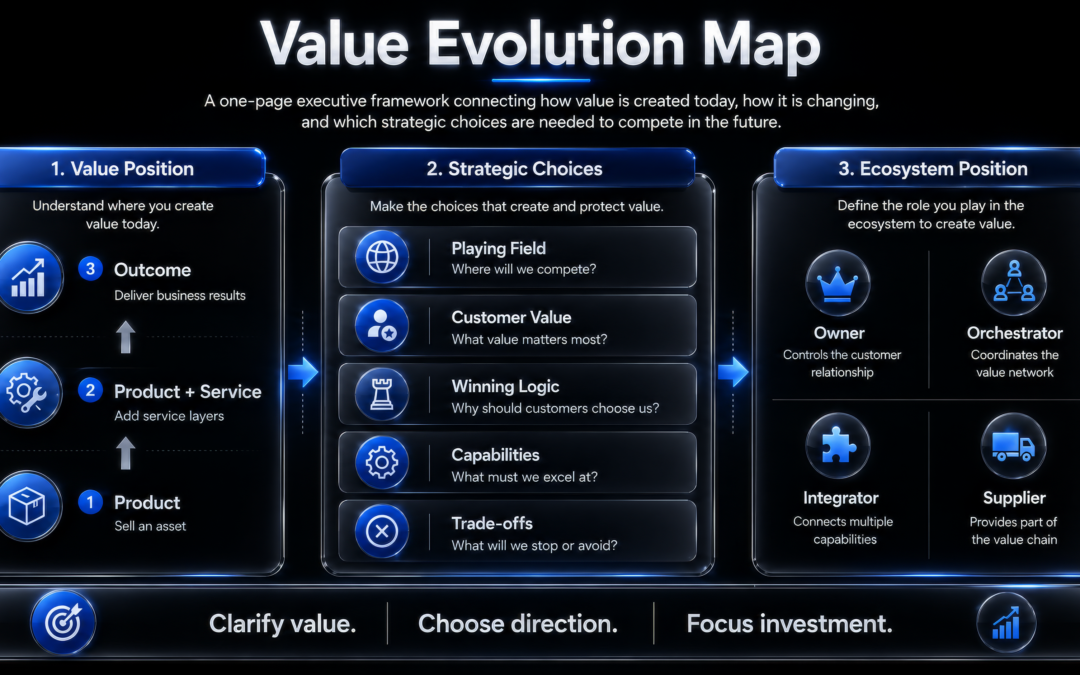
The tool behind this episode fits on one page, on purpose, not a forty-slide deck.
Value position asks where you sit today: selling a product, adding services around it, or being accountable for an outcome the way Rolls-Royce is for flying hours, and where you deliberately need to be in three to five years.
Strategic choices asks five questions most strategy documents avoid: where will we compete, what value matters most to customers, why should customers choose us, what must we excel at, and, the one people skip, what will we stop or avoid?
Ecosystem position asks who controls the value in your network: are you the owner controlling the customer relationship, the orchestrator coordinating the value network, an integrator connecting capabilities, or a supplier providing one piece of someone else’s chain? This is the question the video says makes executives uncomfortable. It should.
One line worth keeping if AI sits anywhere on your roadmap: move too fast into AI before answering these, and AI won’t create direction; it will amplify the lack of one.
What’s coming
The 22nd of September moves from strategy to business models: how the organization you just chose a direction for actually creates, delivers, and captures value in practice.
You can run the Value Evolution Map on your organization now or follow the rest of the series at the series hub.
Get my latest articles in Google
Add tamerbadawy.com as a preferred source to see more of my articles in Google Search and AI results.