Six months after your last major system rollout, was anyone actually working differently, or just sending the same emails inside a more expensive interface? If the technology changed and the work didn't, you didn't transform anything. You paid to speed up the old way.
This week's episode closes phase two with the BBC's Digital Media Initiative: an attempt to move an entire broadcaster off videotape, cancelled in 2013 after five years and £98.4 million written off, called "a complete failure" by the parliamentary committee that reviewed it. The instinct is to blame the technology, bad code, and poor vendor oversight. The independent review found almost the opposite: the system was built around a version of how BBC production worked that didn't match how it actually worked, developed by people in one place for a process understood by people somewhere else. You cannot digitize a process you've never honestly met. You can only digitize what you imagine it to be.
Where three answers reveal one gap
Pick a process that crosses at least three functions in your own organization, onboarding a customer, fulfilling an order, resolving a complaint—and ask three department heads, separately and without comparing notes, where does the process actually break down? Every answer will be accurate. None will be complete, because each leader can only see their own step. The place it actually breaks is almost never inside a department. It's in the handover between two of them, where no one is named as owner. Every function owns a step. Nobody owns the outcome.
Four moves, not a process diagram
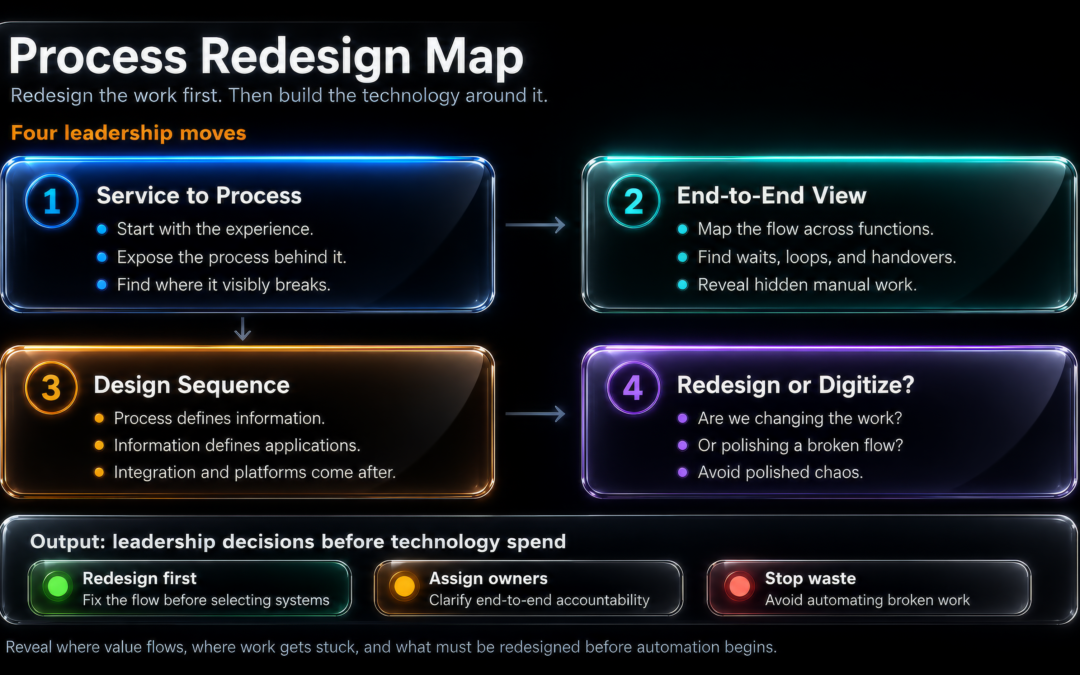
The Process Redesign Map runs on four moves, in a fixed order, because the order is the point.
Service to process: start with the experience someone is trying to have, then expose the process that is actually producing it, and find exactly where it visibly breaks.
End-to-end view: force one picture across every function the work touches, and identify where it waits, loops back, or gets quietly patched by hand.
Design sequence: the process defines the information you need, which defines the applications you need, and integration and platforms come after. Buy the platform first, and the business ends up building itself around the tool instead of the other way around.
Redesign or digitize: for every initiative on the table, one honest question: are you changing how the work happens or putting a cleaner screen on a broken flow? The second one has a name: polished chaos.
A professional services firm ran exactly such an experiment before approving a new CRM for client onboarding. Onboarding touched four teams and took nineteen days on average. The end-to-end view showed eleven of those days weren't inside any step at all, they were sitting in the gaps between them: approvals waiting in inboxes, handovers with no trigger, and the same client details re-entered into three separate systems. The proposed CRM had been designed around the sales team's workflow alone; legal, operations, and finance were never in the room. Same budget, different sequence: they fixed the handovers first, cut the timeline to eight days, then built the system around the process that actually worked.
One line worth keeping if AI sits anywhere in your roadmap: it works when a process is clearly defined, consistently run, and actually owned. Where those three things are missing, AI doesn't clean up the mess. It runs the mess faster, at a scale that's harder to unwind.
Phase two, closed
Three tools Value Evolution Map, Business Model Shift Canvas, and Process Redesign Map provide a cohesive strategy, business model, and process integration. Phase three starts the 6th of October, where plans meet the organization that actually has to run them, not the one on the chart.
If you've run all three tools and want a second opinion before execution starts, that's exactly the conversation worth having now, before the budget commits to a direction. Let's talk before phase three starts.
You can follow the rest of the series at the series hub.
Get my latest articles in Google
Add tamerbadawy.com as a preferred source to see more of my articles in Google Search and AI results.