Articles
You can find all my written resources in one convenient location.
Essays, playbooks, and reflections on AI, digital transformation, leadership, industries, and life in the digital bubble.
Prefer watching instead? Visit the Videos library.
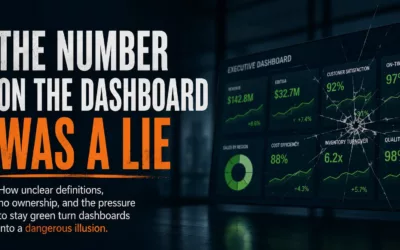
The Number on the Dashboard Was a Lie
The dashboard was green. Every KPI showed the system performing as it should. And almost nobody in the room trusted a single number on it. This is the story of how a reporting system lost its meaning, why nobody owning the data was the real cause, and what it takes to build dashboards your teams actually believe.

The Vendor Promised Everything. We Bought the Wrong Thing.
The demo was flawless. The capabilities matched our requirements line by line. So we signed. The trouble did not show up in the technology. It showed up in everything around it. This is the story of a SOC solution that taught me why you should never let a vendor lead the decision and what owning the full relationship actually requires.

The Farmer With a Phone: What Remote AI Looks Like When You Get Data Mesh Right
A farmer points his phone at a crop problem and gets a real-time AI diagnosis drawing on soil sensors, satellite imagery, weather data, and five years of yield history simultaneously. The technology exists. What most organizations are missing is the data architecture that makes it possible. This article explains data mesh, federated governance, and why the CIO’s most important AI decision is an ownership decision.
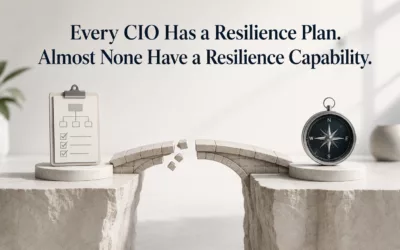
Every CIO Has a Resilience Plan. Almost None Have a Resilience Capability.
71% of organizations do no failover testing. 39% of executives handle outages reactively with no formal protocols. Every CIO has a resilience plan. Almost none have a resilience capability. This article explains the difference and what it takes to close the gap before the next incident makes it visible.
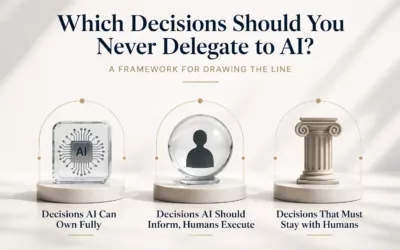
Which Decisions Should You Never Delegate to AI? A Framework for Drawing the Line
The governance question is not how to control AI agents. It is how to classify which decisions they should be making at all. This article gives CIOs, CEOs, and IT leaders a practical three-category framework and a four-criteria matrix to draw the line clearly, before something goes wrong.

Your Bank Has Two Customers. It Can Only Afford One
One in five customers at some Swiss retail banks still does not interact digitally at all. Gen Z customers switch banks three times more often than their parents if digital experience falls short. Most CIOs are serving both groups without a conscious strategy for either. This article gives you a framework to finally make the choice.
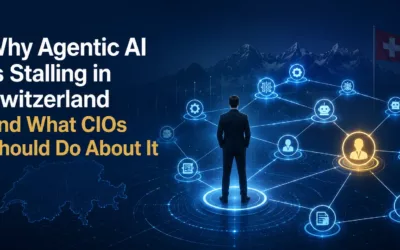
Why Agentic AI Is Stalling in Switzerland and What CIOs Should Do About It
Agentic AI is not stalling in Swiss and European enterprises because of the technology, but because of missing trust and accountability structures. This article provides CIOs with a practical risk assessment framework, six diagnostic questions, a five-level autonomy model and a six-step roadmap to move from cautious pilots to governed, scalable deployments.
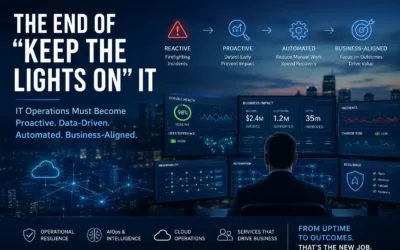
The End of “Keep the Lights On” IT Operations: Why Operations Must Become a Resilience Engine
Traditional IT operations must now go beyond simply keeping systems running. Modern organizations need proactive, data-driven, automated, and business-aligned operations that protect resilience, trust, and business continuity.
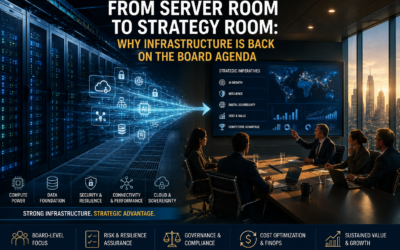
From Server Room to Strategy Room: Why AI Infrastructure Strategy Is Back on the Board Agenda
Infrastructure is not a utility in the back office any more. The strength of the digital foundation is now a factor in AI deployment, cyber resilience, digital sovereignty, cost predictability and business continuity. In this article, we explain why infrastructure has moved from the server room to the strategy room and why boards must now treat it as a strategic asset.
The Seven Deadly Sins of the Legacy CIO (8/8): 7. Lust—Power Over Purpose
Lust, according to Dante, is aimless desire. This seems to be power without a purpose in the legacy CIO. The role grows. There is more control. Visibility increases. However, something vital is lost beneath the surface. Decisions take longer to make. Autonomy vanishes. Trust starts to erode.
The organization does not experience severe failure. It gradually changes from impact to influence, from enablement to control. That change alters everything.
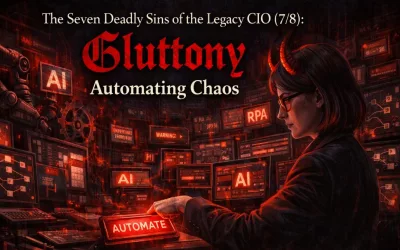
The Seven Deadly Sins of the Legacy CIO (7/8): 6. Gluttony—Automating Chaos
Being a glutton in leadership doesn’t mean using too much technology. It’s about using it without any rules. Automation and AI promise faster, more efficient, and more progress. But they don’t fix the problem when they are used on broken processes and bad data; they make it worse. What used to be a small problem becomes a big problem that happens quickly. What was easy to handle becomes hard to see and control. The speed goes up. Things become less clear. And over time, companies don’t get better; they just get better at doing the wrong things.

The Seven Deadly Sins of the Legacy CIO (6/8): 5. Greed—The Illusion of Simplification
Dante said that greed is not being able to let go. For the legacy CIO leadership, this means not being able to stop adding. Every new system promises to make things better. Without discipline, though, it leads to dependence, fragmentation, and hidden complexity. The danger is not what is added. It is what is never taken away.