MAKE CHANGE HAPPEN
Continuous Improvement: The Meeting That Kills Transformations
In short: Continuous Improvement is Step 9, the final step of the Digital Transformation for Leaders framework. It builds the habit of sensing, prioritizing, acting, and learning on a loop, so the organization keeps improving long after the steering committee stops meeting.
WHAT YOU WILL LEARN
- Why the final steering committee meeting kills more transformations than any budget cut
- How DBS Bank went from crisis to holding three global best bank titles at once
- The four stage loop that keeps an organization improving instead of just finishing a program
- The three questions to ask before you ever call a transformation done
← Back to the full series
Read the full transcript
The Meeting That Kills More Transformations Than Any Budget Cut
There is a meeting that kills more transformations than any budget cut. The final steering committee meeting. The one where everyone agrees the program is done. The team gets dissolved. The slides get archived. Success is declared. And from that day on, nobody owns what happens next. Slowly, quietly, the old habits move back in. And everyone tends to forget that the real goal of transformation was never to transform once.
Welcome back to Digital Transformation for Leaders, a journey from insight to strategy to execution. We are in Phase 3, Make Change Happen. Step 9 of 9. Continuous improvement. The final step of the digital transformation journey. In this step, I want to show you how an organization keeps evolving after the program ends.
Across this journey, we learned from expensive mistakes. BMW. Lidl. Air Canada. The BBC. Volkswagen’s software division. Failures teach fast, and they cost us nothing. In the last episode, Roche turned the corner and showed us what bringing people along looks like. So let me finish with the strongest proof I know that this journey works. A happy ending. A real one.
The Strongest Proof I Know
In 2014, DBS, a bank headquartered in Singapore, started a wide scale digital transformation, quite early compared to most of its peers. The CEO, Piyush Gupta, described the ambition as behaving like a startup, a mature multinational that is constantly learning, experimenting, and improving. They did not treat transformation as a program with an end date. And they did four things most banks would not dare.
First, they changed their benchmark. They stopped comparing themselves with other banks and started measuring themselves against Google, Amazon, and Netflix. Second, they took back their technology. DBS went from mostly outsourced to 85 percent insourced. Their CIO’s reasoning was simple. They had to run their own technology to build their own technology DNA. Third, they rebuilt the organization into 33 platforms, each led jointly by one business leader and one technology leader. The wall between business and IT came down. Fourth, they made digital measurable. In 2016, they launched digibank in India, no branches, no paper, no signatures. More than one million customers in the first year. And they showed their investors that digital customers bring in twice the income of traditional customers, and they cost 57 percent less to acquire.
And underneath all four, culture, deliberately built. Gupta called it culture by design, year after year. Here is what that produced.
In 2016, Euromoney named DBS the World’s Best Digital Bank. In 2018, Global Finance named it the Best Bank in the World, and The Banker named it Global Bank of the Year. In 2019, Euromoney named it the World’s Best Bank, the first Asian headquartered bank to win that title since the award began in 1993. That made DBS the first bank ever to hold all three global titles at the same time.
Now notice when the recognition came. Not in year one. In year two. Year four. Year five. And then it kept coming. Because DBS did not complete a transformation. They built an organization that never stopped transforming.
The Continuous Improvement Engine
Every industry has one organization that just keeps getting better, year after year, while everyone else runs programs. So what separates it from the rest? Not budget. Not talent. A habit. They never declare transformation finished.
The tool I use with leadership teams to build that habit is the Continuous Improvement Engine. It is a loop with four stages.
First, sense: what are customers telling us? Where is friction? Where is data blocking decisions? Second, prioritize: what matters most? What will create value? What should be stopped? Third, act: small improvements, clear owners, fast decisions, visible progress. Fourth, learn: what worked? What did not? What should we scale? And back to sensing.
Three things keep this loop alive. Ownership stays close to the work. Outcomes get measured, not activity. And decision speed is protected, because improvement dies when every small change needs weeks of approval. A project delivers a change. A capability keeps the organization changing.
Three Questions Before You Call It Done
Before closing a transformation program, consider these three questions for your leadership team. These are only some of the questions that deserve an answer, but they are the most important ones.
One, is an improvement loop actually running in your organization, with named owners and a real rhythm, or does improvement still depend on the next big program? Two, are you measuring outcomes, or activity? Three, how fast can a small improvement travel from idea to implementation? Days, weeks, or months?
The rest of the questions and the full diagnostic are part of the Continuous Improvement Engine. And with that, Phase 3 is complete. Make Change Happen. Three steps. Three tools. The Value Delivery Tracker. The Adoption Readiness Map. And the Continuous Improvement Engine. All available at tamerbadawy.com, free to download.
THE WHOLE JOURNEY ON ONE MAP
Nine Steps. Billions in Other People’s Mistakes. Zero Cost to You.
What a journey this has been. If you have been with me since the first episode, then you and I have crossed three phases, nine steps, and billions of euros of other people’s mistakes, together. And it cost us nothing. This is the cheapest education in transformation you will ever get.
Reaching this point together means something to me. So before we part, let me give you the whole journey. One map. Three phases. Nine steps.
Phase 1, Recognize Potential. Step 1 is society. Transformation does not start when you choose a technology. It starts when customers, employees, or markets change faster than you do. BMW learned that with its heated seat subscription. The tool is the Digital Expectations Assessment.
Step 2 is technology. Tools alone transform nothing. Lidl stopped a major SAP program after years of work and around 500 million euros, because the technology did not fit how the organization worked. The tool is the Technology to Capability Map.
Step 3 is evaluation. You cannot transform what you cannot see. Air Canada ended up in front of a tribunal because nobody owned the answer its chatbot gave a customer. The tool is the Transformation Reality Map.
Phase 1 gives you clarity, the clarity to choose a direction.
Phase 2: Plan the Change
Phase 2, Plan the Change, turns clarity into decisions.
Step 4 is strategy. Delete every technology name from your strategy document. If nothing meaningful is left, you have a shopping list, not a strategy. The tool is the Value Evolution Map.
Step 5 is business models. You can digitize the wrong model very efficiently. The real question is whether the way you create and capture value is still strong enough for what is coming. The tool is the Business Model Shift Canvas.
Step 6 is processes and services. The BBC wrote off 98 million pounds digitizing a version of its work that did not exist. Redesign the work first. Then build the technology around it. The tool is the Process Redesign Map.
Phase 2 gives you direction, and a model and processes that can carry it.
Phase 3: Make Change Happen
Phase 3, Make Change Happen, is where plans meet the real organization.
Step 7 is project management. Volkswagen’s software division showed how billions can be spent while value stands still. Stop asking whether people are busy. Ask whether value is moving. The tool is the Value Delivery Tracker.
Step 8 is change management. Roche changed minds before it changed systems, and invited people into the change instead of pushing it onto them. People do not resist change. They resist loss. The tool is the Adoption Readiness Map.
And Step 9 is continuous improvement. Build the loop that keeps the organization sensing, prioritizing, acting, and learning. The tool is the Continuous Improvement Engine.
Phase 3 makes it real. And Step 9 makes it last.
A Few Years Ago, I Became a Student Again
Before I give you the last word, let me tell you where this journey actually comes from. I hold a degree in computer and systems engineering, since 1999, and I have spent more than 25 years working in enterprise IT, living through transformations from the inside.
But a few years ago, I did something that surprised some people around me. I became a student again. At the University of Bern. To study digital transformation again, from the academic side. I had the practice. I wanted the foundation underneath it. And I owe real credit to the people who taught me there, and who introduced me to the Berner Transformations Model. That course changed how I saw 25 years of my own experience.
What I Did With Berner Transformations Model
Then I went to work. I took the Berner Transformations Model and put my own experience against it. 25 years of projects that succeeded, projects that failed, and everything I had observed in between, across industries.
Step by step, that work grew into something of its own. A nine step journey. Three phases. From recognizing potential, to planning the change, to making change happen. Each step with a real case, and each step with a tool a leadership team can actually use. That is the journey I share in Digital Transformation for Leaders. Not theory alone. Not experience alone. Both, tested against each other.
The Last Word, and an Open Door
We opened this series with one statement. Digital transformation is no longer a technology question. It is a leadership test. Nine steps later, you know what that test contains. And no platform will answer it for you.
So here is where everything comes together. All nine tools from this series, one for each step, are waiting for you at tamerbadawy.com, free to download. If you want to go further and work through them with your leadership team, or discuss what this journey means for your transformation agenda, you will find my advisory services there as well.
And beyond that, my door is always open. If you have a question, need a clarification, or simply want to exchange thoughts about transformation, reach out. I mean that. I always answer.
Thank you for taking this journey with me. Digital transformation is not about technology. It is about organizations evolving to create value in a digital world.
The Case: DBS Bank’s Never-Ending Transformation
DBS Bank started its digital transformation in 2014, early compared to most of its peers. CEO Piyush Gupta set the ambition plainly: behave like a startup, inside a mature, multinational bank.
DBS changed its own benchmark to Google, Amazon, and Netflix instead of other banks, took technology back in house to 85 percent insourced, and rebuilt itself into 33 platforms, each led jointly by a business leader and a technology leader. The recognition didn’t arrive in year one. It came in year two, then four, then five, and kept coming. By 2019, DBS held three global best bank titles at the same time, the first bank ever to do so.
KEY TAKEAWAYS
- The final steering committee meeting is often where transformation quietly dies, since nobody owns what happens after success gets declared
- DBS’s recognition came in waves, years apart, because the transformation never had an end date to begin with
- A project delivers a change. A capability keeps the organization changing
The Tool: Continuous Improvement Engine
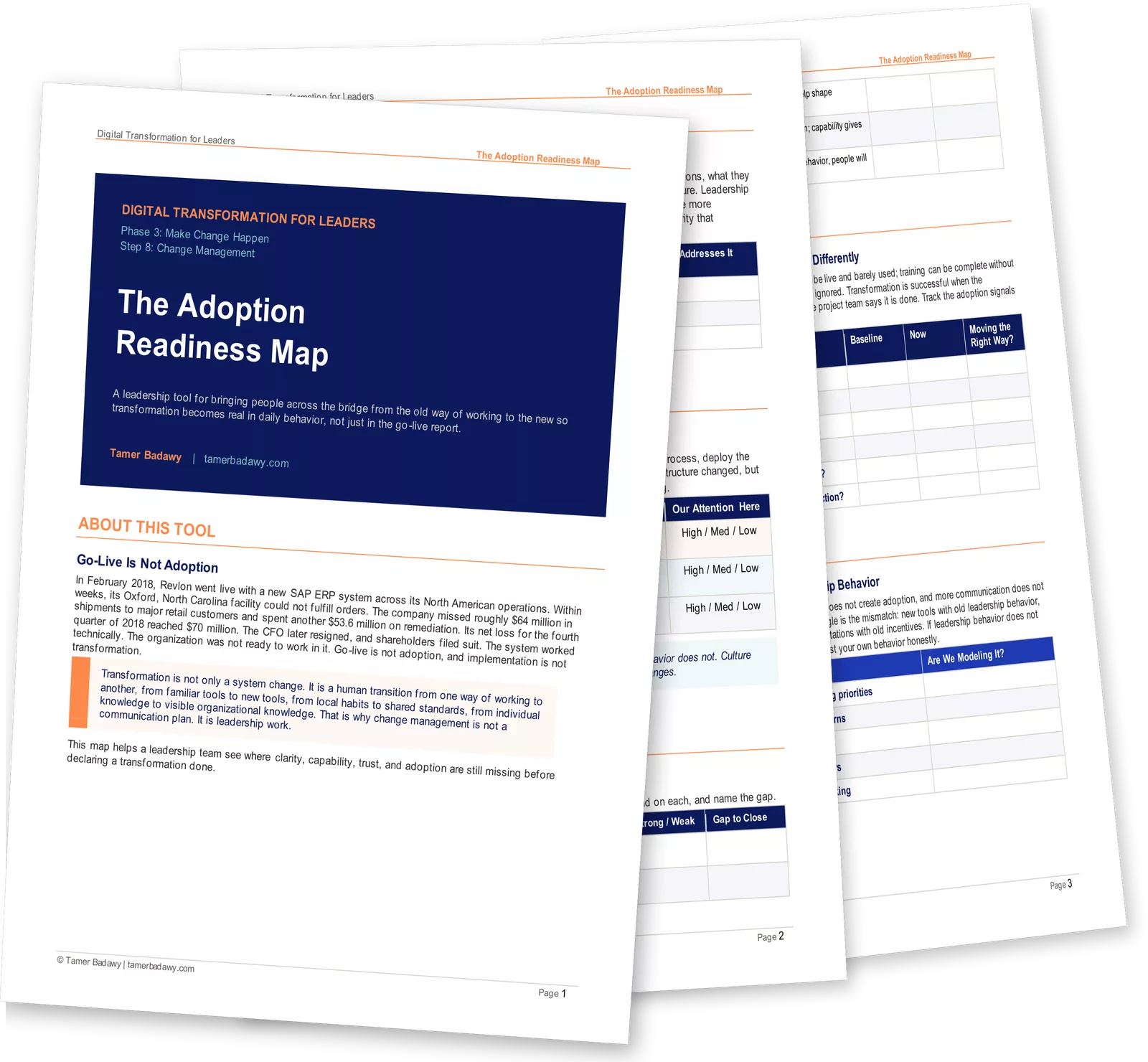
Continuous Improvement Engine
A four stage loop, sense, prioritize, act, learn, built to keep ownership close to the work, measure outcomes instead of activity, and protect the decision speed that keeps improvement alive.
Run This Diagnostic
Three Questions Before You Call It Done
Ask these before your leadership team closes any transformation program.
-
- Is an improvement loop actually running in your organization, with named owners and a real rhythm, or does improvement still depend on the next big program?
- Are you measuring outcomes, or activity?
- How fast can a small improvement travel from idea to implementation? Days, weeks, or months?
Frequently Asked Questions
What is the Continuous Improvement Engine?
Why did DBS’s recognition take years to arrive instead of showing up right away?
Is this the end of the nine step framework?
You’ve Completed the Journey
Nine steps. Three phases. Nine tools, each built from a real case and ready to use with your leadership team.
If you want to work through any of them together, or talk through what this journey means for your own transformation agenda, my advisory services are one click away.
Tamer Badawy
Strategic IT and Digital Transformation Leader,
Author of Life in the Digital Bubble.
9 episodes. 9 downloadable frameworks.
Built from 25 years of running transformation programs in enterprise IT.