MAKE CHANGE HAPPEN
Project Management: 17 Meetings a Week, Zero Value Moving
In short: Project Management is Step 7 of the Digital Transformation for Leaders framework, and the first step of Make Change Happen. It shifts the leadership question from are people busy to is value moving, making outcomes, dependencies, and decisions visible every week.
WHAT YOU WILL LEARN
- Why Volkswagen’s Cariad ran 17 status meetings a week while losing 7.5 billion euros
- The difference between coordination and alignment, and why most teams only have the first
- The three question test that reveals your execution health in ten minutes
- The five parts of a tracker that replaces status reporting with real value delivery
← Back to the full series
Read the full transcript
Your roadmap is approved. Your reports say green. Your teams are working. Six months in, and the business looks exactly the same. No faster decisions. No better processes. No measurable change for customers or employees. That is not a planning problem. That is an execution problem. And it is far more common than many leadership teams want to admit.
Welcome back to Digital Transformation for Leaders, a journey from insight to strategy to execution. I am Tamer Badawy, strategic IT and digital transformation leader and author of Life in the Digital Bubble. We are now starting Phase 3 of the journey: Make Change Happen. In Phase 1, we recognized the potential, where to play and why it matters. In Phase 2, we planned the change: strategy, business models, processes. Now the real test begins, because a plan that does not move is not a plan. It is a document.
This step is called project management. But I am not going to talk about Gantt charts, milestones, or status reports. I am sure your teams have that covered. In transformation, a project can be on time, on budget, and on scope, and still change nothing. Classic project management asks, is the project on track? But project management in the scope of transformation asks a harder question. Is value moving? That is what project management has to mean at this step. Value delivery. And that is what this episode is about. Value delivery.
When Execution Fails at Scale
In 2020, Volkswagen launched what looked like a smart move. They created Cariad, a dedicated software division with one mandate: build a single, unified software platform across all VW Group brands. Audi, Porsche, Volkswagen, all running on one shared platform. The strategy was clear. The investment was enormous. Billions committed. The teams were in place.
By 2022, McKinsey conducted an internal review. The finding was shocking. Structural problems. Massive delays. Software so unreliable that the launch of the Porsche Macan Electric and the Audi Q6 e-tron had to be pushed back by a full year. One insider described it this way: I had 17 status meetings per week. Everyone wanted to hear the same thing, just on different slides. Developers were producing PowerPoint presentations instead of software. Teams were busy. Value was not moving.
By 2024, Cariad had accumulated more than 7.5 billion euros in operating losses. Volkswagen ultimately paid 5 billion dollars to Rivian just to get access to a working software platform.
Here is the question that matters for you. Was this a technology failure? No. The technology was available. The engineers were capable. The funding was there. This was an execution failure. Fragmented ownership across various brands. Decision rights that could not keep up with delivery speed. Dependencies discovered too late. A leadership rhythm built for reporting, not for removing blockers. The strategy was right. The execution broke it.
The Pattern That Kills Execution
The Cariad story is not unique to Volkswagen. Walk into almost any large organization running a transformation program and you will find the same pattern. The CIO is tracking milestone completion. The COO is managing operational continuity. The CFO is watching budget consumption. Each business unit is protecting its own priorities. Everyone is busy while nobody is asking whether value is actually moving. This is the execution trap.
A team delivers its part. A vendor meets its milestone. A system goes live. And the business outcome is still blocked, because one decision was not made, or one dependency was not surfaced, or one process owner was not clear.
There is an important distinction here that most organizations miss. Coordination means people are talking. Alignment means people are moving toward the same outcome. You can have 17 status meetings per week and still have zero alignment. Execution does not fail because teams stop working. It fails because nobody is asking whether value is moving. The shift every leader needs to make is this: stop asking, are people busy. Start asking, is value moving.
The Three-Question Leadership Test
Before we go further, here is a test you can run with your leadership team this week. Three questions. Ten minutes. No slides, no preparation.
Question one: can you name the three most important business outcomes your transformation needs to deliver in the next 90 days? Not projects. Not milestones. Outcomes. If your team cannot agree on the answer in five minutes, your outcomes are not clear enough.
Question two: what is currently blocking value delivery, and who owns resolving it? If your team can name the blockers but cannot name a specific owner for each one, your decision rights are not working.
Question three: when did leadership last actually remove a blocker? Not assign it. Not escalate it. Remove it. If the answer is I am not sure, or we discussed it, your leadership rhythm is built for reporting, not for execution.
This test will tell you more about your execution health in ten minutes than any status report will tell you in a month.
The Value Delivery Tracker
To make execution systematic, I use a tool called the Value Delivery Tracker. It addresses the five things that usually prevent value from moving.
Part one: outcome definition. Rewrite each initiative as a business outcome. Not implement the data platform. But enable real time visibility for the weekly supply decision. If your team cannot restate the initiative as a business outcome, you are managing activity, not delivery.
Part two: the dependency map. Uncover five types of dependency before they become delays. Technical. Business. Data. Security. Decision. Most teams only discover these dependencies after they have already become blockers.
Part three: decision rights. For each key decision, clarify four things. Who decides? Who recommends? Who owns the outcome? Who can remove the blocker? Ambiguity here is one of the most consistent reasons value stalls.
Part four: value measurement. Track whether the business actually changed, not whether the task was completed. Did the process improve? Did the decision become faster? Did risk decrease? A milestone reached is not the same as value delivered.
Part five: the weekly value alignment session. Not a status meeting. Three questions every week. What is the most important outcome to move forward right now? What is blocking value delivery? Which decision must leadership make this week?
Five parts. One focus. Is value moving?
The Tracker in Practice
Consider a global manufacturing company running a data visibility initiative across 14 production sites. The program had been running for 11 months. The platform was technically ready. The integration work was complete. All status reports were green. But plant managers still could not make supply decisions faster.
Why? The dependency map surfaced what the status reports had missed. Six sites were using different data definitions for inventory. Three regional teams had not agreed on who owned the output data. One key business decision had been sitting unresolved for four months: which sites could override the central algorithm when local conditions required such an action.
The platform was live. The value was not there. Once that single decision was resolved in a focused leadership session, three sites moved to real time supply decisions within a few weeks. The problem was never the technology. The problem was execution alignment.
Why AI Makes This More Urgent
Almost every leadership team I speak with right now is accelerating AI and automation programs. And this is where execution discipline becomes even more critical. AI initiatives create new dependencies that most organizations are not prepared for.
Data ownership questions that were vague before become critical when an AI model depends on them. Decision rights that were slow before become dangerous when an automated system needs a human to confirm or override decisions in real time. A governance breakdown that costs you six months on a traditional project can cost you the entire program on an AI initiative, because the model learns from the wrong inputs and you have to rebuild from scratch.
The organizations that will make progress with AI are not the ones with the most sophisticated models. They are the ones with clear outcomes, visible dependencies, fast decisions, and strong ownership. Execution discipline is a core AI readiness issue.
Is Your Execution Actually Working?
If you want to know whether your transformation is actually delivering value or just reporting progress, ask yourself these questions.
One, have you defined outcomes clearly enough that every team knows what success looks like? Not project completion. Business change. Two, are all five dependency types visible before they become delays? Technical, business, data, security, and decision. Three, are decision rights clear? Do you know who decides, who recommends, who owns the outcome, and who can remove the blocker? Four, are you measuring the value delivered, rather than just the tasks completed? Can you point to a process that improved, a decision that got faster, a risk that decreased? Five, do you have a leadership rhythm that removes blockers, not just reviews them? Six, are you asking, is value moving, or are you asking, are people busy? Seven, are you using your delivery framework with intention, or applying it mechanically, adding process overhead without adding alignment?
If you answered not yet to more than three of these, your execution is still developing as a leadership discipline.
Where We Are in the Journey
We are in Phase 3 of the transformation journey. In Phase 1, we recognized the potential. In Phase 2, we planned the change: strategy, business models, and processes. Now, in Phase 3, we make it happen.
Step 7 is the foundation of execution. Without clear outcomes, visible dependencies, fast decisions, and a leadership rhythm, even the best plan will stall here. The Value Delivery Tracker connects everything you built in Phase 2 to what actually needs to happen in Phase 3. If you want to work through this framework with your leadership team, it is available at tamerbadawy.com, free to download.
Closing
Turning vision into value delivery comes down to five things. Clear outcomes. Visible dependencies. Fast decisions. Strong ownership. A leadership rhythm that removes blockers. When those five things are in place, execution becomes a discipline, not a reaction.
But there is a second side to execution that some leaders underestimate. You can deliver the project on time. You can hit every milestone. You can measure every outcome. And people can still refuse to change. Because execution is not only about delivering work. It is about bringing people along. Even if a system goes live, employees may still fail to understand, trust, or use it. When that happens, the transformation fails, regardless of what the project report says.
That is the subject of Step 8. Change management. The difference between a project that lands and a transformation that sticks. I will see you in the next step.
The Case: Volkswagen’s Cariad and the Cost of Busy Teams
In 2020, Volkswagen created Cariad, a new software division meant to build one unified platform across Audi, Porsche, and Volkswagen. The strategy was clear, the investment was enormous, and the teams were fully staffed. The status reports stayed green the whole time.
By 2024, Cariad had accumulated more than 7.5 billion euros in operating losses, delaying two vehicle launches by a full year. Volkswagen ultimately committed up to 5.8 billion dollars to Rivian just to access a working software platform instead.
Source: InsideEVs, March 2025
KEY TAKEAWAYS
- Coordination means people are talking. Alignment means people are moving toward the same outcome. Cariad had plenty of the first and almost none of the second
- A project can be on time, on budget, and on scope, and still change nothing in the business
- The real leadership shift is asking whether value is moving, not whether people are busy
The Tool: Value Delivery Tracker
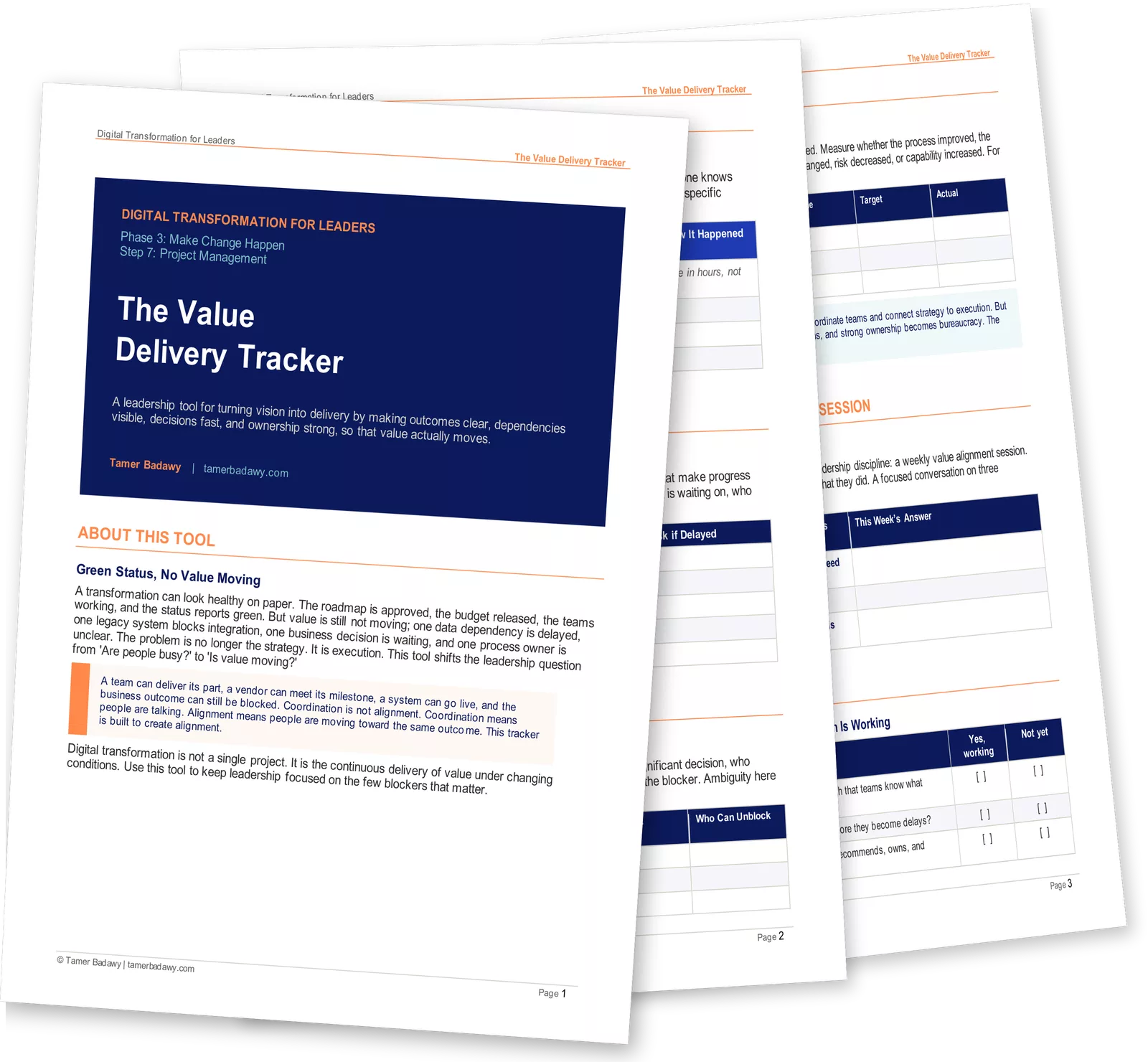
Value Delivery Tracker
A five part tool for making outcomes, dependencies, decision rights, and value signals visible every week, replacing status meetings with real alignment.
Run This Diagnostic
Three Questions, Ten Minutes, No Slides
Run this with your leadership team this week.
-
- Can you name the three most important business outcomes your transformation needs to deliver in the next 90 days? Not projects, not milestones, outcomes.
- What is currently blocking value delivery, and who owns resolving it?
- When did leadership last actually remove a blocker, not assign it, not escalate it, remove it?
Frequently Asked Questions
What is a Value Delivery Tracker?
Why did Cariad fail if the technology and funding were both there?
What’s the difference between a status meeting and a value alignment session?
UP NEXT
Publishes October 13
Step 8: Change Management
You can deliver a project on time, on budget, and on scope, and people can still refuse to change. Execution isn’t only about delivering work. It’s about bringing people along.
Tamer Badawy
Strategic IT and Digital Transformation Leader,
Author of Life in the Digital Bubble.
9 episodes. 9 downloadable frameworks.
Built from 25 years of running transformation programs in enterprise IT.